
As an Amazon Associate I earn from qualifying purchases. All claims are strictly my personal opinion.
My top pick

Marshalltown 26B Pole Sander, 48-Inch Aluminum Handle
A complete pole sander with a no-slip swivel head, quick-change clamps and a 48-inch aluminum handle.

A pole sander is a sanding head on a long handle that lets you smooth drywall walls and ceilings from the floor, with no ladder and no tired arms. For most homeowners the best pole sander for drywall is a manual one with a swivel head, like the Marshalltown 26B with its 48-inch aluminum handle; if dust is the problem, a vacuum-ready kit such as the Hyde 09170 connects to a shop vac and pulls dust in at the head. In my picks, the Marshalltown is the simple one I’d buy first, and the Hyde Professional 09180 kit is the one I’d add if I had to sand a whole room.
Below are four pole sanders and heads for walls and ceilings, a comparison table, short reviews, and plain answers on grit, dust and technique. This page covers manual and vacuum-ready poles only. If you want a powered drywall sander instead, my guide to the best sanders for walls and drywall covers the electric ones.
How I Compare Pole Sanders
A pole sander is a simple tool, so the differences that matter are few. I compare the head (does it pivot to follow the wall or is it built not to flip), the pole (length, whether it extends, whether it is in the box), dust (does it take a vacuum hose) and the paper (what the head holds). I use only the makers’ figures, distributor pages and Amazon listing text I could open in November 2026, and write “not stated” where a page was silent.
| Product | ⭐ Marshalltown 26B 🏆 EDITOR’S CHOICE |
Sheetrock No-Flip Head | Hyde 09170 | Hyde 09180 Professional |
|---|---|---|---|---|
| Image | |
 |
 |
 |
| Price | $ | $$ | $$ | $$$ |
| Head | No-slip swivel bracket, die-cast aluminum | No-flip head, set-screw collar | Vacuum sanding head; swivel not mentioned | Vacuum sanding head, sold as no-flip |
| Pole | 48 in aluminum handle, included | Not included; female coarse thread | Not included; fits 3/4 in male coarse thread poles | 2-piece pole, 28 to 56 in, included |
| Dust | No vacuum port | No vacuum port | 6 ft hose, adapters for 1-1/2, 1-3/4 and 2-1/2 in hoses | 6 ft hose, universal adapter, vacuum through the pole |
| Paper | Quick-change locking clamps | Quick-release clamps, paper or screen | EasyClamp, sanding screen | EasyClamp, 4 sanding screens in the box |
| Best For | First pole sander | A head for a pole you own | Less dust, own a pole | Whole rooms, less dust |
| Availability | Shop Now | Shop Now | Shop Now | Shop Now |
Key takeaways
- A pole sander is for finish sanding walls and ceilings by hand; it will not remove a heavy ridge quickly.
- A head that pivots, like the Marshalltown 26B, stays flat on the wall as the pole angle changes; a no-flip head like the Sheetrock is built not to turn over.
- Manual pole sanders make a lot of fine dust; the Hyde vacuum kits connect to a shop vac to pull it in at the head.
- Check what is in the box: two of these four come without a pole.
- Wear a respirator even when the sander is on a vacuum, and check the safety data sheet of your joint compound.
Best Pole Sanders for Drywall: Reviews
Figures come from the makers’ Amazon listings and distributor pages, read in November 2026. Where a page did not give a figure, I say so instead of filling the gap. I have not used these sanders myself, so I describe what the makers state and say what that means for the job.
Editor's ChoiceManual pole sander, swivel head
Marshalltown 26B Pole Sander
Marshalltown 26B Pole Sander With 48-Inch Aluminum Handle
A complete pole sander with a no-slip swivel head on a 48-inch aluminum handle.
Check price on AmazonSpecs: Amazon listing sold by Marshalltown (model 26B, Creators API, November 2026)
Best for
Homeowners sanding a few walls or one ceiling.
- Pole included
- Swivel head stays flat on the wall
- Quick-change locking clamps
Skip it if
You want dust going into a vacuum.
- No vacuum port
- Fixed 48-inch handle
Read full review
Best Overall Manual Pole Sander
The Marshalltown 26B is a complete pole sander: the head and a 48-inch aluminum handle in one listing, sold by Marshalltown itself on Amazon. The listing describes a body of lightweight reinforced die-cast aluminum, a low-profile, no-slip swivel bracket and quick-change locking clamps for the paper, and says it is made for sanding drywall joints flush with the surrounding wall.
The swivel is what I look for in a first pole sander: when you push up a wall and then reach across a ceiling, a head that pivots stays flat against the surface instead of digging in with one edge. The listing does not give the head or paper size, so measure the sheets you already have against it before buying paper in bulk. Marshalltown lists a limited lifetime warranty.
Pole sander head only
Sheetrock No-Flip Head
Sheetrock No-Flip Drywall Pole Sander Head
A no-flip head with a set-screw collar that fits a standard painter's pole.
Check price on AmazonSpecs: Amazon listing (USG Sheetrock 340900-HD, head only, Creators API, November 2026)
Best for
Owners of a painter's pole who want a head that stays put.
- Head will not turn over
- Set screw stops it unscrewing
- Quick-release clamps
Skip it if
You need a complete pole sander in one box.
- Pole not included
- No vacuum port
Read full review
Best Head for a Pole You Already Own
The USG Sheetrock No-Flip head is sold head only, without a handle. Its female coarse-thread collar fits a standard painter’s pole or extension handle, and the head is designed not to turn over while you sand, which is the classic annoyance of a cheap pole sander.
Two details matter on a wall. A set screw in the collar tightens against the pole threads so the head will not loosen or unscrew mid-stroke, and quick-release clamps hold sanding screen or paper and let you change it with a flip of the clips. The listing does not give the head size, so check it against your sheets.
Less dustVacuum pole sander head
Hyde 09170 Dust-Free Vacuum Sander
Hyde 09170 Dust-Free Vacuum Sander
A vacuum sanding head with a 6-foot hose and adapters for common shop vac hoses; pole not included.
Check price on AmazonSpecs: Amazon listing and AMES Tool Co. distributor page (MPN 09170)
Best for
Owners of a pole and a shop vac who want less dust.
- Hose and adapters in the kit
- Fits a 3/4-inch coarse-thread pole
- EasyClamp screen changes
Skip it if
You also need the pole: the 09180 includes one.
- Pole and vacuum not included
- Head size not stated
Read full review
Best Vacuum-Ready Kit for a Pole You Own
The Hyde 09170 is a vacuum sanding head that attaches to a wet/dry vacuum. The listing includes a 6-foot hose and coupling adapters for 1-1/2, 1-3/4 and 2-1/2 inch vacuum hoses, and Hyde’s EasyClamp system for quick screen changes. The AMES Tool distributor page says the pole connector fits a standard 3/4-inch male coarse-thread pole. The pole is not included.
Hyde’s distributor page says the kit helps eliminate most dust problems and reduce clean-up from indoor drywall sanding, which is a claim about reducing dust, not about removing it all. The head size is not stated, and the listing does not mention a swivel. The hose is the part to plan around: you need a shop vac within 6 feet of the wall, or an extension hose.
ExtendableVacuum pole sander kit with extension pole
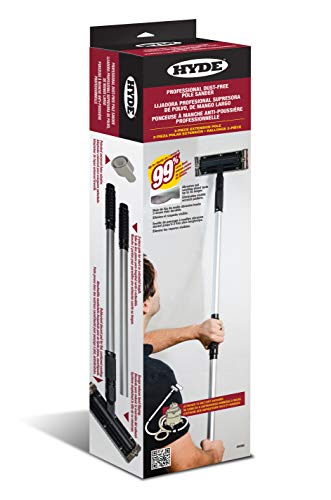
Hyde 09180 Professional Dust-Free
Hyde 09180 Professional Dust-Free Pole Sander
A 2-piece pole from 28 to 56 inches with the vacuum connected through the pole and 4 screens in the box.
Check price on AmazonSpecs: Amazon listing (model 09180) and AMES Tool Co. distributor page
Best for
Whole rooms and ceilings with a shop vac.
- Extension pole included
- Vacuum connects through the pole
- Hose, adapter and screens in the kit
Skip it if
You only sand one small wall.
- Highest price tier of the four
- Head size not stated
Read full review
Best Extendable Pole With Vacuum Hookup
The Hyde 09180 Professional kit adds the pole. The Amazon listing describes aluminum and stainless steel construction, a 2-piece pole that extends from 28 to 56 inches, a 6-foot hose with a universal adapter for wet/dry vacuum hoses, and 4 drywall sanding screens in the box. The AMES Tool distributor page adds that the vacuum connects through the pole, which keeps the hose from dangling off the head.
The extension is the practical gain for ceilings and tall walls: you set the pole to the height you need instead of standing on something. Hyde sells it as sanding with no flipping, and the EasyClamp loads sheets quickly. The distributor page lists a longer pole range than the Amazon listing, so I quote the listing for the model I link. The head size is not stated.
Pole Sander vs Drywall Sander vs Sanding Sponge
A pole sander is the cheapest way to reach a wall or ceiling and the slowest on big areas. A powered drywall sander covers ground faster and is the better choice on a whole house; a sanding sponge is the hand tool for corners and small repairs. The table puts them side by side in plain terms.
| Tool | Reach | Speed | Dust | Best for |
|---|---|---|---|---|
| Pole sander | Walls and ceilings from the floor | Moderate, by hand | A lot, unless on a vacuum | A room or two of finish sanding |
| Powered drywall sander | Long-reach models cover walls and ceilings | Fastest on large areas | Less with a vacuum hooked up | Whole houses and repeat jobs |
| Sanding sponge | Arm’s reach only | Slow | Less, but never none | Corners, edges and small patches |
If you are weighing a motorized option, my pages on the best sanders for walls and drywall and the best dustless sander cover the powered side. For a small repair, my guide on how to sand a drywall patch is the better place to start.
Which Grit to Use With a Pole Sander
The grit you choose decides how much compound comes off and how smooth the wall ends up. A coarser paper cuts faster but leaves deeper scratches, and a finer one leaves a smoother surface that is slower to work. Drywall sanding almost always goes from the coarser grit that levels a ridge to a finer one that blends it, and a pole sander holds either one in its clamp.
Paper or Screen
Both Hyde kits are sold for drywall sanding screen, an open mesh abrasive that lets dust pass through instead of packing the surface. The Sheetrock head takes screen or paper, and the Marshalltown clamps take sheets. Check the sheet size against your head before you buy sheets in bulk.
Choosing the Number
I keep the exact grit sequence in one place so the advice stays consistent: my page on what grit to sand drywall gives the numbers for joint compound, primer and paint-ready walls.
Dust Control
Drywall dust is fine and hangs in the air, and a pole sander held above your head puts it close to your face. The first defense is the one you can control: a vacuum-ready head, a respirator, and a closed-off room. Check the safety data sheet of the compound you used and wear a respirator rated for fine dust.
Vacuum-Ready Kits
The two Hyde kits above connect a hose to the sanding head, and Hyde states they eliminate most dust problems and reduce clean-up. That is a manufacturer statement, so expect less dust, not none. A shop vac with a fine-dust filter and a bag is the setup to aim for, because fine gypsum dust can clog a plain filter fast. My guide to the best vacuum for drywall dust covers the vacuums and the bags.
Habits That Cut Dust
- Close the room, cover floors and vents, and turn off the HVAC while you sand.
- Run the vacuum before the sander touches the wall, and keep it running until the hose is clear.
- Use light, even strokes: pressing hard throws more dust and makes dips.
- Vacuum surfaces and wipe with a damp cloth instead of sweeping dry dust into a pile.
⚠️ A Vacuum Hose Does Not Replace a Respirator
A vacuum-ready pole sander still leaves dust in the air near the head and when you empty the vac. Wear a respirator while you sand and while you empty it.
How to Use a Pole Sander
The technique is the same for every head on this page. For the whole drywall job from taping to paint, see my guide on how to sand drywall.
Step 1: Set Up the Head and the Paper
Clamp a sheet flat on the plate with the ends tucked into the clamps, and make sure the head is tight on the pole. Turn on a light that rakes across the wall from the side, so you can see ridges and dips as you work.
Step 2: Sand With Light, Overlapping Strokes
Start at the top of the wall and work down, using long, light strokes in overlapping passes. Let the paper do the cutting. If you have to lean on the pole, the paper is worn or the grit is too fine for the job.
Step 3: Check, Dust Off and Repeat
Wipe the wall with a damp cloth or vacuum it, then look at it again under the raking light. Spot-fix low areas with more compound rather than sanding through the paper face, and sand again once it is dry. Prime before you paint, because bare compound soaks up paint unevenly.
Why I Picked These Four
I started from what buyers search for: the best pole sander, a drywall sanding pole and a pole sander for drywall. Then I kept the pole sanders with a clear route to the job, from a basic complete pole to a vacuum kit with an extension pole, from brands that make drywall tools. The criteria, in order:
- Head design: a head that pivots or is built not to flip, as stated by the maker.
- What is in the box: pole, head, hose and adapters, so you know what else to buy.
- Dust route: a vacuum connection counted for a lot on whole-room jobs.
- Published specs: only the makers’ and distributors’ figures; “not stated” where a page was silent.
I don’t show star ratings or prices: prices change daily, so each pick carries a price tier and the Amazon button shows the live price.
🏆 The Verdict
For most walls and ceilings, the Marshalltown 26B is my pick: a complete pole with a swivel head. Add the Hyde 09170 or the Hyde 09180 Professional kit when dust matters, and pick the Sheetrock No-Flip head if you already own a painter’s pole.
❓ Frequently Asked Questions
What is a pole sander used for?+
Are pole sanders good?+
Should I pole sand before painting?+
Does Home Depot sell a pole sander?+
Conclusion
A pole sander is the simplest way to finish drywall from the floor, and the choice comes down to two questions: do you want a head that pivots, and do you want the dust to go into a vacuum. The Marshalltown 26B answers the first, and a Hyde vacuum kit answers the second.
For the sanding itself, see how to sand drywall, and for powered options, my best sanders for walls and drywall. Questions about your own job? Leave a comment below.
