
As an Amazon Associate I earn from qualifying purchases. All claims are strictly my personal opinion.
Recommended for Furniture and Cabinets

Fuji Spray Semi-PRO 2 Gravity HVLP
A 2-stage turbine HVLP with a 1.3 mm air cap and a non-bleed gravity gun, built for fine finishes on furniture, doors and cabinets.

HVLP vs airless vs LVLP comes down to what you’re painting. An HVLP sprayer gives the finest, most controlled finish and is the right tool for furniture, cabinets, doors and trim. An airless sprayer pumps paint at thousands of psi and covers walls, ceilings, siding and fences many times faster. An LVLP gun is a low-pressure spray gun that runs on a small air compressor, for people who already own one. A roller still beats all three on a single room you don’t want to mask.
Below is a side-by-side table, how each sprayer works, the three head-to-heads people actually search for (HVLP vs airless, HVLP vs LVLP, and paint sprayer vs roller), a project-by-project chooser, and one sprayer of each type I’d look at, with figures from the makers’ own pages. For full lineups, see my best HVLP sprayers and best paint sprayers for cabinets.
⚡ Quick Answer
Furniture, cabinets, doors: an HVLP turbine sprayer. Example: the Fuji Spray Semi-PRO 2, or the HomeRight Super Finish Max on a budget.
Walls, ceilings, house exteriors, fences: an airless sprayer. Example: the Graco Magnum X5.
You already own an air compressor: an LVLP gun. Example: the InoKraft D1 kit.
One room, or an occupied house: a roller and a good brush.
HVLP vs Airless vs LVLP at a Glance
| Feature | HVLP | LVLP | Airless | Brush and Roller |
|---|---|---|---|---|
| How paint is broken up | A large volume of low-pressure air | A smaller volume of low-pressure air | Paint forced through a tiny tip at high pressure, no air | Not atomized: applied by contact |
| Pressure | 0.1 to 10 psi at the air cap (South Coast AQMD definition) | 10 psi or less at the cap, fed by about 20 to 40 psi from the compressor | Commonly 1,200 to 3,300 psi (Wagner); 3,000 psi max on a Graco Magnum X5 | None |
| Air source | Built-in turbine, or a large compressor with a conversion gun | A small or mid-size compressor | None: an electric piston pump | None |
| Finish | Finest and most controllable | Fine, slower to build a coat | Smooth on big surfaces, less control on detail | Stipple from the roller, marks from the brush |
| Overspray | Low | Low | High: mask everything | Almost none |
| Thinning | Usually needed for latex | Usually needed for latex | Most paints spray unthinned | None |
| Paint supply | Cup on the gun | Cup on the gun | Straight from a 1 or 5 gallon bucket | Tray or bucket |
| Speed | Slow to moderate | Slow | Fastest by far | Slow on big areas, fast to start and finish |
| Cleanup | Gun and cup | Gun and cup | Pump, hose, gun and filters | Rinse or toss the cover |
| Best for | Furniture, cabinets, doors, trim | Furniture, touch-ups, small panels, auto clear coats | Walls, ceilings, siding, fences, new construction | Single rooms, touch-ups, lived-in homes |
| Typical price tier | $$ to $$$$ | $ to $$$ (plus the compressor) | $$$ to $$$$ | $ |
What Is an HVLP Sprayer?
HVLP stands for high volume, low pressure. Instead of blasting paint at high pressure, the sprayer moves a lot of air at a gentle pressure and uses it to shear the paint into a fine mist at the nozzle. The definition regulators use is precise: South Coast AQMD Rule 1136, the Southern California rule for wood coatings, defines HVLP spray as a gun operated at 0.1 to 10 psi, measured at the center of the air cap and at the air horns. Because the spray is slow and soft, less paint bounces off the surface and more of it lands where you aim, which is why Wagner calls HVLP a finishing tool for small to medium projects.
Turbine HVLP
Most HVLP sprayers sold for home use are turbine systems: an electric turbine, like a high-output blower, feeds air through a hose (or straight through the body on handheld units) to a gun with a paint cup. There’s no compressor and no water or oil in the air. The number of turbine stages sets how much pressure you get: Fuji rates its 2-stage Semi-PRO 2 at 5.0 psi, and more stages handle thicker paint with less thinning.
Compressor (Conversion) HVLP Guns
An HVLP gun can also run on a shop compressor. The gun takes high-pressure air from the hose and drops it to 10 psi or less at the cap. The catch is volume: contributors on WOODWEB, the woodworking trade forum, describe the original conversion guns as needing around 22 CFM at 50 psi, far more than a typical garage compressor delivers. That’s the gap LVLP guns were made to fill.
Where HVLP Wins and Where It Loses
- Wins: finish quality, control on edges and profiles, low overspray, quick cleanup of one gun and one cup.
- Loses: speed on large areas, constant cup refills, and thinning. Titan, which sells both types, says thinning is “much more of a requirement” with HVLP because the passages are small and clog with thick paint.
What Is an LVLP Spray Gun?
LVLP means low volume, low pressure. It’s still a low-pressure gun, so it keeps HVLP’s soft spray and low overspray, but its air cap is designed to atomize with much less air. WOODWEB’s knowledge base sums up the difference the way most finishers do: both types run at 10 psi or less at the cap, usually from 20 to 40 psi of inlet pressure, and guns that need less than roughly 7 to 10 CFM tend to be marketed as LVLP, everything above as HVLP. Many guns labeled HVLP are, by air use, LVLP.
Why LVLP Exists: Small Compressors
The selling point is the compressor you already have. The same WOODWEB thread notes that LVLP guns can often run from a compressor the size people use for a nailer, in the 5 to 6 CFM range. For a sense of scale, AEROPRO lists 3.0 to 3.9 CFM at 2.0 to 3.5 bar (about 29 to 51 psi) for its R500 LVLP gun. Always check the gun’s CFM against the compressor’s rated output at that pressure, the same way you would for an air sander.
The Trade-Off
Less air means less paint moved per minute and, usually, a narrower fan. That’s fine for a chair, a drawer front or a car panel, and slow for a set of 20 cabinet doors. You also need clean, dry air: a regulator at the gun and a water separator matter more than the gun itself.
What Is an Airless Paint Sprayer?
An airless sprayer uses no air at all. An electric piston pump pulls paint from the bucket and pushes it down a hose to the gun, and the paint atomizes as it’s forced through a tiny opening in the tip. Wagner puts typical fluid pressures at 1,200 to 3,300 psi or higher. Graco’s Magnum X5, a typical homeowner model, is rated at 3,000 psi, takes tips from 0.009 to 0.015 inches and moves up to 0.27 gallons a minute.
Tips Set the Job
The tip’s orifice size controls how much paint comes out and its fan width controls the stripe. Small orifices suit thin stains and enamels, larger ones suit wall paint and primers, and every machine has a maximum tip size it can supply. That max tip size is the single most useful spec when you compare airless sprayers.
Fine-Finish Tips and Air-Assisted Airless
Airless isn’t only for walls. Titan suggests pairing an airless sprayer with a fine-finish tip as “a good middle ground between airless and HVLP,” at some cost in speed and with fewer coatings. Production cabinet shops go a step further with air-assisted airless (AAA), which wraps the airless fan in a little air to cut overspray. Those are professional systems, but they’re why you’ll read that “pros spray cabinets with airless”: usually it’s a fine-finish setup, not a house-painting rig.
HVLP vs Airless: Which Is Better?
Neither: they’re built for different jobs. Wagner’s own summary is that airless is “typically used for house painting or large projects” and HVLP for “fine finishing on small to medium projects.” Here’s how that plays out.
Finish Quality
HVLP has the edge. Titan’s comparison puts it this way: a given material might call for 2,000 psi through an airless sprayer and only 10 psi through an HVLP, and that lower pressure gives more control over flow and film thickness. Interestingly, WAGNER notes that HVLP droplets are actually larger than airless ones; the difference is in the control and the soft landing, not in a finer mist.
Speed and Project Size
Airless wins, and it isn’t close. It sprays straight from a 1 or 5 gallon bucket, so you never stop to refill a cup, and one pass covers a wide stripe. On a whole room, a fence or a house exterior, HVLP would take many times longer.
Overspray, Masking and Waste
High pressure means more paint drifting off target. With airless you mask everything you don’t want painted, and some paint stays in the pump and hose at cleanup. HVLP lays more of the paint where you aim it. Southern California’s rule for wood-coating shops makes the point in regulatory terms: HVLP is on the list of approved application methods, alongside brushes and rollers, and any other method has to prove it matches HVLP’s transfer efficiency before it can be used.
Thinning
Airless sprays most latex paints unthinned. Most HVLP sprayers need thinner paint, checked with a viscosity cup; more turbine stages reduce the thinning. If you hate thinning, either buy a 3-stage or higher turbine or go airless with a fine-finish tip.
For Cabinets
For a DIY kitchen, HVLP is the safer choice: less overspray in the house, more control on raised panels and edges, and a cup-sized batch is the right amount for a set of doors. Airless with a fine-finish tip works and is faster on a big kitchen, but it takes practice to avoid runs. My best paint sprayers for cabinets cover both, and the cabinet refinishing guide covers the prep.
HVLP vs LVLP: Which Should You Buy?
The question is really about your air supply.
No Compressor: Turbine HVLP
If you don’t own a compressor, buy a turbine HVLP and stop there. It’s one box, the air is dry and warm, and there’s nothing else to size. Buying a compressor to run an LVLP gun only makes sense if you’ll use the compressor for nailers or air tools too.
You Own a Compressor: LVLP
If you already have a compressor in the 5 to 10 CFM class, an LVLP gun with a regulator and water separator is the cheapest way into spraying, and it gives a fine finish on furniture. A true conversion HVLP gun on that compressor will run out of air.
For Woodworking and Furniture
Both work. Turbine HVLP is easier for beginners and better for larger pieces because of its higher flow and wider fan; LVLP is excellent for small parts, touch-ups and clear coats. WOODWEB’s contributors add that HVLP guns generally do better in production because they move more material.
For Cars
Auto painters use both. LVLP is popular with hobbyists because it runs on a home compressor and is easy on clear coats; HVLP guns on a large compressor are the shop standard for full resprays. Automotive paint is a different world from wood finishes, so follow the paint maker’s gun settings.
Paint Sprayer vs Roller
A sprayer doesn’t automatically beat a roller. The time you save spraying is often spent masking, and a roller wastes almost no paint.
When a Roller Wins
- One room, especially a furnished or lived-in one: masking a whole room for 20 minutes of spraying rarely pays.
- Touch-ups and repaints in the same color.
- Tight budgets: a roller frame, covers and a brush cost a fraction of any sprayer.
- Windy days outside, where overspray travels.
When a Sprayer Wins
- Empty rooms and new construction, where there’s nothing to protect: airless.
- House exteriors, fences and decks with lots of surface and texture: airless or a large HVLP. See my best deck stain picks for what to spray.
- Cabinets, doors, shutters, spindles and furniture, where a brush leaves marks and a roller can’t reach: HVLP.
- Ceilings, if the room is empty: faster and kinder to your neck.
Spray and Back-Roll
Many painters do both: spray the paint on with an airless sprayer and immediately roll over it. Spraying is fast; back-rolling works the paint into texture and evens the film, which is why stain and paint makers often call for back-brushing or back-rolling on decks and siding.
What It Costs
For cabinets, professionals usually charge more for a sprayed finish than a brushed and rolled one, because spraying takes more masking and prep. My cabinet refinishing cost calculator shows both, side by side, for your kitchen.
Which Sprayer for Which Project
- Dressers, tables, chairs: HVLP turbine, or LVLP if you own a compressor.
- Kitchen cabinets: HVLP turbine; airless with a fine-finish tip for big kitchens and experienced hands.
- Interior doors and trim: HVLP for a handful, airless for a whole house of new doors.
- Interior walls and ceilings: roller for one room, airless for empty rooms or a whole floor.
- Exterior siding: airless, with back-rolling where the paint maker calls for it.
- Fences and decks: airless or a large HVLP; a roller or pad for small decks.
- Clear finishes on wood (poly, lacquer, shellac): HVLP or LVLP, light coats, sanding between them as in my guide to sanding between coats of polyurethane.
- Cars and metal parts: LVLP or HVLP gun on a compressor.
Whatever you choose, practice on cardboard or the back of a door first. My guide on how to use a paint sprayer covers thinning, distance, overlap and cleanup step by step.
⚠️ Spray Safely
Airless sprayers work at pressures that can inject paint through skin: never point the gun at anyone, keep the tip guard on, lock the trigger whenever you stop, and relieve the pressure before changing tips. With any sprayer, wear a respirator rated for the coating (see my respirator guide), ventilate, and keep solvent-based finishes away from pilot lights and sparks.
Sprayers to Consider, One of Each Type
One machine per type, so you can see what each class looks like. For more choices, see my roundups of the best HVLP sprayers and sprayers for cabinets, and how I choose the products I recommend.
Fuji Spray Semi-PRO 2 Gravity HVLP Spray System (2203G)
Best HVLP for Furniture and Cabinets
A turbine HVLP built for fine finishing. Fuji’s 2-stage turbine delivers 5.0 psi to an M-Model non-bleed gravity gun with a 400cc cup and a 1.3 mm air cap as standard; caps from 0.8 to 2.0 mm are available for thinner or thicker coatings. The 25 ft hose has an air control valve to reduce overspray and bounce-back, the turbine sits in a metal case with a gun holder, and a viscosity cup is included so you can thin by measurement, not guesswork. Fuji backs it with a 2-year warranty.
- ✅ Gravity cup and non-bleed gun for fine work
- ✅ Air control valve at the gun
- ✅ Viscosity cup included
- ❌ 2 stages: latex usually needs thinning
- ❌ Premium price tier
Best For: Woodworkers finishing furniture, doors and cabinet sets regularly.
HomeRight Super Finish Max HVLP Sprayer
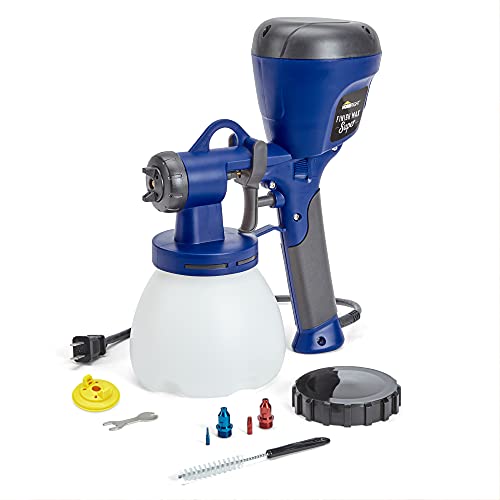
Best Budget HVLP
A handheld HVLP with the turbine in the body. HomeRight lists 450 watts, a 40 oz cup, 1.5, 2.0 and 4.0 mm brass tips, two air caps and a pattern you can set from 1″ to 12″ wide. It’s rated for oil and water-based materials, from chalk-type and milk paint to latex, enamel, primer, poly, stain and varnish, with less thinning than HomeRight’s smaller Finish Max. HomeRight covers it for 2 years.
- ✅ Three tips and two air caps
- ✅ No hose, nothing to set up
- ✅ Low price tier
- ❌ You hold the turbine’s weight
- ❌ Slow on big surfaces
Best For: Furniture makeovers, small fences and a first try at spraying.
Graco Magnum X5 Airless Paint Sprayer

Best Airless for Homeowners
The X5 is the airless most homeowners start with. Graco rates it at 3,000 psi, 0.27 GPM and a maximum tip of 0.015″, and it supports up to 75 ft of hose for second stories. The pressure is fully adjustable, the suction tube drops into a 1 or 5 gallon bucket, and paints and stains spray unthinned. It ships with an SG2 gun, a TrueAirless 515 tip, a 25 ft hose and a Power Flush adapter that connects to a garden hose for cleanup. Graco pitches it for projects of up to 10 gallons.
- ✅ Sprays unthinned paint from the bucket
- ✅ Adjustable pressure
- ✅ Garden-hose cleanup adapter
- ❌ Overspray: masking is part of every job
- ❌ Too much machine for one dresser
Best For: Whole rooms, ceilings, fences and house exteriors.
InoKraft D1 LVLP Air Spray Gun Premium Kit

Best LVLP Gun if You Own a Compressor
The D1 kit is built around the two things beginners forget: it includes a pressure regulator and an oil-water separator with the gun, plus 1.3, 1.5 and 1.7 mm nozzles for thin to heavier coatings. The body is one piece of forged aluminum with a Teflon coating, which makes cleanup easier, and InoKraft pitches it for furniture, automotive and DIY projects. Before buying, check the manual’s air requirement against your compressor’s CFM rating.
- ✅ Regulator and water separator included
- ✅ Three nozzle sizes
- ✅ Easy-clean coated body
- ❌ Needs a compressor
- ❌ Slower than a turbine on big pieces
Best For: Furniture, small panels and clear coats in a shop that already has air.
🏆 The Verdict
Pick by the job, not the spec sheet. For furniture and cabinets, buy a turbine HVLP: the Fuji Semi-PRO 2 if you finish often, the HomeRight Super Finish Max if you’re starting out. For walls, ceilings, fences and houses, buy an airless like the Graco Magnum X5. If you already own a compressor, an LVLP gun such as the InoKraft D1 is the cheapest way into a fine finish. And for one room you don’t want to mask, a roller is still the right tool.
❓ Frequently Asked Questions
What are the disadvantages of an HVLP spray gun?+
Is HVLP or LVLP better for beginners?+
What paint sprayer do professional painters use?+
How do I know if my spray gun is HVLP?+
Can I paint my car with an LVLP spray gun?+
Do professional painters spray or roll walls?+
Should I spray or roll my house?+
Is HVLP airless?+
Still deciding? Tell me in the comments what you’re painting and I’ll help you pick the type.

