
As an Amazon Associate I earn from qualifying purchases. All claims are strictly my personal opinion.
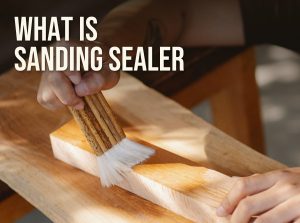
Sanding sealer is a first coat for bare wood that’s made to dry fast and sand easily, so you can lock down raised grain and fill the surface before the real finish goes on. It saves time and sandpaper on big projects and under lacquer, but it’s softer and less durable than a topcoat, and some kinds weaken the bond of polyurethane. Use the right type for your finish, sand it lightly with 320 grit, and never use it as the final coat.
Here is what sanding sealer is made of, the four main types and which finish each one goes under, when it’s worth using and when to skip it, how to apply and sand it, and the products and abrasives that make the job easy.
⚡ Quick Answer
Under any clear finish, including polyurethane: a dewaxed shellac sealer such as Zinsser SealCoat, or the sealer your topcoat brand makes for it.
Under Minwax polyurethane on floors, furniture and cabinets: Minwax Sanding Sealer, dry 1 hour, sand with 320.
Sanding it: 320 grit, light pressure, by hand with 3M Wetordry 320 or on a random orbital sander on its lowest speed.
What Is Sanding Sealer?
Sanding sealer is a finish formulated to be the first coat on raw wood. The first coat of any finish soaks into the fibers, makes them stand up and dries rough, so it always needs sanding. Sanding sealer is built for that step: it dries fast, builds a film quickly and powders when you sand it, instead of gumming up the paper.
General Finishes, which makes a water-based sanding sealer, lists four benefits: it’s a softer finish designed for faster sanding and faster drying, it costs less than topcoat, the film builds faster because the particle size is larger, and it has strong adhesion. The same FAQ adds a limit: it does not stop tannin or dye bleeding through, and it only makes sense if the project is large enough to justify buying a third product.
What Sanding Sealer Is Made Of
Traditional lacquer and varnish sanding sealers are the finish itself with zinc stearate added. Finishing writer Bob Flexner, in Popular Woodworking, describes zinc stearate as a type of soap: it makes the film slick so it sands to powder, but it also makes the coating less moisture resistant, softer, more likely to crack and less able to bond the coats above it. Dewaxed shellac and water-based sealers are the alternatives, and their makers sell them as “universal” sealers that go under several kinds of finish.
Is Sanding Sealer the Same as Varnish or Polyurethane?
No. A lacquer or varnish sanding sealer is related to the finish, but it’s deliberately softer so it sands quickly. That’s exactly what you don’t want in the final coat, which has to resist scratches, water and heat. Flexner’s point about polyurethane is blunt: it dries hard and sands easily, so it doesn’t need a special sealer, and using anything other than the polyurethane itself as the first coat weakens the total film.
The Four Types of Sanding Sealer (and What Goes on Top)
| Type | Goes under | Example | Watch out for |
|---|---|---|---|
| Lacquer sanding sealer | Nitrocellulose lacquer | Deft, Sherwin-Williams Sher-Wood | Contains stearate; not for polyurethane |
| Dewaxed shellac | Any clear finish | Zinsser Bulls Eye SealCoat | Must be dewaxed if poly goes on top |
| Water-based | Water- or oil-based poly (check label) | Minwax, Varathane, General Finishes Enduro | Minwax says not under lacquer |
| Thinned topcoat | The same topcoat | First coat of your polyurethane | Slower to dry and to sand |
Lacquer Sanding Sealer
This is the original, built for furniture factories and cabinet shops that spray nitrocellulose lacquer. Lacquer gums up sandpaper, and on a production line the time saved by a sealer that sands to powder is worth the trade-off. Keep it under lacquer: Flexner notes that manufacturers began warning against putting polyurethane over stearated sealers because the bond is weak.
Dewaxed Shellac (SealCoat)
Zinsser’s Bulls Eye SealCoat is sold as a universal sanding sealer. Rust-Oleum’s page says it’s compatible with all clear wood finishes, can be sanded and recoated in minutes, doesn’t darken or yellow with age, works as a pre-stain conditioner for pine and softwoods and as a bond coat over existing finishes. The key word is dewaxed: according to Flexner, polyurethane doesn’t bond well to ordinary shellac because of its natural wax, and SealCoat was created to solve that.
Water-Based Sanding Sealer
Water-based sealers are made to go under water-based and, in some cases, oil-based finishes. Minwax’s Professional Formula Sanding Sealer is for bare wood floors, furniture, doors and cabinets, dries in 1 hour and can be topcoated with any Minwax oil- or water-based polyurethane, but Minwax says not to use it under lacquer. Rust-Oleum calls Varathane Sanding Sealer universal, for oil and water-based finishes. General Finishes says its sealer works with all its water- and oil-based finishes.
Thinned First Coat of the Finish
The no-extra-product option: brush or wipe on a first coat of the same polyurethane, let it dry fully and sand it. It’s slower than a dedicated sealer, but it gives the strongest film, and on a small piece it’s what I’d do.
When to Use Sanding Sealer (and When to Skip It)
Use It When
- The project is big. Cabinets, a floor, a set of doors: General Finishes and Flexner both say the savings in time and sandpaper are what justify it.
- You’re spraying lacquer. Lacquer sanding sealer exists for exactly this.
- You need a barrier coat. A dewaxed shellac seals in old finish residue, and Zinsser markets SealCoat as a bond coat under new finishes.
- Pine or another blotch-prone softwood will be stained. Zinsser says SealCoat can be used as a pre-stain conditioner on pine and softwoods, and Crystalac says the same of its sealer.
- You want water-based poly to look warmer. Zinsser says SealCoat gives extra warmth to water-based polyurethanes, which on their own can look cold on some woods.
Skip It When
- Your finish is oil-based polyurethane on a small project. The first coat of poly is the best sealer.
- You’d be using a stearated lacquer or varnish sealer under polyurethane. That’s the combination that peels.
- You were going to use it as the finish. It’s softer and less water resistant than a topcoat.
- The sealer and topcoat brands disagree. If the topcoat can doesn’t approve the sealer, test on scrap or use the topcoat as its own sealer.
What Can You Use Instead of Sanding Sealer?
A thinned first coat of your topcoat, or dewaxed shellac, cover almost every situation. On blotch-prone wood that you’re staining, a pre-stain wood conditioner does the conditioning half of the job; my guide on how to stain wood explains when that matters.
How to Apply Sanding Sealer
- Sand the bare wood to your final grit. Crystalac’s tutorial says 220; Minwax’s floor sealer goes on bare wood after normal floor sanding. The wood grit guide has the sequence.
- Remove all dust with a vacuum and a clean cloth.
- Apply one thin coat with the grain. Minwax lists a synthetic bristle brush, foam applicator or synthetic pad. Rust-Oleum says thin, even coats in smooth, level strokes.
- Let it dry. Minwax: at least 1 hour. General Finishes: tack-free in 10 to 20 minutes, dry in 1 to 2 hours at 70°F and 50% humidity. SealCoat: minutes.
- Sand it smooth (next section), then remove every bit of dust.
- Apply the topcoat. Minwax recommends two or three coats of polyurethane; General Finishes suggests one or two sealer coats at most, then one or two topcoats.
Sanding Sealer Before or After Stain?
Both are used, for different reasons. Before stain, a thin coat acts as a conditioner: Crystalac’s method is one coat of sealer, then sand back to bare wood so sealer stays only in the grain and pores, then stain. After stain, it’s the first clear coat: General Finishes lists stained wood as a surface to seal before topcoat, and Crystalac recommends one or two coats over dried stain to lock the color in. Check that the stain is fully dry first; Crystalac warns oil-based stains can take up to a week.
How to Sand Sanding Sealer
Minwax’s instruction is to abrade the dried sealer with new 320-grit sandpaper or screen, or a maroon floor pad, then remove all dust. The goal is only to knock off the raised grain and dust nibs until the surface feels smooth and looks evenly dull. You are not trying to sand through the sealer.
By Hand or With a Sander
On flat panels, a random orbital sander with a 320 disc on its lowest speed is fast and even. On edges and profiles, sand by hand with a fine sponge: edges are where you cut through first. The whole technique, including when to sand wet, is in my guide to sanding between coats of polyurethane.
Don’t Cut Through Over Stain
If the sealer is over stain, sanding through it sands the color off and leaves a light spot that shows under every coat after. Use light pressure, fewer passes on edges and corners, and stop as soon as the surface is smooth.
💡 Pro Tip
A properly dry sanding sealer turns to fine white powder under 320 grit. If it rolls into little gummy balls on the paper, it isn’t dry yet: stop, wait another hour and try again on a hidden spot.
Sanding Sealer vs Wood Conditioner vs Primer
Wood conditioner goes on before stain to even out absorption, and it’s wiped off. Sanding sealer builds a sandable film under a clear finish. Primer is pigmented and goes under paint. Dewaxed shellac blurs the lines, because it can do the first two jobs, and Zinsser also makes a shellac-based primer, but in general use the product that matches your topcoat: clear finish, sealer; paint, primer.
The Sealers and Abrasives I’d Use
The specs below come from the makers’ product pages, and from the Amazon listing where I say so. I don’t show customer ratings or prices.
Zinsser Bulls Eye SealCoat Universal Sanding Sealer
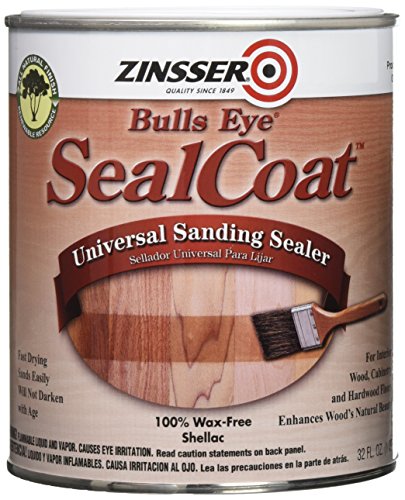
Best Universal Sanding Sealer
If you buy one sealer, make it this. SealCoat is a dewaxed shellac that Rust-Oleum says is compatible with all clear wood finishes, including polyurethane, and it sands and recoats in minutes. It doesn’t darken or yellow with age, cleans up with alcohol or ammonia and water, works as a pre-stain conditioner on pine and as a bond coat over existing finishes. For more film build, the maker suggests two coats.
- ✅ Works under any clear finish
- ✅ Dries in minutes
- ✅ Doubles as conditioner and bond coat
- ❌ Alcohol-based: strong smell, ventilate
Best For: Any project, especially under polyurethane or over an old finish.
Minwax Professional Formula Sanding Sealer (Water-Based)
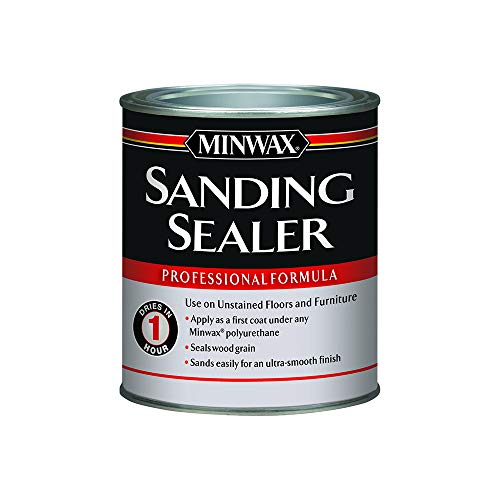
Best Under Minwax Polyurethane
Minwax designs this one for bare wood floors, furniture, doors and cabinets, and says any Minwax oil- or water-based polyurethane can go over it. It dries and recoats in 1 hour, so you can seal and topcoat in one day; Minwax recommends one coat, sanded with new 320-grit paper or a maroon pad, then two or three coats of poly. The listing says it cleans up with water. Don’t use it under lacquer.
- ✅ Seal and topcoat the same day
- ✅ Approved under Minwax oil and water poly
- ✅ Water cleanup
- ❌ Not for lacquer finishes
Best For: Floors, cabinets and furniture finished with Minwax polyurethane.
Varathane Sanding Sealer

Best for Porous Woods Under Varathane Finishes
Rust-Oleum pitches Varathane’s sealer at porous woods: a high-building coat that dries clear, sands easily and is universal, for oil- and water-based finishes. Apply thin, even coats with the grain. The Amazon listing adds that it’s for furniture, doors, cabinets and trim, dries to the touch in 1 hour, covers 60 to 90 sq ft per quart and cleans up with soap and water.
- ✅ Builds fast on open-grained wood
- ✅ Oil or water-based topcoats
- ✅ Soap and water cleanup
- ❌ Lower coverage per quart than Minwax quotes
Best For: Oak, ash and other open-grained furniture and trim.
3M Wetordry Sandpaper, 320 Grit

Best Paper for Sanding the Sealer
320 is the grit Minwax names for its sealer, and this 3M pack is sold for final or between-coats sanding. It’s silicon carbide on waterproof paper, so you can use it dry or with water to stop it clogging, and the 25 full 9 x 11 in sheets cut into quarters for a block or a 1/4-sheet sander. Why silicon carbide suits finishes is explained in my guide to types of sandpaper.
- ✅ The grit sealer makers ask for
- ✅ Wet or dry
- ✅ 25 sheets go a long way
- ❌ Needs a block for flat surfaces
Best For: Sanding sealer and between coats by hand.
Bosch ROS20VSC Random Orbital Sander + Mirka Abranet 320

Best Sander for Big Flat Surfaces
On tabletops, cabinet sides and doors, a 5″ random orbital sander sands sealer evenly and fast. The ROS20VSC has a 2.5 amp motor with variable speed from 7,500 to 12,000 OPM, so you can drop it to the bottom of the dial for a finish coat, plus a microfilter canister and a vacuum adapter. Pair it with Mirka Abranet 320 mesh discs, which pull dust through the whole disc and fit any 5″ hook-and-loop pad. My Bosch ROS20VSC review has the details.
- ✅ Low speed setting for finish coats
- ✅ Dust canister and vacuum port
- ✅ Standard 5″ hook-and-loop discs
- ❌ Round pad misses inside corners
Best For: Tabletops, doors and cabinet panels.
How I Put This Guide Together
The product facts come from the makers: Minwax’s product page and directions for its sanding sealer, Rust-Oleum’s pages for Zinsser SealCoat and Varathane Sanding Sealer, General Finishes’ FAQ on sanding sealer, and Crystalac’s sanding sealer tutorial. The explanation of stearates and polyurethane adhesion comes from Bob Flexner’s column on sealers in Popular Woodworking. Anything from an Amazon listing is marked. More on how I choose the products I recommend.
🏆 The Verdict
Sanding sealer is a time saver for big jobs and lacquer finishes, not a step every project needs. Match it to the topcoat: lacquer sealer under lacquer, dewaxed shellac or the topcoat maker’s own sealer under polyurethane, and never a stearated sealer under poly. Sand it lightly at 320 and don’t use it as the final coat. Zinsser SealCoat is the safe pick under anything, and 3M Wetordry 320 is the paper to sand it with.
❓ Frequently Asked Questions
What is sanding sealer used for?+
What can I use instead of sanding sealer?+
Do I need to use sanding sealer?+
Is sanding sealer the same as varnish?+
Is sanding sealer the same as polyurethane?+
Can I use sanding sealer as a finish?+
Conclusion
Sanding sealer is a fast, sandable first coat, and the whole decision comes down to the topcoat you’ll put over it and the size of the job. For polyurethane, the first coat of poly or a dewaxed shellac does the job; for lacquer, a lacquer sealer saves real time. Whatever you use, sand it with 320 and keep your pressure light. Then follow my guide to sanding between coats of polyurethane for the coats that come after.

