
As an Amazon Associate I earn from qualifying purchases. All claims are strictly my personal opinion.

Is a WEN oscillating spindle sander worth it? For a home shop, yes: the WEN 6510T and WEN 6524 are two of the least expensive ways to get a real benchtop spindle sander, both with a 3.5 A motor, 2,000 RPM and 58 oscillations per minute with 5/8″ of travel, and both covered by a 2-year warranty. Buy the 6510T if you only sand curves and want the 3″ sleeve and the cast iron table. Buy the 6524 if you also want a belt for straight edges and outside curves, and a table that tilts to 45°.
Below I compare the two WEN models spec by spec, explain what each one does well and where each falls short, and tell you which to buy for the work you do. Every number comes from WEN’s own instruction manuals.
⚡ Quick Verdict
Inside curves only, and you want the widest sleeve range? The WEN 6510T: six sleeves from 1/2″ to 3″ and a cast iron table.
One machine for curves and straight edges? The WEN 6524: spindle plus a 4″ x 24″ oscillating belt, and a beveling table.
Need more than a WEN? My best spindle sanders guide covers JET and Delta.
WEN 6510T vs 6524 at a Glance
| Spec (from WEN’s manuals) | WEN 6510T | WEN 6524 |
|---|---|---|
| Type | Oscillating spindle sander | Oscillating belt and spindle sander |
| Motor | 120V, 3.5 A | 120V, 3.5 A, 1/2 HP |
| Spindle speed | 2,000 RPM | 2,000 RPM |
| Oscillation | 58 per minute, 5/8″ travel | 58 per minute, 5/8″ travel |
| Sleeve sizes | 1/2″, 3/4″, 1″, 1-1/2″, 2″, 3″ | 1/2″, 3/4″, 1″, 1-1/2″, 2″ |
| Belt | None | 4″ x 24″, 1,575 FPM |
| Table | Cast iron, fixed | Tilts 0 to 45° |
| Max workpiece height | 3-5/8″ | Not listed |
| Dust port | 1.5″ outside diameter | 1-1/2″ |
| Weight | 35 lb | 27 lb |
| Warranty | 2 years (90 days for professional or commercial use) | |
| Price tier | $$ | $$ |
What Is an Oscillating Spindle Sander For?
An oscillating spindle sander is a benchtop machine with a vertical sanding drum that sticks up through the table. The drum spins and, at the same time, moves up and down. You hold the workpiece flat on the table and feed its edge against the drum. Its job is curves: the inside of a cabriole leg, a scroll-sawn bracket, a curved apron, a template for a router, anything you cut on a band saw or jigsaw and now need smooth and true.
The up-and-down motion is what makes it better than a drum in a drill press. A drum that only spins wears a single band of abrasive, gets hot and leaves horizontal scratch lines on the edge. Oscillation spreads the wear over 5/8″ of the sleeve on both WEN models, so the paper cuts cooler and lasts longer, and the scratches cross each other instead of lining up.
Spindle Only, or Belt and Spindle?
This is the real choice between the two WENs. A spindle handles inside curves. It is poor at straight edges and long, gentle outside curves, because the small round drum tends to leave dips. A belt attachment gives you a flat platen for straight edges and a large-radius curve at the belt’s end for outside curves. If you want a belt and spindle machine with more capacity than the WEN, the best oscillating belt and spindle sanders guide compares the RIDGID EB4424 and others.
WEN Oscillating Spindle Sander Reviews
WEN 6510T 3.5 Amp Oscillating Spindle Sander

The Spindle-Only Pick, With the Bigger Sleeve
WEN’s manual lists the 6510T at 120V and 3.5 A, 2,000 RPM, and 58 oscillations per minute with 5/8″ of travel. It comes with six 80-grit sleeves from 1/2″ to 3″, a matching throat plate for each, and onboard storage for all of them. The work table is cast iron, which adds mass and keeps the machine planted, and the manual gives a maximum workpiece height of 3-5/8″ and a weight of 35 lb. The listing I link is the 6510T sold together with a 12-pack of WEN’s 240-grit sleeves, so you have a finishing grit from day one.
The 3″ sleeve is the feature to notice. Gentle inside curves, such as the arch of a chair rail or a wide cutout, sand more smoothly on a big drum, because a small drum digs in and follows every waver in the saw cut. The trade-off is the table: WEN does not list a tilt for the 6510T, so it sands square edges only.
- ✅ Six sleeves, 1/2″ to 3″
- ✅ Cast iron table, 35 lb of mass
- ✅ Onboard storage for drums and throat plates
- ❌ Fixed table: no bevel sanding
- ❌ Spindle only: no belt for straight edges
Best For: Scroll saw and band saw work, templates and curved parts with square edges.
WEN 6524 Oscillating Belt and Spindle Sander
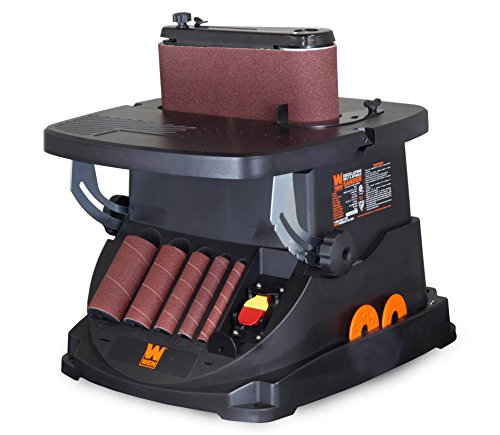
The Two-in-One Pick, With a Beveling Table
The 6524 uses the same 3.5 A motor (WEN rates it at 1/2 HP), 2,000 RPM spindle and 58 oscillations per minute over 5/8″, and adds a 4″ x 24″ sanding belt running at up to 1,575 FPM that also oscillates. WEN’s manual lists sanding drums of 3/4″, 1″, 1-1/2″ and 2″, sleeves from 1/2″ to 2″, a table that tilts from 0 to 45° for bevels, a 1-1/2″ dust port and a weight of 27 lb. The kit includes five throat plates, the belt attachment and an 80-grit sleeve or belt for each size.
Swapping from spindle to belt means removing the spindle parts, storing them and installing the belt attachment, and the manual covers belt tracking with a knob on the attachment. In practice that makes the 6524 a machine you set up for a session of one kind of sanding, not one you flip between every minute. The tilting table is the other big gain: beveled edges on curved parts are something the 6510T simply can’t do.
- ✅ Spindle plus a 4″ x 24″ oscillating belt
- ✅ Table tilts 0 to 45° for bevels
- ✅ Lighter and more compact than the 6510T
- ❌ Largest sleeve is 2″, not 3″
- ❌ Changing between belt and spindle takes a few minutes
Best For: A small shop that wants one benchtop machine for curves, straight edges and bevels.
WEN 6510T vs WEN 6524: How They Really Differ
Power, speed and oscillation are identical on paper. The decision comes down to four things.
Sleeve Range
The 6510T goes up to 3″, the 6524 stops at 2″. Sleeve diameter sets the tightest and the gentlest curve you can sand cleanly: the 1/2″ sleeve on both machines reaches into tight inside curves, while the 3″ sleeve on the 6510T is the one you want for long, shallow arcs.
Belt Attachment
Only the 6524 has one. If you sand straight edges on small parts, or outside curves like the round end of a shelf, the belt saves you from reaching for a handheld sander. If you already own a benchtop belt sander, the 6524’s belt matters much less; see my benchtop belt and disc sander guide if you’re weighing that route.
Table
The 6510T has a fixed cast iron table. The 6524 has a beveling table that tilts to 45°. Cast iron is heavier and damps vibration; a tilting table opens up bevels and chamfers on curved parts. Which matters more depends on whether you build furniture with beveled edges or mostly cut shapes and templates.
Weight and Footprint
At 35 lb the 6510T is heavier, mostly because of the iron table. The 6524 weighs 27 lb. Both are benchtop tools; WEN’s manuals ask you to mount the machine on a flat, stable surface, and bolting either one down makes a real difference.
💡 Pro Tip
Read the warranty note before you plug in. Both WEN manuals state that running the sander without a dust collection system voids the warranty. A shop vac on the 1-1/2″ port meets that and keeps fine dust out of the motor; my shop vac for dust collection guide covers the hoses and adapters.
What to Know Before You Buy Either WEN
- Use the right throat plate. Each sleeve has a matching plate. The smallest gap around the drum supports the workpiece best and keeps small parts from dropping into the opening.
- Keep sleeves in two or three grits. Both machines ship with 80 grit only. WEN sells 120, 150 and 240-grit sleeves and an assorted pack for the 6510T, and combination belt and sleeve sets for the 6524.
- Feed against the rotation and keep moving. Holding the part in one place on a spinning, oscillating drum still creates a flat spot.
- These are hobby-class machines. WEN’s warranty drops to 90 days for professional or commercial use. A production shop should look at the JET JBOS-5 or Delta 31-483 in my spindle sander roundup.
How I Reviewed Them
This review compares the WEN 6510T and 6524 using WEN’s own instruction manuals (specifications, included parts, table and dust port details, warranty terms) and each product’s current Amazon listing, checked on the day of writing. Where a listing and a manual disagreed, as with the 6510T’s weight, I used the manual. I haven’t run these two WEN machines in my own shop, so I don’t describe them as if I had; what I add is how those specs translate into curve work, from years of sanding curved parts on spindle and belt sanders. My full method is on the how I choose page. No star ratings or prices here: each product has a price tier, and the Amazon button shows the live price.
🏆 The Verdict
Both WEN oscillating spindle sanders give a home shop the core of the job, a 2,000 RPM spindle oscillating 58 times a minute, at a price tier that makes sense for occasional curve work. Choose the WEN 6510T for spindle sanding only, with the 3″ sleeve and a cast iron table. Choose the WEN 6524 if you want a belt for straight edges and outside curves plus a table that tilts to 45°. For most people building furniture, the 6524 is the more useful of the two.
❓ Frequently Asked Questions
What is an oscillating spindle sander good for?+
Is the WEN 6524 oscillating belt and spindle sander any good?+
Are WEN belt sanders any good?+
What is the best oscillating spindle sander?+
Which oscillating spindle belt sander is the best?+
What replacement sleeves does the WEN 6510T take?+
Conclusion
A WEN oscillating spindle sander is the cheapest sensible way to stop sanding curves by hand. The 6510T is the purer spindle sander, with the bigger sleeve and the heavier table; the 6524 trades the 3″ sleeve for a belt and a tilting table, which makes it the more versatile machine for most furniture makers. Pick by the shapes you cut, then add a few sleeves in finer grits and a vacuum on the dust port.
Want to see how the WENs stack up against heavier machines? My guide to the best oscillating spindle sanders covers the full range. Questions about either WEN? Ask in the comments below.

