
As an Amazon Associate I earn from qualifying purchases. All claims are strictly my personal opinion.

For most woodworkers, the Festool sander to buy is a brushless ETS EC 150: the 150/3 if you mostly finish, the 150/5 if you also remove stock. Add a ROTEX RO 150 only if you strip old finishes or flatten rough boards, a DTS 400 or RTS 400 for corners and edges, an ETSC 2 if you need cordless, and a PLANEX for drywall. The ETS 125 REQ is the cheapest way into Festool sanders, built for fine finish work rather than removal.
Festool sells more than a dozen sanders in the US, and the names (ETS, ETS EC, RO, RTS, DTS, ETSC) look like a parts catalog until you know the code. Below is every current Festool sander side by side, how to read the model names, 125 vs 150 and 3 mm vs 5 mm, each model’s job, and the extractor that should go with it. Every figure comes from Festool USA’s own product pages. Still choosing between brands? See my Festool vs Mirka comparison first.
⚡ Quick Answer
Best first Festool sander: the ETS EC 150/3, or the ETS EC 150/5 if you remove a lot of material.
Best for stripping and coarse work: the ROTEX RO 150 FEQ.
Best for corners, edges and profiles: the DTS 400 or the ROTEX RO 90 DX.
Cheapest way in: the ETS 125 REQ, a fine-finish 5″ sander.
Every Festool Sander at a Glance
| Model | Type | Pad | Stroke | Speed (rpm) | Power | Best for |
|---|---|---|---|---|---|---|
| ETS 125 REQ | Random orbital, brushed | 5″ | 2 mm | 6,000-12,000 | 250 W | Fine finishing, first Festool |
| ETS EC 125/3 | Random orbital, brushless | 5″ | 3 mm | 6,000-10,000 | Not stated | Small parts, one-hand work |
| ETS EC 150/3 | Random orbital, brushless | 6″ | 3 mm | 6,000-10,000 | 400 W | Finishing, between coats |
| ETS EC 150/5 | Random orbital, brushless | 6″ | 5 mm | 6,000-10,000 | 400 W | All-round sanding |
| ROTEX RO 150 FEQ | Gear-driven + random orbital + polish | 6″ | 5 mm | 320-660 rotary · 3,300-6,800 orbit | 720 W | Stripping, coarse removal |
| ROTEX RO 125 FEQ | Gear-driven + random orbital | 5″ | 3.6 mm | 300-600 rotary · 3,000-6,000 orbit | 500 W | Smaller ROTEX jobs |
| ROTEX RO 90 DX FEQ | Gear-driven, round or delta pad | 3.5″ / delta | 3 mm | 260-520 rotary · 3,500-7,000 orbit | 400 W | Windows, doors, profiles |
| RTS 400 REQ | Orbital finish sander | 80 x 133 mm | 2 mm | 6,000-12,000 | 250 W | Square inside corners, edges |
| DTS 400 REQ | Delta finish sander | 100 x 150 mm | 2 mm | 6,000-12,000 | 250 W | Corners, rails, small panels |
| ETSC 2 125 / 150 | Cordless random orbital, brushless | 5″ / 6″ | 3.5 mm | 6,000-10,000 | 18V | Job sites, no cord |
| PLANEX LHS 2 225 | Long-reach drywall sander | 8-7/8″ abrasive | 4 mm | 5,000-8,500 | 400 W | Walls and ceilings |
How to Read Festool Sander Names
Once you know three rules, the names tell you what each sander does.
- The letters are the type. ETS is a random orbital sander. RO is a ROTEX, which adds a gear-driven rotary mode. RTS is the rectangular orbital finish sander and DTS the delta (triangular) one. A C added after the type means cordless (ETSC), and EC means a brushless EC-TEC motor (ETS EC).
- The first number is the pad diameter in millimeters. 125 is a 5″ pad, 150 a 6″ pad, 90 a 3-1/2″ pad. On the RTS and DTS, 400 is the model size, not a diameter.
- The number after the slash is the stroke in millimeters, the diameter of the orbit: /3 is a 3 mm stroke and /5 a 5 mm stroke. A bigger stroke removes material faster; a smaller one leaves a finer scratch pattern.
So an ETS EC 150/5 is a brushless random orbital with a 6″ pad and a 5 mm stroke. The suffix letters (REQ, FEQ, EQ) identify the version, and the “Plus” kits linked on this page come in a Systainer case.
125 or 150: Which Pad Size?
A 150 mm (6″) pad covers about 44% more area than a 125 mm (5″) pad, because area grows with the square of the diameter. On tabletops, doors, cabinet sides and floors, that means fewer passes. A 125 is lighter in the hand and easier to control on narrow rails, small parts and vertical surfaces. If you only buy one, the 6″ ETS EC 150 is the more efficient sander; if most of your work is furniture parts and trim, a 5″ model is the more comfortable one. My random orbital sander reviews cover the same choice in other brands.
3 mm or 5 mm Stroke?
The stroke decides the balance between speed and finish. A 3 mm stroke leaves a finer scratch pattern and is the classic choice for sanding between coats of finish, veneers and final grits. A 5 mm stroke removes material faster and suits leveling glue-ups, taking off old finish and working through coarse grits, and with fine abrasive it still finishes well. Festool’s ETS 125 REQ goes even finer at 2 mm, like the RTS and DTS finish sanders. If you sand raw lumber from 80 grit up, choose 5 mm; if you mostly sand finished or nearly finished surfaces, choose 3 mm.
The Festool Sanders, Model by Model
Random Orbital Sanders (ETS and ETS EC)
These are the everyday sanders and the ones most people should start with. The brushless ETS EC models add a carbide-tipped pad brake, which keeps the pad from spinning up when you lift the sander off the work, and electronics that hold the speed under load.
Festool ETS EC 150/3 EQ-Plus 6″ Random Orbital Sander

Best Festool Sander for Finishing
The finishing version of Festool’s brushless 6″ sander: 3 mm stroke, 6,000-10,000 rpm, 400 W. Festool states it is 4-1/2″ tall, holds its speed under load, and has a carbide-tipped pad brake and a vibration control system. The 3 mm stroke leaves the finer scratch pattern you want for final grits and sanding between coats, and the 6″ pad still covers big panels quickly.
- ✅ Fine scratch pattern
- ✅ Brushless with pad brake
- ✅ Low, palm-height body
- ❌ Slower than the 150/5 on raw lumber
- ❌ Premium price tier
Best For: Final sanding, veneers and sanding between coats of finish.
Festool ETS EC 150/5 EQ-Plus 6″ Random Orbital Sander

Best All-Round Festool Sander
The same brushless body with a 5 mm stroke, which removes material noticeably faster at coarse grits while still finishing well at fine ones. Speed is 6,000-10,000 rpm from a 400 W motor, and Festool ships it with its MULTI-JETSTREAM 2 pad and a Systainer case. If you only buy one Festool sander and you start from raw lumber, this is it.
- ✅ Removes and finishes
- ✅ MULTI-JETSTREAM 2 pad included
- ✅ Pad brake
- ❌ Slightly coarser final finish than the 3 mm
- ❌ Premium price tier
Best For: One sander for raw lumber, glue-ups and finishing.
Festool ETS EC 125/3 EQ-Plus 5″ Random Orbital Sander

Best Compact Festool Sander
The brushless sander in the 5″ size: 3 mm stroke, 6,000-10,000 rpm, Jetstream extraction, electronic vibration stop and a carbide-tipped pad brake, listed at 3.31 lb in Festool’s spec table. It takes standard 5″ discs and is easier to balance on narrow edges, drawer parts and vertical surfaces than a 6″ sander.
- ✅ Easy to control on small parts
- ✅ Brushless and pad brake
- ✅ Common 5″ discs
- ❌ Smaller pad means more passes on panels
- ❌ Costs close to the 6″ model
Best For: Small furniture parts, boxes and one-handed work.
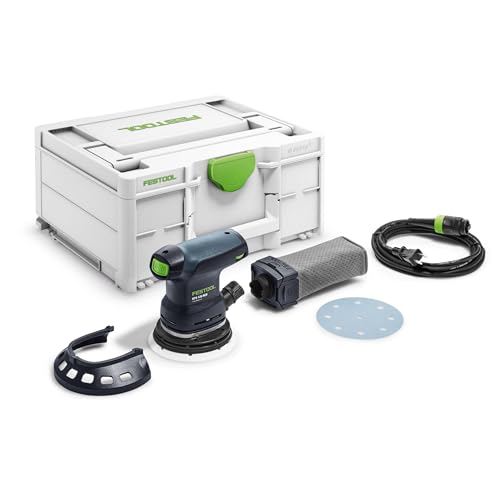
Festool ETS 125 REQ-Plus 5″ Random Orbital Sander
Best Entry-Level Festool Sander
The cheapest Festool sander uses a brushed 250 W motor, a very fine 2 mm stroke and 6,000-12,000 rpm variable speed, with Festool’s vibration-stop balancing, a pad brake and Jetstream extraction through the pad. The 2 mm stroke makes it a finishing sander: excellent on final grits and between coats, slow if you ask it to level rough boards. It comes in a Systainer.
- ✅ Lowest price in the Festool range
- ✅ Very fine finish
- ✅ Pad brake and Jetstream
- ❌ Slow at stock removal
- ❌ Brushed motor
Best For: A dedicated finish sander alongside a faster sander.
ROTEX Gear-Driven Sanders (RO)
A ROTEX locks the pad into forced rotation for aggressive removal, then switches back to random orbit to finish. That makes it the Festool for refinishing work: old paint and varnish, glue squeeze-out, weathered boards. The 5″ and 6″ ROTEX models are heavier than an ETS and work best with two hands in rotary mode.
Festool ROTEX RO 150 FEQ-Plus 6″ Multi-Mode Sander

Best Festool Sander for Stripping
Festool’s most versatile sander has three modes: gear-driven rotary at 320-660 rpm for coarse removal, random orbit at 3,300-6,800 rpm for finishing, and polishing. A 720 W motor, a 5 mm stroke, tool-free FastFix pad changes and a protector ring around the pad round it out. Festool lists 5.95 lb, so this is a two-handed sander for horizontal work more than a palm sander.
- ✅ Strips paint and varnish fast
- ✅ Finishes and polishes too
- ✅ Tool-free pad change
- ❌ Heavy for vertical work
- ❌ Top of the Festool price range
Best For: Refinishing furniture, doors and weathered decking.
Festool ROTEX RO 90 DX FEQ-Plus 3-1/2″ Multi-Mode Sander

Best Festool Sander for Profiles and Corners
A small ROTEX with a 3-1/2″ round pad that swaps for a delta pad without tools. It runs at 260-520 rpm gear-driven and 3,500-7,000 rpm random orbit, a 3 mm stroke, a 400 W motor and an edge protector, at 3.08 lb. The round pad strips small areas in rotary mode and the delta pad reaches into corners, which makes it the Festool for window sashes, doors, chairs and trim.
- ✅ Round and delta pads
- ✅ Rotary mode in a small sander
- ✅ Light at 3.08 lb
- ❌ Small pad for flat panels
- ❌ Costs as much as a full-size sander
Best For: Restoring windows, doors, chairs and profiled trim.
Between the two sits the ROTEX RO 125 FEQ: a 5″ ROTEX with a 3.6 mm stroke, 300-600 rpm in rotary mode, 3,000-6,000 rpm in random orbit mode and a 500 W motor, at 5.07 lb in Festool’s table. It suits smaller parts if you want gear-driven power without the 6″ pad.
Finish Sanders for Corners (RTS 400 and DTS 400)
Round pads can’t reach into a square inside corner. Festool’s two finish sanders are orbital rather than random orbital, with a fine 2 mm stroke, so they leave a smooth surface right into the corner.
Festool RTS 400 REQ-Plus Orbital Finish Sander

Best for Square Inside Corners
A rectangular 80 x 133 mm pad on an orbital (not random orbital) sander with a fine 2 mm stroke, 6,000-12,000 rpm variable speed, 250 W, MMC electronics and vibration-stop balancing. The straight edges of the pad reach right into inside corners and along face frames, and the orbital motion leaves a fine, even finish.
- ✅ Reaches square corners
- ✅ Fine finish
- ✅ Shares the 27 mm port
- ❌ Slow for stock removal
- ❌ Smaller area than a 6″ disc
Best For: Face frames, cabinet interiors and edges.
Festool DTS 400 REQ-Plus Delta Finish Sander

Best Festool Detail Sander
The delta version: a 100 x 150 mm triangular pad, 2 mm stroke, 6,000-12,000 rpm, 250 W, electronic speed control and vibration-stop balancing. The point of the triangle gets into corners and the narrow spaces between rails and stiles, where a round or rectangular pad can’t reach.
- ✅ Gets into tight corners
- ✅ Fine finish
- ✅ Light, one-handed
- ❌ Small pad
- ❌ Delta abrasives cost more per area
Best For: Corners of cabinet doors, stair treads and tight spots.
Cordless (ETSC 2)
Festool ETSC 2 125 Cordless Random Orbital Sander (Basic)

Best Cordless Festool Sander
Festool’s second-generation cordless random orbital: an 18V brushless 5″ sander with a 3.5 mm stroke and 6,000-10,000 rpm, an LED light ring with two modes that you can control from Festool’s app, vibration protection and a carbide-tipped pad brake. It weighs 2.65 lb as a bare tool. “Basic” means no battery or charger in the box, so it makes most sense if you already own Festool 18V packs.
- ✅ No cord to drag across the work
- ✅ LED light ring shows scratches
- ✅ Light bare tool
- ❌ Battery and charger sold separately
- ❌ Runtime limits long sanding jobs
Best For: Job sites and quick sanding where a cord is in the way.
The ETSC 2 150 is the same sander with a 6″ pad: 3.5 mm stroke, 6,000-10,000 rpm, LED light ring and pad brake, at 2.65 lb as a bare tool.
Drywall Sanders (PLANEX)
Festool’s PLANEX models are long-reach sanders for walls and ceilings. The PLANEX LHS 2 225 has a 220 mm pad that takes 225 mm (8-7/8″) abrasives, a 4 mm stroke, 5,000-8,500 rpm, a 400 W brushless motor, a full-circle LED light ring and adjustable suction, and it extends from 47-1/4″ to 65″ with up to two extensions. The PLANEX easy LHS-E 225 is the newer single-piece version: 1.6 m long, 8.82 lb, with a direct-drive brushless motor over the pad. I compare the PLANEX against cheaper options in my best drywall sanders guide.
Which Festool Sander Should You Buy?
Match the sander to the work you do most often.
- Furniture and cabinets from new lumber: ETS EC 150/5 for the main surfaces, plus a DTS 400 for inside corners and rails.
- Fine finishing and sanding between coats: ETS EC 150/3, or the ETS 125 REQ on a tighter budget.
- Refinishing old furniture, doors and decks: ROTEX RO 150 FEQ. It strips in rotary mode and finishes in random orbit mode.
- Windows, trim and profiles: ROTEX RO 90 DX with the delta pad.
- Small parts, boxes and one-hand work: ETS EC 125/3.
- Job sites without power: ETSC 2 125 or 150.
- Drywall: a PLANEX, on a Festool extractor.
A two-sander kit covers almost everything: an ETS EC 150 for flat work plus either a DTS 400 (new work) or a ROTEX RO 90 DX (refinishing).
Do You Need a Festool Dust Extractor?
To get what you’re paying for, yes. Every sander above has the same 27 mm dust port, and Festool designs its pads, abrasives and hoses around a CT extractor with auto-start. The CT MIDI I is the one I’d pair with a sander: 130 CFM, 96″ of water lift, a HEPA filter, a 15-liter container, an outlet that starts the extractor with a corded tool, Bluetooth auto-start for cordless tools, and a T-LOC top that holds a Systainer. The CT 15 has the same airflow and HEPA filter in a simpler unit that Festool positions for cleaning. A good shop vacuum with an adapter will run a Festool sander, but you lose auto-start and much of the fine dust control. My Festool dust extractor comparison puts the CT 15, CT MIDI I, CT 26 and CT 36 side by side.
Is a Festool Sander Worth the Money?
It depends on how many hours you sand. Festool’s case is a system: brushless motors, pad brakes, matching extractors, Systainer storage, and a 3-year warranty that Festool USA says covers wear and tear, for tools bought from authorized US dealers. If you sand every week, or sand indoors where dust matters, that adds up. If you sand a few weekends a year, a good mid-priced random orbital does most of the same work, and my best random orbital sanders list has options at every price tier. For the closest premium alternative, read my Mirka DEROS review.
When you buy, check the seller. Festool’s warranty depends on an authorized dealer, and Festool publishes its list of authorized online dealers on its US site. When I checked, the Festool listings linked on this page were sold by Hartville Hardware, which is on that list.
🏆 The Verdict
Start with an ETS EC 150: the 150/5 if you sand raw lumber, the 150/3 if you mostly finish. Add a DTS 400 or RTS 400 for corners, and choose the ROTEX RO 150 instead of the ETS EC if stripping old finishes is your main job. Buy the ETS 125 REQ only as a fine-finish sander, not as your only sander, and plan for a CT extractor from day one.
❓ Frequently Asked Questions
Which Festool sander should I get?+
What is the difference between Festool sander 125 and 150?+
Is a Festool sander worth the money?+
Why are Festools so expensive?+
Which Festool sander is considered the best?+
Not sure which one fits your projects? Tell me what you build in the comments and I’ll point you to the right Festool.

