


As an Amazon Associate I earn from qualifying purchases. All claims are strictly my personal opinion.
A palm sander and an orbital sander are not really opposites: “palm sander” describes the size and grip, “orbital” describes the motion. In everyday use, though, “palm sander” means a small square-pad finishing sander, and “orbital sander” means a round-pad random orbital sander. The square palm sander reaches into corners and finishes gently; the random orbital removes wood faster and leaves fewer visible scratches.
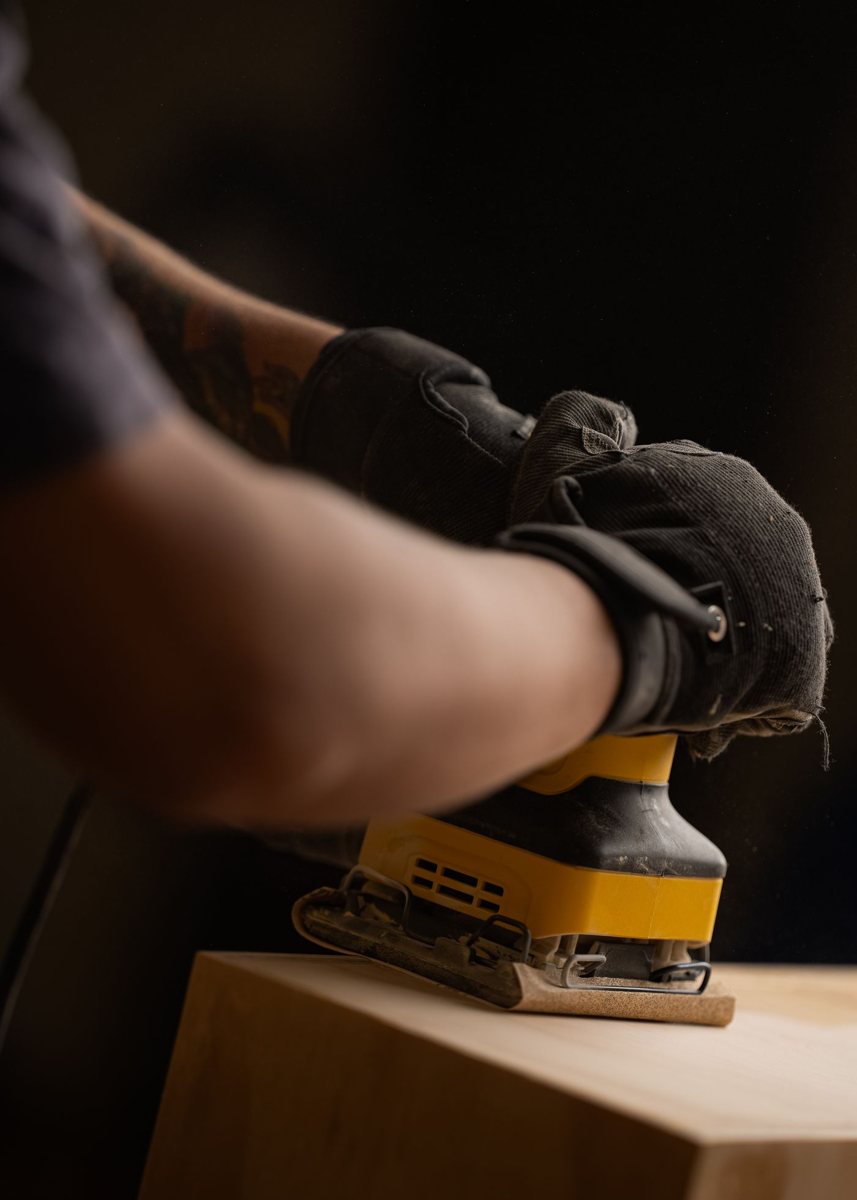
So the real question is which pad and which motion suit your project. Below I clear up the names, compare the two tools side by side, and pick three sanders I’d buy on each side, from budget to premium.
Why “Palm Sander” Confuses Everyone
Tool makers and stores use “palm sander” for any sander small enough to hold in one hand with your palm on top. That includes two very different tools:
- Palm-grip sheet sanders (also called finishing sanders or 1/4-sheet sanders). They have a square pad that clamps a piece of ordinary sandpaper and moves in a small, fixed orbit.
- Palm-grip random orbital sanders. They have a round 5″ pad that orbits and spins freely at the same time. Bosch even names its ROS10 a “Palm Random Orbit Sander”.
Most people searching “palm sander vs orbital sander” mean the first against the second: square pad versus round pad. That is the comparison on this page. If you want the full technical breakdown of the two motions, I cover it in my sheet sander vs random orbital sander guide.
Palm Sander vs Orbital Sander at a Glance
| Feature | Palm Sander (square pad) | Orbital Sander (random orbital) |
|---|---|---|
| Pad | Square, sized for a 1/4 sheet of sandpaper | Round, usually 5″ |
| Motion | Small fixed orbit | Orbit plus free rotation |
| Removes wood | Slowly | Faster |
| Inside corners | ✅ Reaches them | ❌ Leaves an arc |
| Scratch pattern | Repeating loops, can show under stain | Random, harder to see |
| Sandpaper | Cut from ordinary sheets | Hook-and-loop discs |
| Best for | Finish sanding, corners, between coats, drywall patches | General woodworking, tabletops, removing finish |
| Typical price tier | $ to $$ (premium $$$$) | $ to $$ (premium $$$$) |
Palm Sander (square pad)
- Pad
- Square, sized for a 1/4 sheet of sandpaper
- Motion
- Small fixed orbit
- Removes wood
- Slowly
- Inside corners
- ✅ Reaches them
- Scratch pattern
- Repeating loops, can show under stain
- Sandpaper
- Cut from ordinary sheets
- Best for
- Finish sanding, corners, between coats, drywall patches
- Typical price tier
- $ to $$ (premium $$$$)
Orbital Sander (random orbital)
- Pad
- Round, usually 5″
- Motion
- Orbit plus free rotation
- Removes wood
- Faster
- Inside corners
- ❌ Leaves an arc
- Scratch pattern
- Random, harder to see
- Sandpaper
- Hook-and-loop discs
- Best for
- General woodworking, tabletops, removing finish
- Typical price tier
- $ to $$ (premium $$$$)
⚡ Quick Answer
One sander for general woodworking? A 5″ random orbital such as the DEWALT DWE6421K.
Painting prep, drywall patches, cabinets and corners? A square palm sander such as the BLACK+DECKER BDEQS300.
Want the palm-size feel with a round pad? The Bosch ROS10 is a true palm-grip random orbital.
Where Each One Wins
The Palm Sander Wins at Corners and Finishing
The square pad goes all the way into an inside corner, which a round pad can’t. Its small fixed orbit removes very little wood, so it is hard to sand through a veneer or round over a crisp edge. That makes it the tool for the last pass before finish, for scuffing between coats of paint or varnish, and for cabinets, drawer boxes and face frames. It also runs on cheap sandpaper you cut from full sheets.
The Orbital Sander Wins at Speed and Scratch Pattern
A random orbital’s pad spins as it orbits, so it cuts faster and its scratches cross in every direction. On a tabletop, a glued-up panel or a door that needs its old finish removed, it does in minutes what a palm sander does in an hour, and the random pattern is much less visible under stain. For flat surfaces, it is the better tool.
They Tie on Size and Control
Both come in palm-sized bodies you can use with one hand, and both have small models light enough for vertical work. Control depends more on the pad: a square pad is easy to keep flat on edges and narrow parts, while a round pad can tip and dig if you tilt it.
The Downsides of Each
Orbital Sander Downsides
- It can’t reach inside corners. You’ll finish those by hand or with a detail sander.
- It can leave swirls if you press too hard, tilt the pad or skip grits.
- Discs cost more than sheets, and the holes have to match your pad for dust extraction to work.
- It is aggressive on veneer and edges: easy to sand through at coarse grits.
Palm Sander Downsides
- It is slow on anything that needs real stock removal.
- Its repeating scratch loops can show under stain if you rush or skip grits.
- Paper clamps can loosen, and a loose sheet tears at the edges.
Which One for Your Project?
Woodworking
Start with a random orbital: it does the leveling and most of the smoothing on boards, tabletops and panels. Add a palm sander later for corners and final passes. The complete lineup is in my best random orbital sanders guide.
Drywall
For patches and repairs, a square palm sander at 120 to 150 grit is the easier tool: its flat pad stays level on a wall and it removes compound gently, so you don’t dig into the paper face. Connect it to a vacuum. For whole rooms, a dedicated drywall sander is faster; see the best sanders for walls and drywall and my guide on how to sand a drywall patch.
Painting Prep and Between Coats
A palm sander at 180 to 220 grit scuffs a surface evenly without cutting through, which is what paint needs. Painters working on doors, trim and cabinets usually reach for one; for large flat areas, a random orbital on an extractor is faster.
Furniture Refinishing
Both: the random orbital for tops and flat panels, the palm sander for corners, rails and the final pass. I explain the whole routine in my guide to the best sanders for furniture refinishing.
💡 Pro Tip
When a product title just says “orbital sander”, look at the pad before you buy. Square means a sheet-style palm sander; round means a random orbital. The name is often the same, the tool isn’t.
The Best Palm Sanders to Buy
All three are 1/4-sheet sanders with square pads. For more models, see my full palm sander reviews and sheet sander reviews.
BLACK+DECKER BDEQS300 1/4 Sheet Sander

Best Budget Palm Sander
The BDEQS300 runs a 2 A motor at 16,000 orbits per minute and is built to sand flush on three sides, with 270 degrees of clearance, so it gets right up to edges and into corners. A soft-grip paddle switch on top locks on for one-handed use, the paper clamps make sheet changes quick, and a tri-layer dust bag keeps the surface clear.
- ✅ Flush sanding on three sides
- ✅ Lock-on paddle switch
- ✅ Lowest price tier
- ❌ Single speed
Best For: Paint prep, drywall patches and occasional finish sanding.
DEWALT DCW200B 20V MAX XR Cordless 1/4 Sheet Sander
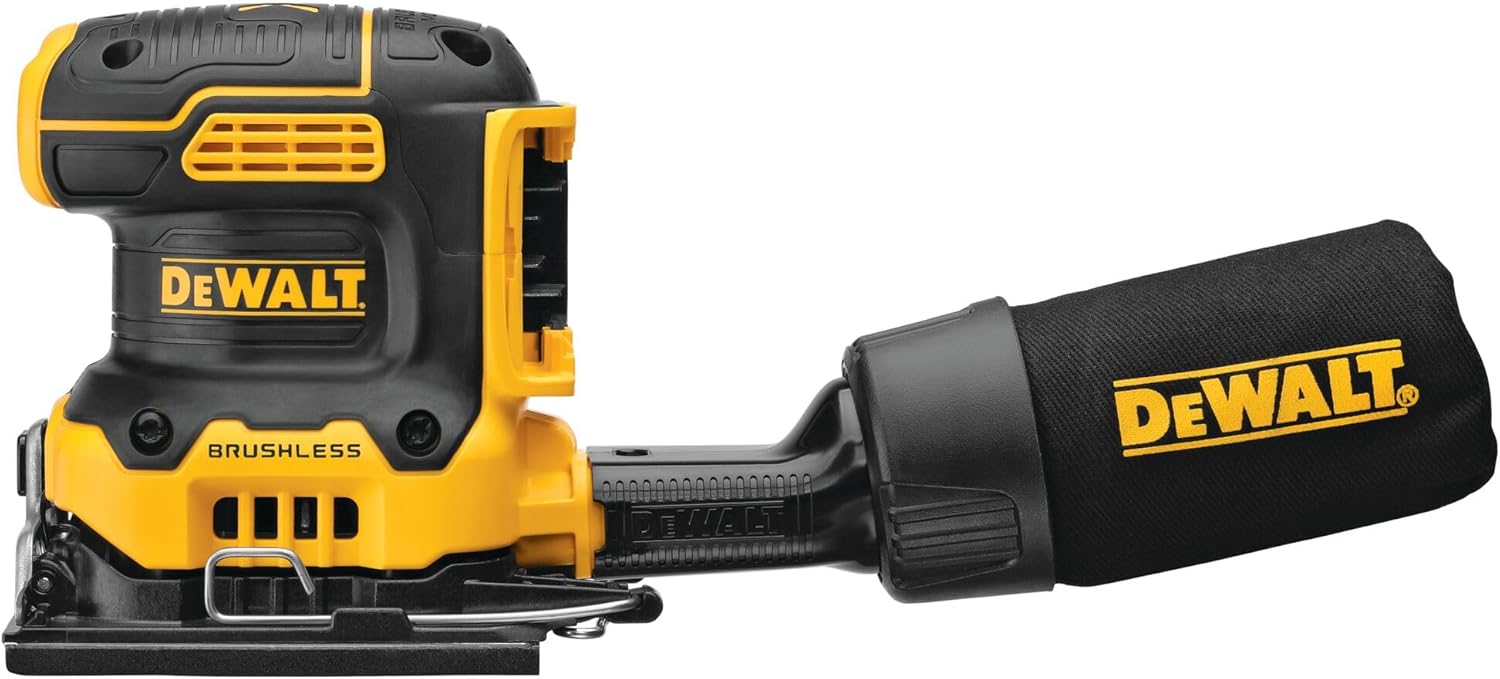
Best Cordless Palm Sander
The DCW200B takes the palm sander off the cord. Its brushless motor runs at a variable 8,000 to 14,000 OPM, so you can slow it down for delicate finishing, and the low-profile body keeps your hand close to the work. It has a paper clamp, a dust-sealed switch and a one-handed locking dust bag. It is sold as a bare tool: you need a DEWALT 20V MAX battery and charger. More battery-powered options are in my cordless sander reviews.
- ✅ Cordless, brushless
- ✅ Variable speed, 8,000-14,000 OPM
- ✅ Low profile for control
- ❌ Battery and charger not included
Best For: Painters and remodelers already on DEWALT 20V batteries.
Festool RTS 400 REQ-Plus Finish Sander
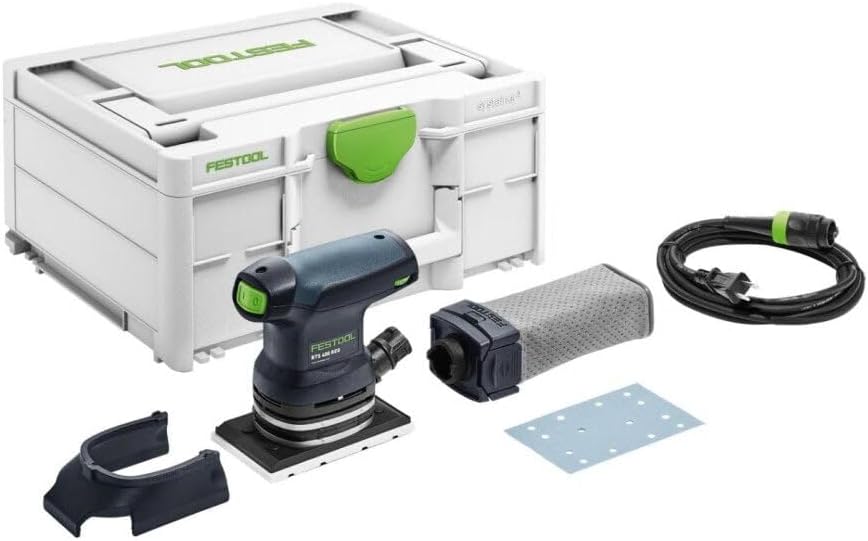
Best Premium Palm Sander
The Festool RTS 400 is a rectangular-pad finish sander for people who sand every day. Its 250 W motor with MMC electronics is, per Festool, a 25% increase over the previous version, the grip has rubberized textured surfaces, and the interlocking dust port locks onto Festool’s current CT hose connector, so it is designed to run on an extractor. Festool backs it with a 3-year warranty.
- ✅ Built for all-day finishing on an extractor
- ✅ Interlocking dust port
- ✅ 3-year warranty
- ❌ Premium price tier
Best For: Professional finishers and cabinetmakers with a dust extractor.
The Best Orbital Sanders to Buy
All three are 5″ random orbital sanders small enough to hold in one hand.
Bosch ROS10 5″ Palm Random Orbit Sander

Best “Palm” Random Orbital
The Bosch ROS10 is the answer to “palm sander or orbital sander?” in one tool: a palm-grip body with a 5″ random orbit pad. The 2.5 A motor runs at 12,000 OPM (single speed), a pad dampening braking system is designed to prevent swirl marks when you set it down, and the microcellular backing pad helps with fine finishes. Discs attach with hook-and-loop.
- ✅ True palm grip with a round pad
- ✅ Pad braking against swirl marks
- ❌ Single speed
Best For: Anyone who likes the one-handed feel of a palm sander but wants random orbital results.
DEWALT DWE6421K 5″ Random Orbital Sander
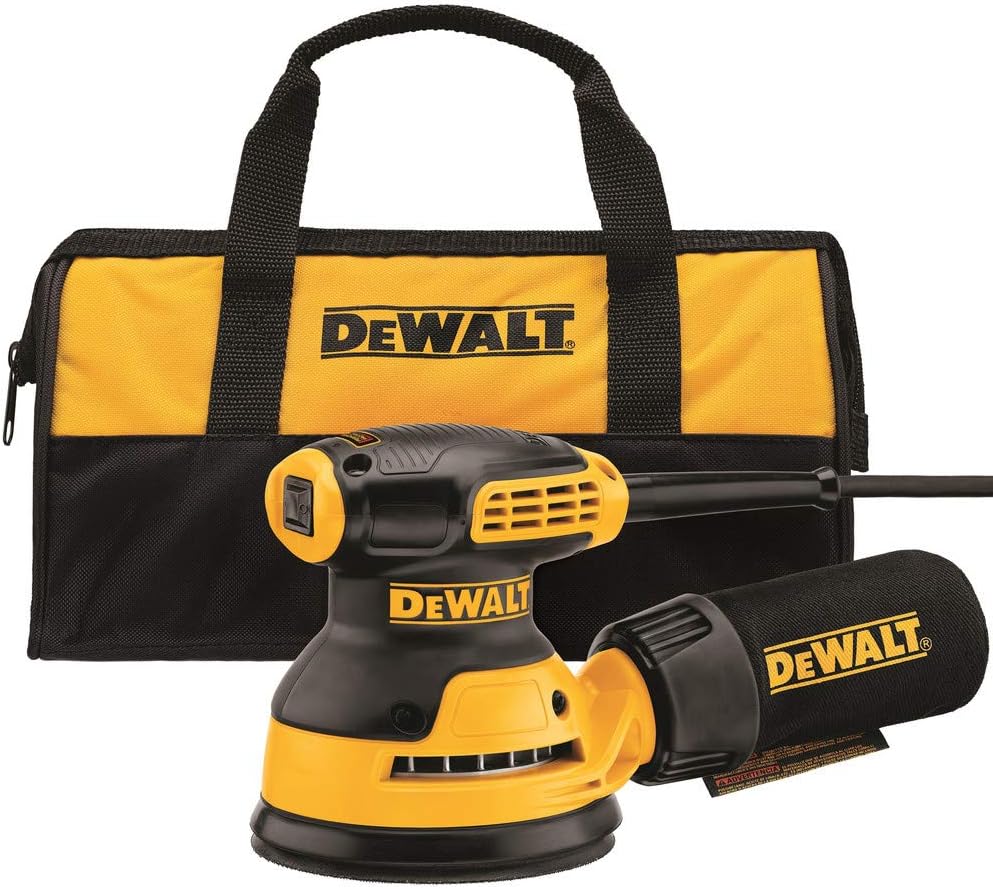
Best Orbital Sander for Most People
The DWE6421K has a 3 A motor at 12,000 OPM in a shorter body that puts your hand closer to the work. A separate counterweight reduces vibration, rubber overmold covers the grip areas, and the dust-sealed switch keeps sanding dust out. The one-handed locking dust bag comes off easily, and the port fits DEWALT’s DWV010 and DWV012 extractors directly (other 1-1/4″ hoses need DEWALT’s DWV9000 connector).
- ✅ 3 A, low body for control
- ✅ Counterweight against vibration
- ✅ Dust-sealed switch, locking dust bag
- ❌ Single speed
Best For: A first sander for woodworking and furniture.
SKIL SR211601 5″ Random Orbital Sander

Best Budget Orbital Sander
The SKIL SR211601 brings variable speed to the lowest price tier: a 2.8 A motor at up to 13,000 OPM, a counterweight to reduce hand fatigue and a compact body for tight spaces. Its cyclonic “X-flow” dust box is see-through, so you can tell when to empty it, and the on/off switch is dust-sealed.
- ✅ Variable speed at the lowest tier
- ✅ Clear cyclonic dust box
- ❌ Budget build, fewer refinements
Best For: Occasional DIY sanding on a tight budget.
Other Comparisons
- Removing a lot of wood or old finish fast? See belt sander vs orbital sander.
- Corners tighter than a square pad? See detail sander vs orbital sander.
🏆 The Verdict
If you’re choosing one sander for woodworking, choose the orbital (random orbital): it’s faster and leaves a less visible scratch pattern. The DEWALT DWE6421K is a great first one. If your work is mostly paint prep, drywall patches, cabinets and corners, choose a square palm sander like the BLACK+DECKER BDEQS300. And if you want both in feel, the Bosch ROS10 is a palm-grip random orbital.
❓ Frequently Asked Questions
What are the downsides of using an orbital sander?+
What is the best palm sander?+
What sanders do professional painters use?+
What is a palm sander good for?+
Is a palm sander or an orbital sander better for drywall?+
Is a palm sander or an orbital sander better for woodworking?+
Still deciding? Tell me what you’re sanding in the comments and I’ll point you to the right tool.

