


As an Amazon Associate I earn from qualifying purchases. All claims are strictly my personal opinion.
Editor’s Choice
Short on time? Of the 6 sanders I tested for removing paint, this is the one I'd buy.
- Also recommended Makita 9903 3″ x 21″ Belt Sander
- Budget pick WEN HB321V

The best sander for paint removal depends on the surface. On flat boards, doors laid flat, tabletops and deck planks, a 3″ x 21″ belt sander strips paint fastest. On curves, furniture and anything you plan to repaint straight away, a dual-mode random orbital sander is the safer all-rounder.
My overall pick is the Bosch GET65-5N, because its Turbo mode gets close to belt-sander speed without the directional scratches. If your job is mostly flat and you searched for a belt sander, the Makita 9903 is the belt sander I recommend first. Below you’ll find the comparison table, short reviews of every pick, when to use a belt sander and when not to, and the lead-paint check you need to do before any of it.
⚡ Quick Pick
Best overall for paint removal: the Bosch GET65-5N Dual-Mode Random Orbit Sander. Turbo mode strips, random-orbit mode finishes, one tool.
Best belt sander for paint removal: the Makita 9903 3″ x 21″ Belt Sander. 8.8 A, variable speed and a nose that sands flush to a wall.
Best budget belt sander: the WEN HB321V. Variable speed and a 3″ x 21″ belt at the lowest price tier.
For narrow edges and tight spots: the Makita 9031 belt file. A 1-1/8″ belt that reaches where a wide belt can’t.

Best Sanders for Paint Removal: Comparison
Six electric sanders that strip paint well, side by side. Speeds and amps come from each manufacturer’s listing; price tiers run from $ (entry level) to $$$$ (professional).
| Product | ⭐ Bosch GET65-5N 🏆 EDITOR’S CHOICE |
Makita 9903 | Metabo HPT SB8V2 | CRAFTSMAN CMEW213 | WEN HB321V | Makita 9031 |
|---|---|---|---|---|---|---|
| Image | 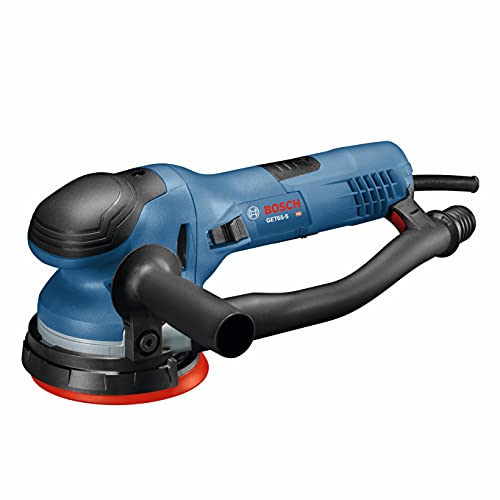 |
 |
 |
 |
 |
 |
| Price | $$$$ | $$$$ | $$$ | $$ | $ | $$$ |
| Type | Dual-mode random orbital | Belt sander | Belt sander | Belt sander | Belt sander | Belt file |
| Motor | 6.5 A | 8.8 A | 9 A | 7 A | 7.5 A | 5 A |
| Pad / Belt | 5″ multi-hole pad | 3″ x 21″ | 3″ x 21″ | 3″ x 21″ | 3″ x 21″ | 1-1/8″ x 21″ |
| Speed | 3,300-7,300 OPM | 690-1,440 ft/min | Variable (dial) | Up to 800 ft/min | 620-1,200 ft/min | 656-3,280 ft/min |
| Variable Speed | ✅ | ✅ | ✅ | ❌ | ✅ | ✅ |
| Dust Collection | Vacuum port (hose adapter included) | ✅ Dust bag | ✅ Side-mounted bag | ✅ Dust bag | ✅ Bag + 1-1/4″ port | Port only, no bag |
| Best For | All-round stripping, curves, furniture | Large flat surfaces, up to a wall | Heavy stripping, long sessions | Occasional flat jobs | Budget variable speed | Edges, slots, tight spots |
| Availability | Shop Now | Shop Now | Shop Now | Shop Now | Shop Now | Shop Now |
⭐ Bosch GET65-5N
🏆 EDITOR’S CHOICE
- Price
- $$$$
- Type
- Dual-mode random orbital
- Motor
- 6.5 A
- Pad / Belt
- 5″ multi-hole pad
- Speed
- 3,300-7,300 OPM
- Variable Speed
- ✅
- Dust Collection
- Vacuum port (hose adapter included)
- Best For
- All-round stripping, curves, furniture
Makita 9903
- Price
- $$$$
- Type
- Belt sander
- Motor
- 8.8 A
- Pad / Belt
- 3″ x 21″
- Speed
- 690-1,440 ft/min
- Variable Speed
- ✅
- Dust Collection
- ✅ Dust bag
- Best For
- Large flat surfaces, up to a wall
Metabo HPT SB8V2
- Price
- $$$
- Type
- Belt sander
- Motor
- 9 A
- Pad / Belt
- 3″ x 21″
- Speed
- Variable (dial)
- Variable Speed
- ✅
- Dust Collection
- ✅ Side-mounted bag
- Best For
- Heavy stripping, long sessions
CRAFTSMAN CMEW213
- Price
- $$
- Type
- Belt sander
- Motor
- 7 A
- Pad / Belt
- 3″ x 21″
- Speed
- Up to 800 ft/min
- Variable Speed
- ❌
- Dust Collection
- ✅ Dust bag
- Best For
- Occasional flat jobs
WEN HB321V
- Price
- $
- Type
- Belt sander
- Motor
- 7.5 A
- Pad / Belt
- 3″ x 21″
- Speed
- 620-1,200 ft/min
- Variable Speed
- ✅
- Dust Collection
- ✅ Bag + 1-1/4″ port
- Best For
- Budget variable speed
Makita 9031
- Price
- $$$
- Type
- Belt file
- Motor
- 5 A
- Pad / Belt
- 1-1/8″ x 21″
- Speed
- 656-3,280 ft/min
- Variable Speed
- ✅
- Dust Collection
- Port only, no bag
- Best For
- Edges, slots, tight spots
⚡ Key Takeaways
- A belt sander is the fastest way to strip paint from flat wood, but it leaves straight scratches and can gouge. Always finish with an orbital sander.
- A dual-mode random orbital like the Bosch GET65-5N is the safer single tool if you strip furniture, doors and anything curved.
- Variable speed matters more for paint than for bare wood: slow the belt down and the paint heats and gums up the abrasive less.
- Never belt-sand drywall or plaster walls. Use an orbital sander, a pole sander or a scraper there.
- If the paint could be from before 1978, test it for lead before any sanding at all.
Best Belt Sanders for Paint Removal
A belt sander runs a continuous abrasive loop in one direction, so every inch of the belt is cutting at the same speed. On a flat painted board that makes it faster than any orbital sander of the same power. The trade-off is control: it cuts in straight lines, it follows the board rather than the curve, and it will dig a trench if you stop moving. These five cover every budget, from a first belt sander to a professional one.
Makita 9903 3″ x 21″ Belt Sander
Best Belt Sander for Paint Removal
When the job is a large flat painted surface (a workbench top, exterior boards, deck planks, a door laid across sawhorses), the Makita 9903 is the one I reach for. Its 8.8 A motor drives a 3″ wide belt at 690 to 1,440 ft/min, and the speed dial is what makes it a good paint tool rather than just a fast one. Old paint softens with friction heat and smears onto the belt; turning the speed down keeps the abrasive cutting instead of loading up.
Two details matter on painted work. The auto-tracking belt system keeps the belt centered without fiddling with a tracking knob, and the nose and side are designed to sand flush to a wall, so you can strip a board right up to trim or an adjacent surface. Makita lists the tool at 9.5 lbs, which is heavy enough to do the cutting for you: you guide it, you don’t push it.
- ✅ 8.8 A motor, 690-1,440 ft/min variable speed
- ✅ Auto-tracking belt, no adjustment needed
- ✅ Sands flush to a wall with the nose and side
- ✅ Dust bag included
- ❌ 9.5 lbs is tiring on vertical surfaces
- ❌ Top price tier for a 3″ x 21″ belt sander
Best For: Stripping paint from large flat wood surfaces quickly, including boards that meet a wall or trim.
Metabo HPT SB8V2 3″ x 21″ Belt Sander
Most Powerful Belt Sander for Heavy Stripping
The Metabo HPT SB8V2 (the tool line formerly sold as Hitachi) has the biggest motor in this group: 9 A and 1,020 W, with a variable-speed dial at the base of the handle. That extra power is what you want on thick, layered paint over a large area, where a smaller motor slows down every time you meet a heavy patch.
Two design choices suit paint work. The clear front cover lets you see exactly where the belt meets the edge of the board, and the dust bag sits on the left side, which keeps it out of the way when you sand into a corner. It also carries a 5-year limited warranty, the longest of any tool on this page.
- ✅ 9 A, 1,020 W motor, the most power here
- ✅ Variable speed dial
- ✅ Clear front cover for sighting edges
- ✅ 5-year limited warranty
- ❌ Metabo HPT does not state the belt speed range on the listing
- ❌ Heavy for overhead or vertical work
Best For: Big stripping jobs with many coats of paint, where motor power and a long warranty matter more than weight.
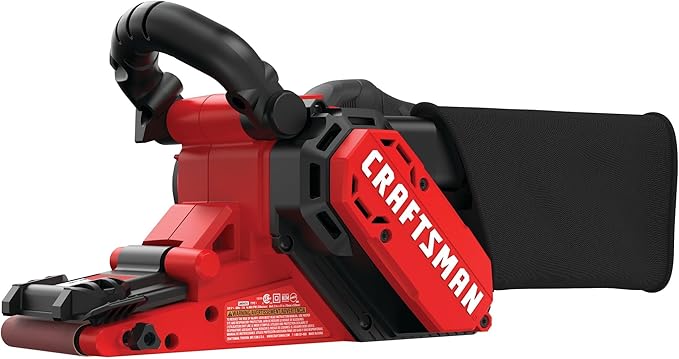
CRAFTSMAN CMEW213 3″ x 21″ Belt Sander
Best Mid-Price Belt Sander for Occasional Paint Jobs
The CRAFTSMAN CMEW213 is a straightforward 7 A, 3″ x 21″ belt sander with a maximum belt speed of 800 ft/min and no speed dial. That lower top speed is not a bad thing on paint: it generates less heat than a fast belt, so paint is less likely to melt and glaze the abrasive. The price for that is slower stock removal on bare hardwood.
Its angled belt design lets you sand closer to an adjoining surface, belt changes are tool-free, and the three-position over-molded handle helps on long passes. CRAFTSMAN lists it at 6.6 lbs, noticeably lighter than the two professional belt sanders above.
- ✅ Angled belt design sands close to adjoining surfaces
- ✅ Tool-free belt changes
- ✅ 6.6 lbs, easier on vertical work
- ❌ Single speed, 800 ft/min maximum
- ❌ Less motor than the Makita or Metabo HPT
Best For: Homeowners who strip paint a few times a year and want a brand-name belt sander without paying for professional power.
WEN HB321V 3″ x 21″ Variable Speed Belt Sander
Best Budget Belt Sander for Paint Removal
The WEN HB321V is the cheapest way into a variable-speed belt sander. Its 7.5 A motor runs the belt from 620 to 1,200 ft/min, and that low end of the range is useful on paint for the same reason as above: slow, cool passes keep the belt from clogging.
WEN lists it at 6.4 lbs, with a lock-on switch for long passes, a quick-release tension lever for belt changes, a detachable dust bag plus a 1-1/4″ dust port for a shop vac, and a two-year warranty. For one door, one table or one small deck, it is hard to justify spending more.
- ✅ Variable speed, 620-1,200 ft/min
- ✅ Lowest price tier on this page
- ✅ 6.4 lbs with a lock-on switch
- ✅ Dust bag and a 1-1/4″ vacuum port
- ❌ Budget build: expect less refinement than Makita or Metabo HPT
Best For: A one-off stripping project on a tight budget, or a first belt sander you want variable speed on.
Makita 9031 1-1/8″ x 21″ Belt Sander
Best for Paint in Tight Spots and Narrow Edges
The Makita 9031 is a belt file: a narrow 1-1/8″ belt on an exposed front pulley, driven by a 5 A motor with a variable-speed dial from 656 to 3,280 ft/min. It is not for flat panels. It is for the places a 3″ belt can’t reach: the inside edge of a window sash, slots, the gap between balusters, the edge of a shelf still fixed to a wall.
At the top of its speed range this tool cuts very quickly, so on paint start low and raise it only if the belt is not loading up. Makita lists it at 4.6 lbs and it ships with 10 abrasive belts. Note that it has no dust bag: it connects to a dust collector or shop vac, and on paint you should always run it that way.
- ✅ Narrow belt and exposed pulley reach into tight areas
- ✅ Variable speed, 656-3,280 ft/min
- ✅ 4.6 lbs, 10 belts included
- ❌ No dust bag, needs a vacuum
- ❌ Too narrow for flat panels
Best For: Stripping paint from edges, slots and narrow parts that a standard belt sander can’t reach.
Best Orbital Sander for Paint Removal
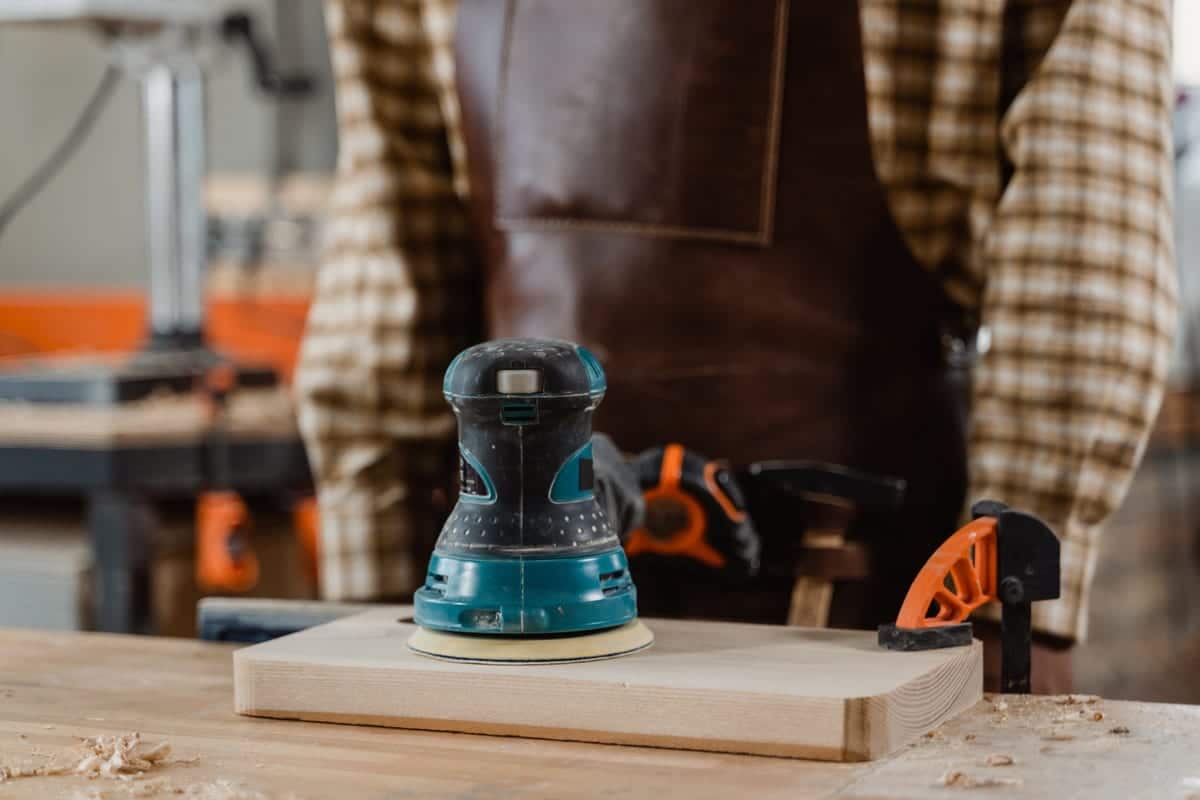
A random orbital sander spins and oscillates at the same time, so the scratches don’t line up in one direction. That makes it slower than a belt sander on flat stock, but it follows curves, it won’t gouge, and the surface it leaves is ready for primer. For most people stripping furniture, doors and trim, this is the tool that finishes the job.
Bosch GET65-5N Dual-Mode Random Orbit Sander
Best Overall Sander for Paint Removal
This is my top pick for paint removal. The Bosch GET65-5N has two modes: a normal random-orbit mode for stock removal and fine finishing, and a Turbo mode with direct-drive eccentric rotation that Bosch rates at 3x the stock removal of its standard mode. In Turbo it behaves like a much more aggressive sander; switch back and the same tool leaves a swirl-free surface.
The 6.5 A variable-speed motor runs from 3,300 to 7,300 OPM in random-orbit mode (290 to 640 RPM in Turbo), and the multi-hole pad takes most 5″ hook-and-loop discs. One thing to plan for: its dust collection is passive and needs a vacuum. The kit includes a vacuum hose adapter, and on paint you should use it every time.
- ✅ Turbo mode rated at 3x standard stock removal
- ✅ 6.5 A, 3,300-7,300 OPM variable speed
- ✅ Multi-hole pad takes a wide range of 5″ discs
- ✅ Follows curves and leaves a primer-ready surface
- ❌ No onboard dust bag, needs a shop vac
- ❌ Top price tier; 5.3 lbs is heavy for a 5″ sander
💡 Pro Tip
Strip in Turbo mode with 40 or 60 grit, then switch to random-orbit mode for 80, 120 and 180. You change discs, not tools, and the last passes erase the Turbo scratch pattern.
Best For: Anyone who wants one sander that strips paint and then leaves a surface ready for primer, especially on furniture, doors and curved parts.
For Trim, Window Frames and Moldings
Neither a belt sander nor a 5″ orbital gets into the corners of a window frame or the profile of a molding. For those, pair either tool with a small detail sander such as the BLACK+DECKER BDEMS600, a 1.2 A, 16,000 OPM mouse sander with a pointed pad and a detail finger attachment. It is slow on paint, so scrape first and use it for cleanup. For more options, see my guide to the best detail sanders.
Sanders for Car Paint Removal
Car panels are thin sheet metal, and the tools above are wrong for them: a belt sander will cut through to bare metal and flatten body lines in seconds. Body shops strip and feather paint with random orbital sanders, and most of them run on compressed air. Air sanders are light and keep their speed under load, but they need a compressor that can supply enough air continuously, which is a bigger purchase than the sander itself. If body work is your main job, my guide to the best sander for auto body work compares electric and air sanders for panels, filler and primer.
Dynabrade 56815 Dynorbital Supreme (5″)

Best 5″ Air Sander for Car Panels
The Dynabrade 56815 is a 5″ pneumatic random orbital with a 3/16″ (5 mm) orbit and a 0.28 hp air motor rated up to 12,000 RPM. The smaller pad follows door skins, quarter panels and tighter curves better than a 6″ pad. This version is the non-vacuum model, so plan on a mask and good ventilation, or a vacuum conversion.
- ✅ 5″ pad follows curved panels
- ✅ 3/16″ orbit for a swirl-free finish
- ❌ Needs a compressor
- ❌ Non-vacuum version
Dynabrade 56830 Dynorbital Supreme (6″)

Best 6″ Air Sander for Hoods, Roofs and Doors
The Dynabrade 56830 is the 6″ version, with the same 3/16″ orbit and 0.28 hp motor, plus a 1″ vacuum port for a central vacuum system. The bigger pad covers hoods, roofs and door faces faster. If most of your work is large flat panels, choose this one; if it is mostly curves, choose the 5″.
- ✅ 6″ pad for large panels
- ✅ Vacuum port for central extraction
- ❌ Needs a compressor and a vacuum system
Belt Sander or Orbital Sander: Which One for Your Paint Job?
The two tools solve different halves of the same job. Here is how I split it.
Use a Belt Sander When
- The surface is flat and solid wood: tabletops, doors laid flat, shelves, deck boards, exterior siding boards.
- There are several coats of paint and you want most of it gone fast. On really thick buildup, softening it first with a heat gun for thick paint and a scraper saves belts.
- You will follow up with an orbital sander anyway, because the paint is being replaced.
Use a Random Orbital Sander When
- The part is curved, turned or profiled: chair backs, legs, raised panels.
- The wood is veneer or softwood that a belt would gouge.
- You want to go straight from stripping to primer with one tool.
Use Neither When
- The paint may contain lead (see below).
- The surface is drywall or plaster (see the walls section).
- The piece is an antique where the original surface matters. A chemical stripper and a scraper remove paint without removing wood, as I explain in my guide to stripping paint from wood.
⚠️ Important
A belt sander leaves straight scratches that show through new paint. After the belt, run an orbital sander at 120 and then 180 grit across the whole surface before you prime.
How to Remove Paint From Walls
Walls are the one place where the question “which sander” usually has the wrong answer. Drywall paper and plaster are softer than paint, so any aggressive sander goes through the paint and into the wall. For loose or flaking paint, scrape first, then feather the edges with a random orbital sander or a pole sander at 120 grit or finer, connected to a shop vac. For a whole room, a dedicated drywall sander with its own extraction does it faster and cleaner; I compare them in my guide to the best sanders for walls and drywall. Belt sanders don’t belong on walls at all.
Lead Paint: Check Before You Sand
This is the step that matters most and gets skipped most. According to the EPA’s page “Protect Your Family from Sources of Lead”, if your home was built before 1978 it is more likely to have lead-based paint, and dust and chips from that paint are one of the most common sources of lead exposure at home.
The EPA’s guidance for do-it-yourselfers under its Renovation, Repair and Painting program recommends hiring a lead-safe certified contractor for work in a pre-1978 home with lead-based paint. For anyone doing the work themselves, it lists dust-reducing methods: wet-dry sandpaper and misting the surface before sanding, a HEPA vacuum, and a low-temperature heat gun (under 1,100 degrees F) or chemical stripper instead of dry power sanding.
- Test first. Lead test kits are sold at hardware stores; a lab test is more reliable.
- If the test is positive, don’t dry-sand with any of the tools on this page.
- If it is negative, still work with extraction, a well-fitted respirator and the room sealed off. Old paint dust is unpleasant even without lead.
How I Chose These Sanders
Paint removal punishes the wrong tool, so I picked for the job rather than for general sanding.
Speed Control First
Paint heats up and smears onto the abrasive. A tool with a speed dial lets you slow down before that happens, which is why five of the six electric tools in the table have one. The CRAFTSMAN is the exception, and its low 800 ft/min top speed partly makes up for it.
Power for the Stock-Removal Pass
For belt sanders I looked for 7 A or more on 3″ x 21″ belts, the standard size, so replacement belts are cheap and easy to find. For the orbital, I wanted a mode that removes material fast, not just a finishing sander.
Dust Handling You Can Actually Use
Every pick either has a dust bag or a port for a shop vac. On paint I recommend the vacuum every time; a bag catches the coarse dust but lets fine paint dust through.
Brands With Parts and Belts in Stock
Makita, Metabo HPT, CRAFTSMAN, WEN, Bosch and Dynabrade all sell replacement belts, pads and brushes in the US. A cheap no-name sander you can’t get a pad for is a disposable tool.
Every product was checked on its manufacturer’s Amazon listing in September 2026, and the Makita specs were also checked on Makita’s own site. For the wider belt sander range, including benchtop models, see my belt sander reviews; for more random orbitals, see the best random orbital sanders.
Grit Sequence for Stripping Paint
The right grit at each stage is what separates a fast, clean result from a slow, clogged one.
- 40-60 grit: heavy stripping. Several coats, thick buildup. Don’t worry about scratches yet.
- 80 grit: transition. Removes the coarse scratches; the last of the paint should be gone by the end of this stage.
- 120 grit: smoothing. Bare, even wood, and the belt scratches disappear under the orbital.
- 180-220 grit: final prep for primer or paint. If you are repainting, see my guide on how to sand furniture to paint.
When a belt or disc glazes over with paint, change it. A loaded abrasive only rubs and heats the surface, and it is the main reason paint removal feels slow.
🏆 The Verdict
For most paint removal, the Bosch GET65-5N is the best single sander: Turbo mode for stripping, random-orbit mode for the finish, and it follows curves. If your job is large and flat, a belt sander is faster, and the Makita 9903 is the one I recommend, with the Metabo HPT SB8V2 for the heaviest stripping and the WEN HB321V if the budget is tight. Keep the Makita 9031 for edges and slots. Whatever you choose, test for lead first if the paint could be older than 1978.
❓ Frequently Asked Questions
What type of sander is best for removing paint?+
Can I use a belt sander to remove paint?+
What sanders do professional painters use?+
What type of sander should I use to remove paint from walls?+
How do I use an electric sander to remove paint?+
Thanks for reading. If you’re stripping something unusual, like a painted floor or a piece with thick old enamel, tell me about it in the comments and I’ll help you pick the right tool.

A Lot of important information is collected from this blog. Very detailed plenty of useful information here. Good work!
Hi James!
We have wood trim on the exterior of our home. It is looking rough – peeling/cracking finish and the wood is starting to look dark. I am sure we need to sand and re-stain(?) the trim. But I am wondering which sander would be best?
Thanks!
Hey Jen, I’d definitely go with a random orbital sander so both the Bosch 1250 DEVS and the Festool ETS 150 are superb choices – they’re perfect for this type of work, easy to use and deliver excellent results. Hope that helps and good luck with the renovation!
I want to paint an old picket fence, which sander should I use to remove old paint?
I don’t want heavy one as I have very weak wrists.
I was going to sand by hand but dreading doing this!
Hey Carole! If you’ve got weak wrists, a palm sander is definitely the best option – head on over to that section by clicking on the main menu above as I’ve extensively reviewed and compared my top picks on the market. They’re compact, lightweight and get the job done!
Hi James,
We are in the process of renovating our 100 year old home. We want to re stain all of the trim and baseboards in the home. Which sander would you recommend for this job?
Hey Aaron – first of all sorry for the delay on my response, I was completely drowned with work! For that renovation job I’d certainly go with either the Bosch 1250DEVS or the Festool ETS – they’re both random orbital sanders which makes them just perfect for that type of work (versatile, effective, easy to move around). Hope that helps and good luck with your renovation Aaron!
Hi James,
The Hitachi SVHB2 belt sander has been discontinued and the company is now Metabo. When searching for the belt sander u recommended the company redirects to Metabo HPT belt sander. It’s a great price too but I wouldn’t want a product that is inferior to your suggestions. Any thoughts on this?
Thank you!
Hey Amy – the brand name itself changed but the machine stays exactly the same (same design, performance, specifications and so on) with only the dust bag changing logos to reflect the new brand. On top of it all, the price is further reduced, making it a better choice than ever. Hope that helps and have a great day!
Hi James,
I need to re stain the outside of a house that has plywood siding with wood slats. There are area’s of the plywood that have gotten rough looking so was thinking I should sand it before re staining. Will sanding make the plywood smooth again?
Hey Jill, you can (and should) absolutely sand plywood before re-staining it. Before you do though, take a look at the grain and thickness of it – this will give you an idea of how deep and hard you can sand it. In general, I recommend going for a higher grit sandpaper from the start, something like 120 or even 200, to ensure that you get a nice smooth finish without damaging the plywood. Thanks for the great question and best of luck with the renovation!
Hello James,
Your suggestions , is it suitable to remove paint from concrete plaster (cement and sand mix)
Hey David, they absolutely are. The best choices on the list for concrete plaster walls are the Bosch 1250DEVS and the Festool ETS 150/3 – any of these will be perfect to deal with that surface with ease, giving you excellent results and a tool that’ll last a lifetime.
Do you have a recommended sand for sanding thick paint off of drywall. I know it can easily wreck the drywall. My wife is chemically sensitive to paint and we cannot get a 4 coat job (applied poorly by contractor) to cure. We may never be able to occupy. Have tried everything else.
Hey James, you’re absolutely right – drywall sanding is tricky – but I’ve got you covered with a full article on this subject that you can read here. Hope that helps and thanks for stopping by – be sure to tell me if you need any further guidance, I’ll be here!
What would you recommend to get painted plaster off of dry wall? We just bought a house that has faux bricks that I would like to remove from the walls without having to replace the dry wall. Not sure if the above recommendation still apply. Thanks!
Hey Sharon – the machines above apply just as well to that situation. All of them will easily remove the painted plaster and leave the drywall safe and sound behind, just be sure to use a higher grit after the first pass or simply use a finer grit from the start (it’ll be easier to safely stop before damaging the drywall). Thanks for stopping by and good luck with the renovation!
Hi James, did you test the Festool RAS 115 for paint removal? I’m repainting my cedar shakes and I’ve got it narrowed down to the Bosch and the RAS. My impression is the RAS is faster but is more of a scorched earth approach whereas the Bosch might be more work but leave a better finished surface.
Hi Adam, I don’t own the RAS 115 but I have had the opportunity to try it and it’s an absolutely beautiful machine for hardcore material removal. Those 500 watts of power put into the 4.5″ pad make for an unstoppable combination. As you mentioned though, it’s not the best when it comes to finishing as the pad is a bit small and it doesn’t have random orbital motion – it’s a rotary sander instead. In short, your analysis was absolutely correct – the RAS is unbeatable for focused material removal while the Bosch DEVS manages to still offer vicious power but also allow for excellent finishing capabilities. Hope that helped, they’re both are wonderful choices.
Thanks for stopping by Adam and good luck with the cedar shakes!
I have an orbital sander that I’m hoping to use to remove house paint. I’m assuming there are a few layers on there. What kind of disc would you recommend? Straight sandpaper (x thousands of sheets) or something else?
Hey Dave, as long as you use low grit sandpaper you’ll clear the layers quickly and easily without having to go through endless sheets. While it will depend on the state of the paint, be sure to start with around 50 grit and then, if you’re either getting too close to your desired layer or want to end it with a nice, polished finish (ready to take another coat of paint, a varnish, or whatever it may be) simply move on up to a finer grit like 120 or more. The rougher grits will very quickly remove paint so be careful not to spend too much time or apply too much pressure on the same spot. Hope that helped!
Hey James, this article was really remarkable, especially because I was searching for thoughts on paint removal for so long but couldn’t find a solid article. Yours blew everyone out of the water, thank you so much for the tips and fantastic machine recommendations!
Hello Sarah, thank you for the kind words – I’m just happy I could help. Thanks for the visit!
Hey James, I got both the Makita belt sander and the Bosch ROS as I’m in the middle of a big house renovation. Best purchases I’ve done in my life, you’re the man!
Hey Charlie, good luck with the renovations – with the right tools they can be a lot of fun. Thanks for stopping by!
Quality guide, I decided to get the Festool as I can see it’s very versatile. I want to be able to use it for paint and any other task that comes up. Have a great day James and keep it up!
You’re absolutely right Joseph, not only is it versatile but it’ll last a lifetime too. Thank you and enjoy!