
As an Amazon Associate I earn from qualifying purchases. All claims are strictly my personal opinion.
Best wood glue

Titebond III Ultimate Wood Glue
ANSI Type I water resistance, 8 to 10 minutes of open time and FDA compliance for indirect food contact.

A good wood glue makes a joint stronger than the wood around it, as long as you pick the right glue for the job and clamp it properly. For most woodworking, that means a PVA glue (the yellow and tan glues), and the choice comes down to water resistance and how much working time you need. The best wood glue for most woodworkers is Titebond III Ultimate, because it’s rated for outdoor use, gives you 8 to 10 minutes to assemble and is approved for indirect food contact. Titebond Original is the best for indoor furniture, Titebond II is the fast-setting outdoor glue, and System Three T-88 epoxy is the answer when joints don’t fit tightly.
Below are eight glues for different jobs, from everyday PVA to hide glue, epoxy and CA, a comparison table built from the makers’ data sheets, short reviews, a guide to choosing by job, and how to glue up, clamp and sand the squeeze-out.
Best Wood Glue: Comparison
Water resistance, open time and food-contact status come from the makers’ technical data sheets; where a maker publishes only its Amazon listing, the table says “not listed” or “not stated” instead of guessing. Open time is the time you have between spreading glue and closing the joint, at 70°F. I don’t print prices: wood glue is inexpensive, and the Amazon buttons show the live price.
| Product | ⭐ Titebond III Ultimate 🏆 EDITOR’S CHOICE |
Titebond Original | Titebond II Premium | Gorilla Wood Glue | Elmer’s Wood Glue Max | Titebond Genuine Hide Glue | System Three T-88 | Starbond Medium CA |
|---|---|---|---|---|---|---|---|---|
| Image | |
 |
 |
 |
 |
 |
 |
 |
| Type | Proprietary polymer (PVA family) | Aliphatic resin (yellow PVA) | Cross-linking PVA | PVA (water-based) | PVA (extra-strength) | Protein (hide) glue | Two-part epoxy | Cyanoacrylate (medium) |
| Water resistance | ANSI Type I | Interior only | ANSI Type II | ANSI Type II | Interior and exterior (no class listed) | Interior only | Waterproof | Not stated |
| Open time | 8-10 min | 4-6 min | 3-5 min | Not listed | Not listed | About 10 min | Slow (good properties in 16 h) | Sets in 10-15 s |
| Food contact | FDA, indirect contact | Not stated | FDA, indirect contact | Not stated | Not stated | Not stated | Not stated | Not stated |
| Best for | Outdoor, cutting boards, long glue-ups | Indoor furniture and cabinets | Small outdoor projects | General indoor and outdoor work | Repairs and painted projects | Antiques and fine furniture | Gaps, outdoor, wood to metal | Chips, cracks, knots |
| Availability | Shop Now at Amazon | Shop Now at Amazon | Shop Now at Amazon | Shop Now at Amazon | Shop Now at Amazon | Shop Now at Amazon | Shop Now at Amazon | Shop Now at Amazon |
Best Wood Glues: Reviews
Every pick could be ordered on Amazon when I checked it. Construction adhesives and foaming polyurethane glues are left out on purpose: they’re good at gluing wood to concrete or filling gaps in framing, but they’re messy and weaker than PVA in a well-fitted furniture joint.
Editor's ChoiceWaterproof PVA-type wood glue
Titebond III Ultimate
Titebond III Ultimate Wood Glue
Type I water resistance, 8 to 10 minutes of open time and food-contact compliance: the one bottle to keep.
Shop Now at AmazonSpecs: Titebond
Best for
One glue for indoor, outdoor and cutting-board work.
- ANSI Type I water resistance
- 8 to 10 minutes of open time
- FDA-compliant for indirect food contact
Skip it if
You want the fastest grab for small indoor parts: Titebond Original sets quicker.
- Darker tan glue line than Original
- Slower set when you want speed
Read full review
Best Wood Glue Overall
If you keep one bottle of wood glue in the shop, make it Titebond III. It’s the glue in Titebond’s line that does the most jobs: Franklin rates it as passing ANSI/HPVA Type I water resistance, the stricter of the two standards, and designs it for interior and exterior projects. It also gives you more time: an open assembly time of 8 to 10 minutes and a total assembly time of 20 to 25 minutes at 70°F, roughly double Titebond Original, which matters on a tabletop glue-up with six joints or a cabinet carcass. It can be applied down to 45°F, so it works in a cold garage in spring. Titebond lists a bond strength of 4,000 psi on hard maple, the highest of its PVA glues, and says it’s FDA-compliant for indirect food contact, which is why it’s the usual choice for cutting boards. It cleans up with water while wet and sands well once dry. The limits: it isn’t for continuous submersion, below the waterline or load-bearing structures. Budget price tier.
Interior aliphatic resin glue
Titebond Original
Titebond Original Wood Glue
The classic yellow glue: a fast set and a light glue line for indoor furniture. Keep it out of the weather.
Shop Now at AmazonSpecs: Titebond
Best for
Fast, clean indoor joinery.
- Fast set, short clamp time
- Light glue line
- Sands cleanly
Skip it if
The project lives outdoors or near water: use Titebond II or III.
- Not for exterior or damp use
- Short open time for big glue-ups
Read full review
Best Wood Glue for Indoor Furniture
Titebond Original is the yellow glue most woodworkers learned with, and for indoor furniture, cabinets and boxes it’s still hard to beat. Franklin describes it as an aliphatic resin emulsion with a fast set that shortens clamp time, and lists a bond strength of 3,600 psi on hard maple, stronger than the wood itself in a well-fitted joint. The open assembly time is 4 to 6 minutes (10 to 15 minutes total at 70°F), so it suits small assemblies where you want the joint to grab quickly. It dries to a light, translucent line that’s less visible on pale woods than Titebond III, and it sands easily instead of gumming paper. Titebond is clear about the limit: Original is not intended for exterior use or where moisture is likely, and it needs glue, air and wood above 50°F. Budget price tier.
Water-resistant cross-linking PVA
Titebond II Premium
Titebond II Premium Wood Glue
Exterior-rated with a fast grab: the glue for small outdoor projects, if you can assemble quickly.
Shop Now at AmazonSpecs: Titebond
Best for
Quick outdoor assemblies in warm weather.
- ANSI Type II water resistance
- Fast initial tack
- FDA-compliant for indirect food contact
Skip it if
You need time for a big glue-up: Titebond III gives you twice as long.
- Shortest open time here
- Needs 55°F or warmer
Read full review
Best Fast-Setting Outdoor Wood Glue
Titebond II sits between Original and III. It’s a cross-linking polyvinyl acetate that Titebond says was the first one-part wood glue to pass ANSI Type II water resistance, and it’s designed for exterior use: outdoor furniture, planters, birdhouses and anything that gets rained on now and then. It keeps Original’s quick grab, with an open assembly time of 3 to 5 minutes, the shortest here, and a bond strength of 3,750 psi on hard maple. Like III, it’s FDA-compliant for indirect food contact. The trade-offs: it needs temperatures above 55°F, it isn’t for continuous submersion, and its short open time makes large assemblies stressful. Titebond suggests calling its technical team before gluing oily exotics like teak and ipe. Budget price tier.
Water-resistant PVA
Gorilla Wood Glue
Gorilla Wood Glue
A Type II water-resistant PVA with a 20 to 30 minute clamp time. A solid alternative to Titebond II.
Shop Now at AmazonSpecs: the maker's Amazon listing
Best for
General woodworking with a Type II rating.
- ANSI Type II water resistance
- Natural tan color, no foaming
- Clamp time listed at 20 to 30 minutes
Skip it if
You want published open time and bond data: Titebond lists both.
- Less published technical data
- Not food-contact rated on the listing
Read full review
Best Alternative to Titebond
Gorilla’s wood glue is a water-based PVA, not the foaming polyurethane the brand is famous for, and that’s the first thing to know: it behaves like the yellow glues above, with no expansion and a natural tan glue line. Gorilla says it passes ANSI/HPVA Type II water resistance, so it’s rated for indoor and outdoor use in the same class as Titebond II. It lists 20 to 30 minutes of clamp time and a full cure in 24 hours, and it works on hardwoods, softwoods and wood composites. It’s sandable and paintable and cleans up with water while wet. Gorilla publishes less technical data than Titebond (no open time or bond strength on the listing), which is why it’s the alternative here rather than the pick. Budget price tier.
Interior and exterior PVA
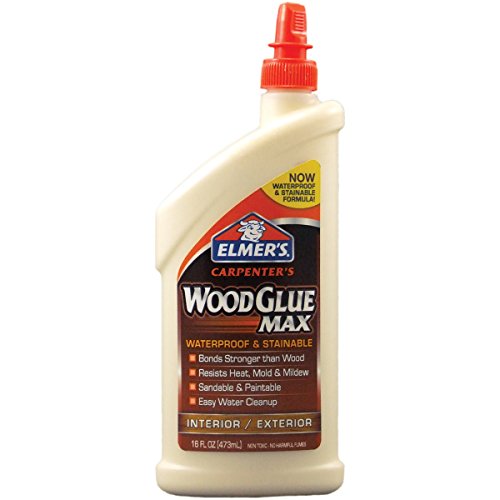
Elmer's Wood Glue Max
Elmer’s E7310 Carpenter’s Wood Glue Max
An everyday interior and exterior wood glue that resists heat and mildew. Fine for repairs and painted work.
Shop Now at AmazonSpecs: the maker's Amazon listing
Best for
Everyday repairs and painted projects.
- Interior and exterior use
- Resists heat, mold and mildew
- Easy to find
Skip it if
You need a published water-resistance rating: choose Titebond II or III.
- No published ANSI class or open time
- Little technical data
Read full review
Best Budget Wood Glue
Elmer’s Carpenter’s Wood Glue Max is the orange-cap bottle in most hardware stores, and it’s a capable everyday glue. Elmer’s describes it as an extra-strength wood adhesive for interior and exterior use that resists heat, mold and mildew. It’s non-toxic, cleans up with water and is sandable and paintable once dry. It’s a good fit for household repairs, shop jigs, birdhouses and painted projects where the glue line won’t show. Elmer’s doesn’t publish a water-resistance class, open time or bond strength on the listing, so for a dining table or outdoor chair that has to last, I’d still pick a Titebond with a published rating. Budget price tier.
Liquid hide glue
Titebond Genuine Hide Glue
Titebond Genuine Hide Glue
Ready-to-use hide glue with a slow set and creep resistance. The glue for antiques and reversible joints.
Shop Now at AmazonSpecs: Titebond
Best for
Furniture repair and joints that may need to come apart.
- Reversible with heat and moisture
- Excellent creep resistance
- Sands well, takes finishes
Skip it if
The piece will see moisture or the outdoors.
- Interior only
- Slow set means longer in clamps
Read full review
Best Glue for Antiques and Fine Furniture
Hide glue is the traditional furniture glue, and Titebond’s version comes ready to use: no heating pot, no mixing. It’s a natural protein solution with a slow set that allows precise assembly, an open assembly time of about 10 minutes and 20 to 30 minutes total at 70°F. Two properties make it special. It has excellent creep resistance, so joints under constant stress don’t slowly slide, and it can be released with heat and moisture, which is why restorers use it on antiques and instrument makers on guitars: the next repairer can take the joint apart without destroying the wood. Titebond also says it sands well and is unaffected by finishes, which helps when you refinish a repaired piece. Titebond lists a bond strength of about 3,591 psi. It’s for interior use only. Budget to mid price tier.
Structural 2-part epoxy
System Three T-88
System Three T-88 Structural Epoxy Adhesive
A structural two-part epoxy that fills gaps and is waterproof. The glue for repairs PVA can't do.
Shop Now at AmazonSpecs: the maker's Amazon listing
Best for
Gap-filling and waterproof repairs.
- Fills gaps, waterproof
- Bonds wood to metal and composites
- Strong in imperfect joints
Skip it if
Your joints fit well and stay indoors: a PVA is faster and cheaper.
- Long cure, about 16 hours at 70°F
- Mixing, gloves and cleanup
Read full review
Best Epoxy for Gaps and Outdoor Wood
PVA glues need tight joints: they don’t fill gaps and they lose strength when a joint is sloppy. When the fit isn’t perfect, or the wood is oily, or the project lives outdoors, a two-part epoxy is the better tool. System Three’s T-88 is a structural two-part epoxy made for wood and marine work, and the maker says it’s waterproof and bonds wood, metal and composites. At 70°F it develops good properties within 16 hours and cures to a clear amber. System Three’s own tip is worth repeating: coat both surfaces and don’t overtighten the clamps, which squeezes out the epoxy and starves the joint. Mix the two parts in equal amounts, and wear gloves. It’s slower and messier than PVA, so it’s the specialist bottle, not the everyday one. Mid price tier.
Cyanoacrylate (super glue)
Starbond Medium CA
Starbond Medium CA Glue Pro Kit
A medium CA glue with microtips that sets in seconds. The bottle for chips, cracks and knots, not joints.
Shop Now at AmazonSpecs: the maker's Amazon listing
Best for
Fast small repairs, cracks and knots.
- Sets in 10 to 15 seconds
- Microtips for hairline cracks
- Works on wood, plastic and metal
Skip it if
You're gluing a joint: use a PVA.
- Not a joinery glue
- Brittle under shock and flexing
Read full review
Best CA Glue for Small Wood Repairs
CA glue (cyanoacrylate, or super glue) isn’t for joinery, but every woodshop needs a bottle. It fixes the small problems: a chip that broke off an edge, a split along a knot, a loose piece of veneer, a crack in a turned bowl, or a jig part you need holding in seconds. Starbond’s medium-viscosity CA sets in 10 to 15 seconds, slow enough to position the part, and the kit includes applicator nozzles, a pin cap and eight precision microtips for getting glue into a hairline crack. Woodturners also use it to stabilize punky spots and fill small voids. Starbond sells it with a shelf-life guarantee for glue stored cold, which matters because CA thickens once opened. Budget price tier.
How I Chose These Wood Glues
I started from the jobs woodworkers actually glue: indoor furniture, outdoor projects, cutting boards, big glue-ups that need time, loose or gappy joints, antique repair and quick fixes. Then I looked at the glues sold on Amazon today from established makers and picked the best for each job. I favored glues whose makers publish real data (open time, water-resistance class and bond strength), which is why Titebond appears four times: Franklin International publishes a full technical data sheet for each of its glues. I don’t show customer ratings or prices. For how I pick products across the site, see how I choose.
Which Wood Glue for Which Job
Indoor Furniture and Cabinets
Any good PVA works. Titebond Original is the classic choice because it grabs fast and leaves a light glue line; Titebond III gives you more time on large assemblies. If the joint fits well, the glue line is stronger than the wood.
Outdoor Projects
Use a glue with a water-resistance rating. The ANSI/HPVA standard has two classes: Type II (water-resistant, like Titebond II and Gorilla Wood Glue) and Type I (the stricter test, like Titebond III). For garden furniture and planters, Type I is the safer choice. Nothing in the PVA family is meant for continuous submersion; for boats and wood that sits in water, use an epoxy like T-88.
Cutting Boards and Food Contact
Titebond II and III are both listed by Titebond as FDA-compliant for indirect food contact, and III adds Type I water resistance for a board that gets washed every day. Let the glue cure fully before you sand and oil the board.
Loose Joints, Gaps and Oily Woods
PVA glue doesn’t fill gaps: a sloppy joint glued with PVA is weak no matter how hard you clamp it. A two-part epoxy like T-88 fills small gaps and bonds better on oily species like teak. Titebond itself recommends contacting its technical team before gluing oily exotics with its PVAs.
Antiques, Chairs and Instruments
Use hide glue. It’s reversible with heat and moisture, so the next repair is possible, and it resists creep in joints under constant load, like chair rungs.
Types of Wood Glue
- PVA (polyvinyl acetate): white and yellow “carpenter’s” glues. Water cleanup, easy to use, strong in tight joints. Titebond Original is an aliphatic resin, a yellow PVA; Titebond II is a cross-linking PVA with water resistance.
- Hide glue: a natural protein glue. Slower, reversible, traditional for furniture and instruments.
- Epoxy: two parts mixed together. Fills gaps, waterproof, bonds wood to other materials. Slower and messier.
- Polyurethane glue: expands as it cures with moisture. Waterproof, but the foam squeeze-out is hard to clean and it’s not a gap filler in a structural sense.
- CA (cyanoacrylate): super glue. Seconds to set, for small repairs and jigs, not joinery.
How to Glue Up Wood
- Dry-fit everything first with clamps on, and lay the clamps out where you’ll need them. Most glue-up disasters happen because a clamp wasn’t ready.
- Check the temperature. PVA needs glue, wood and air above its minimum: 50°F for Titebond Original, 55°F for II, 45°F for III.
- Spread a thin, even coat on both mating surfaces for wide joints, or one surface for small ones. A small roller or an acid brush speeds up long edges.
- Close the joint within the open time and apply clamps. Titebond’s guidance is “enough pressure to bring the joints tightly together”: roughly 100 to 150 psi for softwoods and 175 to 250 psi for hardwoods. A small, even bead of squeeze-out along the joint means you used the right amount of glue.
- Leave it clamped for at least 30 minutes for PVA (Gorilla lists 20 to 30 minutes), and don’t stress the joint for 24 hours. Epoxy and hide glue need longer.
For panels, joint alignment is easier with a biscuit joiner; for face frames and cabinet boxes, pocket screws clamp the joint while the glue dries. My guide to clamps for woodworking covers which clamps each glue-up needs.
Sanding Squeeze-Out and Glue Lines
Dried PVA is a finishing problem more than a strength problem: wherever it sits on the surface, stain won’t soak in and you get a pale blotch. There are two ways to deal with it. Let the squeeze-out set to a rubbery gel (about 20 to 30 minutes) and pare it off with a chisel or scraper, or let it dry completely and scrape, then sand. Avoid wiping wet glue with a soaked rag, which thins it and pushes it into the grain. After scraping, sand the joint flush with a random orbital sander, starting at 120 grit across a panel joint and finishing at your final grit; my grit guide has the sequence. Wipe the surface with mineral spirits before staining: any remaining glue shows up as a light patch.
💡 Pro Tip: Glue Doesn’t Fix a Bad Fit
The strength of a PVA joint comes from wood fibers bonded face to face. Plane or joint edges so they meet along their full length with light clamp pressure. If you need heavy clamping to close a gap, the joint will be under stress forever; re-cut it, or switch to an epoxy.
🏆 The Verdict
The best wood glue for most woodworkers is Titebond III Ultimate: Type I water resistance, a longer open time and indirect food contact in one bottle. Titebond Original is the fast indoor glue, Titebond II the quick outdoor one, and Gorilla Wood Glue and Elmer’s Wood Glue Max are solid alternatives. For special jobs, keep Titebond Genuine Hide Glue for antiques, System Three T-88 for gaps and wet conditions, and Starbond CA for quick repairs.
❓ Frequently Asked Questions
What is the strongest glue for wood?+
What is better, Titebond or Gorilla Glue?+
Which glue is best for wood?+
What type of glue is best for wood?+
What is the best wood glue for outdoor use?+
How long should wood glue be clamped?+
Conclusion
Choose wood glue by where the project will live and how much time the glue-up needs. Titebond III covers the most ground, Titebond Original is the fast indoor glue, and epoxy, hide glue and CA handle the jobs PVA can’t. Dry-fit, clamp evenly, and deal with squeeze-out before it reaches your finish. Questions about a glue-up? Ask in the comments.
