


As an Amazon Associate I earn from qualifying purchases. All claims are strictly my personal opinion.

There are more types of sanders than most people expect, and the names overlap: a palm sander can be a sheet sander or a random orbital, and “finishing sander” means different things on different boxes. This guide sorts the types of sanders by what each one actually does to the surface, so you can match the tool to the job instead of the label. If you would rather skip ahead, the finder below asks six questions and tells you which sander you need, why, and which model we would look at first. Every pick links to our full review before it links to a store.
The short version
- Your first sander: a 5-inch random orbital. It strips, smooths and finishes almost any flat surface.
- Heavy removal on big, flat surfaces: a belt sander.
- Corners, trim and tight spots: a detail (mouse) sander.
- Curves and cutouts: an oscillating spindle sander. Flattening boards: a drum sander.
- Walls: a drywall sander, or just a sanding sponge for patches. Car body: a dual-action (DA) sander.
Jump to: the sander finder · handheld sanders · stationary sanders · conclusion · FAQ
Find Your Sander: 6 Questions
Pick an answer in each group. The result updates as you go and appears under the questions once the first four are answered; the last two are optional. The finder only recommends tools we have reviewed, and when nothing on our review pages fits your answers, it says so instead of guessing.
Sander finder
0 of 6 answered
Your sander appears here
Answer the first four questions. We match your surface and job to a type of sander, then sort the models from our reviews by your batteries, dust and budget.
The Types of Sanders at a Glance
Sanders split into two families. Handheld sanders move over the work, so they suit anything already installed or too big to carry: decks, floors, doors, walls, furniture. Stationary sanders stay put and you bring the work to them, which gives you control over edges, curves and thickness that no handheld tool can match.
| Type | How it moves | Best for |
|---|---|---|
| Random orbital | Round pad spins and orbits at the same time | Stripping, smoothing and finishing flat surfaces; the best all-rounder |
| Sheet (finishing) | Rectangular pad vibrates in tiny orbits | Final smoothing, square inside corners, flat panels |
| Palm | One-hand body, either quarter-sheet or 5-inch orbital | Small projects, furniture, overhead work |
| Detail (mouse) | Pointed pad oscillates | Corners, trim, carvings, louvers |
| Belt | Abrasive loop runs in one direction | Fast removal on large flat surfaces |
| Disc (rotary) | Disc spins on a fixed center | Aggressive stripping, metal, rough shaping |
| Dual-action (DA) | Random orbit built for body work, electric or air | Feathering filler and primer on cars |
| Drywall | Round head on a long pole, usually vacuum-fed | Joint compound on walls and ceilings |
| Multi-tool pad | Triangle pad on an oscillating head | Occasional sanding in tight spots |
| Benchtop belt and disc | Stationary belt plus disc, each with a table | Small parts, outside curves, squaring ends |
| Spindle | Drum spins and moves up and down | Inside curves and cutouts |
| Drum | Wide drum over a feed belt | Flattening and thicknessing boards |
| Edge | Long horizontal belt beside a table | Long straight edges and faces |
| Floor (rental) | Walk-behind drum or orbital, plus an edger | Refinishing a whole floor |
Handheld Power Sanders
Handheld sanders differ in two ways that matter: the shape of the pad, which decides where it can reach, and the motion, which decides how fast it cuts and what kind of scratch it leaves behind. A tool that cuts fast leaves deeper, more visible scratches, so most projects use two types in sequence: an aggressive one to remove material and a gentle one to finish.
In the overview under each type, the removal and finish dots compare the types with one another on a 1 to 5 scale. They are our relative reading of how each tool cuts, not lab measurements. Each type also shows the Editor’s Choice from its own review page.
Random Orbital Sander
- Best for
- All-round flat work
- Removal
- 3 of 5
- Finish
- 4 of 5
- Size
- 5 or 6 in round pad
- Power
- Corded or cordless
Choose it if you are buying one sander for general DIY, furniture or finishing. Skip it if your work is mostly corners and profiles, or you need to flatten rough boards.

Our pick
6-inch pad with two sanding modes, plus a dust canister and a vacuum port.
Check price on Amazon: Bosch GET75-6N (opens in a new tab)Read our review of the Bosch GET75-6N
A random orbital sander drives a round, hook-and-loop pad in two motions at once: it spins, and it moves in small offset circles. Because no abrasive grain follows the same path twice, the scratches it leaves are short and scattered rather than lined up, and they disappear under stain far better than the swirls from a plain spinning disc. The common pad sizes are 5 inches and 6 inches, and the discs are sold everywhere.
It is the closest thing to a universal sander. With a coarse disc it strips old finish from a tabletop; with a fine disc it prepares bare wood for oil or paint. What it cannot do is reach into a square inside corner, since the pad is round, and it is slower than a belt sander on very rough stock. Our random orbital sander reviews compare the corded models, and how to use an orbital sander covers technique.
Sheet Sander (Finishing Sander)
- Best for
- Final smoothing, inside corners
- Removal
- 2 of 5
- Finish
- 4 of 5
- Size
- 1/4, 1/3 or 1/2 sheet
- Power
- Corded or cordless
Choose it if you want a smooth final pass on flat work with square corners. Skip it if you need to take off paint or old finish quickly.

Our pick
Half-sheet pad for wide flat panels, with a dust canister and a vacuum port.
Check price on Amazon: Bosch OS50VC (opens in a new tab)Read our review of the Bosch OS50VC
A sheet sander, also sold as an orbital finishing sander, has a flat rectangular pad that vibrates in tiny orbits without rotating. It clamps ordinary sandpaper cut from a standard sheet, and the size names describe how much of the sheet it takes: quarter-sheet, third-sheet or half-sheet. The square pad reaches right into inside corners and sits flat on narrow edges, which a round pad cannot do.
It removes material more slowly than a random orbital, so it is a finishing tool rather than a stripping tool. Quarter-sheet models are small enough for one hand; half-sheet models cover wide panels such as doors and cabinet sides. See our best sheet sanders, and sheet sander vs random orbital sander if you are choosing between the two.
Palm Sander
- Best for
- Small projects, furniture
- Removal
- 2 of 5
- Finish
- 4 of 5
- Size
- 1/4 sheet or 5 in pad
- Power
- Corded or cordless
Choose it if you want one-hand control on furniture and small projects. Skip it if you mostly strip large surfaces.

Our pick
Classic quarter-sheet pad and a dust bag in a one-hand body.
Check price on Amazon: Makita BO4556K (opens in a new tab)Read our review of the Makita BO4556K
“Palm sander” names a body shape, not a mechanism: a compact sander you hold with one hand on top. In practice it covers two tools, the quarter-sheet finishing sander and the 5-inch random orbital, which is why the phrase causes so much confusion in reviews and at the store. Before buying one, check which pad it has, because that decides what it does.
Palm sanders are the right size for furniture, shelving, cabinet doors and anything you sand overhead or on a ladder. Our palm sander picks include both kinds, and palm sander vs orbital sander explains the overlap.
Detail Sander (Mouse Sander)
- Best for
- Corners, trim, carvings
- Removal
- 1 of 5
- Finish
- 3 of 5
- Size
- Small pointed pad
- Power
- Corded or cordless
Choose it if you refinish trim, shutters, stairs or furniture with corners. Skip it if your work is mostly large flat surfaces.
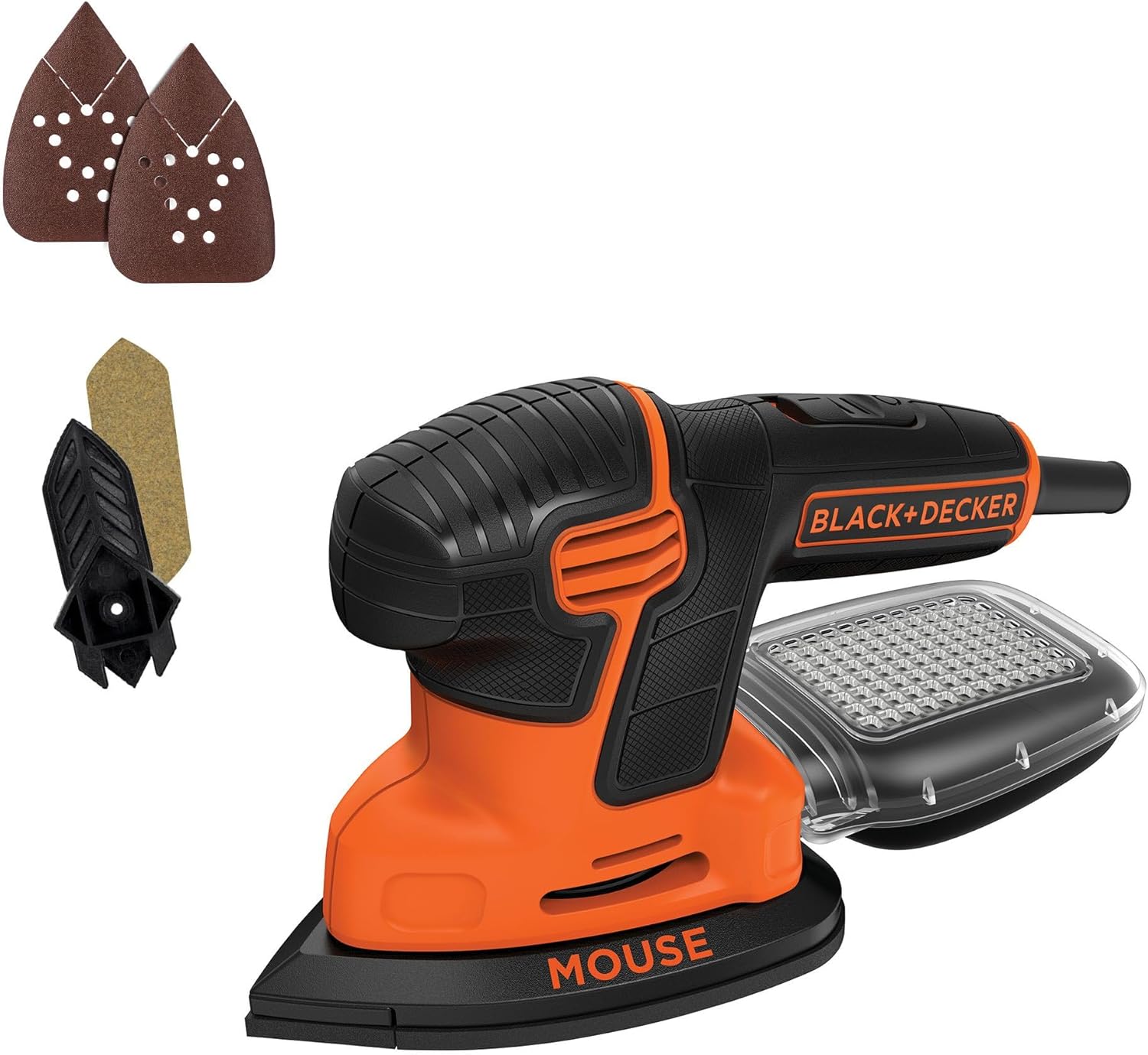
Our pick
Pointed pad plus a detail finger, with its own dust canister, at a budget price.
Check price on Amazon: BLACK+DECKER BDEMS600 Mouse (opens in a new tab)Read our review of the BLACK+DECKER BDEMS600 Mouse
A detail sander has a small, pointed, iron-shaped pad that oscillates. The point pushes into inside corners, along window muntins, between balusters and into the recesses of raised panels. Many models add finger attachments for louvers and slots, and the smallest delta sanders are built for model work and tight joinery.
The small pad that makes it useful also makes it slow, so it is a second sander rather than a first one. Pair it with a random orbital for the open areas. Our best detail sanders cover corded and cordless models, and detail sander vs orbital sander compares the two directly.
Belt Sander
- Best for
- Fast removal on big flat surfaces
- Removal
- 5 of 5
- Finish
- 2 of 5
- Size
- 3 x 21 or 4 x 24 in belt
- Power
- Corded or cordless
Choose it if you face big, flat, rough surfaces or thick coatings. Skip it if you work on veneered furniture or small parts.

Our pick
3 x 21 in belt with variable speed and automatic belt tracking.
Check price on Amazon: Makita 9903 (opens in a new tab)Read our review of the Makita 9903
A belt sander runs a continuous loop of abrasive over two drums, always in one direction. That straight, continuous cut makes it the fastest handheld sander for removing material: leveling glued-up panels, stripping a weathered deck, taking paint off a door. Common handheld belt sizes are 3 by 21 inches and 4 by 24 inches, and the larger belt covers more ground per pass.
The same power is the risk. Parked in one spot or tipped on an edge, a belt sander digs a hollow in seconds, and it will cut straight through veneer. Always move with the grain and follow up with a random orbital to erase the straight scratches. Start with our belt sander reviews, then read how to use a belt sander and belt sander vs orbital sander.
Disc Sander (Rotary Sander)
- Best for
- Stripping, metal, rough shaping
- Removal
- 4 of 5
- Finish
- 1 of 5
- Size
- 5 or 7 in disc
- Power
- Corded
Choose it if you strip paint or work on metal. Skip it if the wood will be stained.

Our pick
7-inch disc with a wide variable speed range.
Check price on Amazon: Makita GV7000C (opens in a new tab)Read our review of the Makita GV7000C
A handheld disc sander spins its abrasive disc on a fixed center, with no orbit. It removes material aggressively and leaves circular scratches, which is fine on metal, on paint you are about to strip away, or on rough shaping, but not on wood you plan to stain. Most woodworkers reach for a random orbital instead; the disc sander earns its place in auto body, metal and heavy paint removal. Our disc sander picks cover the handheld models.
Dual-Action (DA) Sander
- Best for
- Car body filler and primer
- Removal
- 3 of 5
- Finish
- 4 of 5
- Size
- 5 or 6 in round pad
- Power
- Electric or air
Choose it if you do body work on cars. Skip it if you only sand wood; a woodworking random orbital does that job.

Our pick
Electric DA with a 6-inch pad and a 5 mm orbit, so no compressor is needed.
Check price on Amazon: Mirka DEROS 650CV (opens in a new tab)Read our review of the Mirka DEROS 650CV
In a body shop, “DA” means a random orbital sander built for automotive work. The motion is the same as a woodworking random orbital; the tools differ in orbit size, weight and power source. Traditional DAs run on compressed air, which needs a compressor that can keep up, while newer brushless electric models such as the Mirka DEROS plug into the wall. DAs feather filler and primer without the flat spots or grooves a rotary tool leaves. Our best sander for auto body work compares electric and air models.
Drywall Sander
- Best for
- Walls and ceilings
- Removal
- 3 of 5
- Finish
- 3 of 5
- Size
- Round head on a pole
- Power
- Corded or cordless
Choose it if you finish whole rooms of drywall. Skip it if you only have a few patches; use a sanding sponge.

Our pick
Festool Planex LHS 2 225 EQI-Plus
Long-reach wall and ceiling sander built to run with a Festool extractor.
Check price on Amazon: Festool Planex LHS 2 225 EQI-Plus (opens in a new tab)Read our review of the Festool Planex LHS 2 225 EQI-Plus
A drywall sander puts a round sanding head on a long pole, so you can reach from the baseboard to the ceiling without a ladder. Most connect to a vacuum or extractor, and that matters more than the motor, because joint compound dust is extremely fine and travels through the whole house. For a few patches or a single seam, you do not need one: a sanding sponge is quicker to set up and easier to control. Compare the options in our best sanders for walls, and choose paper with what grit to sand drywall.
Oscillating Multi-Tool With a Sanding Pad
- Best for
- Occasional tight spots
- Removal
- 1 of 5
- Finish
- 2 of 5
- Size
- Small triangle pad
- Power
- Corded or cordless
Choose it if you already own one and sand corners now and then. Skip it if sanding is the main job.

Our pick
DEWALT DCS356 Oscillating Tool Kit
Brushless, three speeds, battery and charger included, with a universal accessory adapter.
Check price on Amazon: DEWALT DCS356 Oscillating Tool Kit (opens in a new tab)Read our review of the DEWALT DCS356 Oscillating Tool Kit
An oscillating multi-tool is mainly a cutting and scraping tool, but a triangular sanding pad turns it into a passable detail sander. It is slow on flat areas and the pad is small, so treat it as a bonus, not a replacement. If you already own one, try it on corners before buying a dedicated detail sander. Our oscillating multi-tool picks note which ones take sanding pads well.
Stationary and Benchtop Sanders
Stationary sanders bolt to a bench or stand on the floor. Because the tool stays fixed and a table supports the work, you get square edges, true curves and even thickness that are hard to achieve freehand. They are corded shop machines, and each has a narrow specialty, so buy them for a specific kind of work rather than as a general sander.
Benchtop Belt and Disc Sander
- Best for
- Small parts, outside curves
- Removal
- 4 of 5
- Finish
- 2 of 5
- Size
- Belt plus disc
- Power
- Corded, benchtop
Choose it if you shape and square small parts in a shop. Skip it if your work is installed or too big to carry.

Our pick
6 x 48 in belt and 9 in disc on an open stand.
Check price on Amazon: JET JSG-96OS (opens in a new tab)Read our review of the JET JSG-96OS
This combination machine puts a vertical or tilting belt and a spinning disc on one motor, each with its own table and miter slot. The disc squares and trims end grain and sands outside curves; the belt flattens faces and edges on small parts. It is the stationary sander most home shops buy first. See our belt and disc sander reviews and the wider benchtop sander guide.
Oscillating Spindle Sander
- Best for
- Inside curves and cutouts
- Removal
- 3 of 5
- Finish
- 3 of 5
- Size
- Interchangeable drums
- Power
- Corded, benchtop
Choose it if you cut curves with a band saw, jigsaw or scroll saw. Skip it if your work is flat and straight.
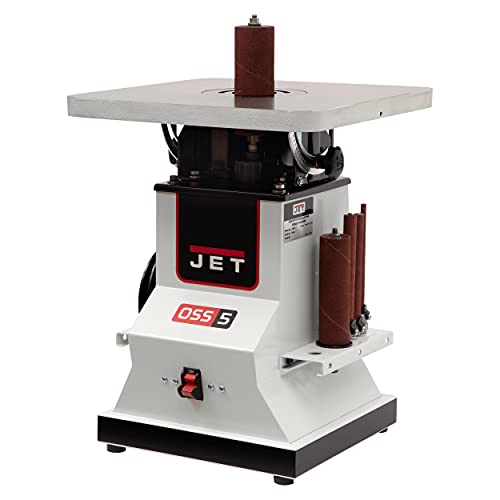
Our pick
Oscillating benchtop spindle sander with a tilting cast iron table.
Check price on Amazon: JET JBOS-5 (opens in a new tab)Read our review of the JET JBOS-5
A spindle sander spins an abrasive sleeve on a vertical drum and moves it up and down at the same time. The oscillation spreads wear along the sleeve and keeps the abrasive from burning the wood, and interchangeable drums let you match the radius of an inside curve. Nothing else sands inside curves, cutouts and scroll work as cleanly. Our spindle sander picks include benchtop and portable models.
Drum Sander
- Best for
- Flattening boards and glue-ups
- Removal
- 4 of 5
- Finish
- 4 of 5
- Size
- 10 to 22 in drum on our list
- Power
- Corded, benchtop or stand
Choose it if you flatten glue-ups and wide boards. Skip it if a planer already covers your thicknessing.

Our pick
Closed-stand drum sander with an LED control panel.
Check price on Amazon: Powermatic PM2244 (opens in a new tab)Read our review of the Powermatic PM2244
A drum sander feeds a board on a conveyor under a spinning abrasive drum, taking a very light cut each pass. It flattens glue-ups and brings wide boards to an even thickness, and it handles figured wood that tears out in a planer. Open-ended models can sand boards wider than the drum by flipping them for a second pass. It is slower than a planer and the abrasive costs more, so many shops use both. Read our drum sander reviews and drum sander vs planer.
Edge Sander
- Best for
- Long straight edges
- Removal
- 4 of 5
- Finish
- 3 of 5
- Size
- 6 in wide long belt
- Power
- Corded, floor-standing
Choose it if you sand many long edges, doors or panels. Skip it if you have a small shop and sand few edges.

Our pick
Oscillating edge sander with a 6 x 89 in belt and a 4 in dust port.
Check price on Amazon: JET OES-80CS (opens in a new tab)Read our review of the JET OES-80CS
An edge sander runs a long belt horizontally beside a table, often with oscillation. You slide long boards, doors and panels along it to sand edges straight and square, and many models add a curved end roller for inside curves. It is a shop machine for furniture and cabinet makers who sand a lot of edges. Our edge sander picks compare the main models.
Floor Sanders: Rent, Don’t Buy
- Best for
- Refinishing a whole floor
- Removal
- 5 of 5
- Finish
- 3 of 5
- Size
- Walk-behind drum or orbital
- Power
- Corded, rental
Choose it if you refinish an entire floor (rent the machine). Skip it if you only sand stair treads or small patches.
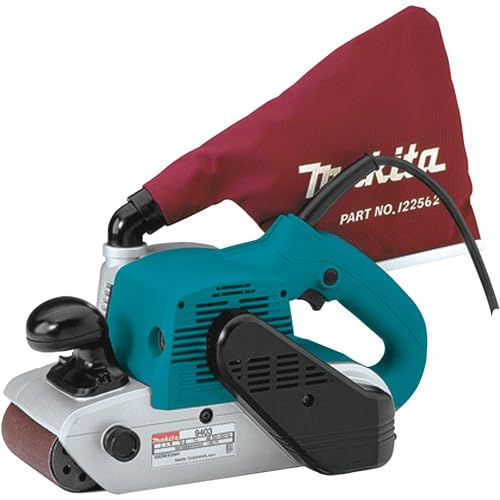
Our pick
Our floors pick for treads and patches: a 4 x 24 in belt with a built-in dust bag.
Check price on Amazon: Makita 9403 (opens in a new tab)Read our review of the Makita 9403
Refinishing a whole floor calls for walk-behind machines most people rent by the day: a drum floor sander, which cuts fast and demands a steady hand, or an orbital floor sander, which is gentler and slower. Both need an edger for the strip along the walls, and a detail sander finishes the corners. For stair treads, thresholds and small patches, handheld tools are enough. Start with how to sand hardwood floors and our best sanders for floors.
How to Choose the Right Type of Sander
Start With the Surface, Then the Job
The surface decides the family and the job decides the type. A deck and a tabletop are both flat wood, but a weathered deck needs removal first, so a belt sander leads; a tabletop needs a flawless finish, so a random orbital leads. Corners and profiles always add a detail sander. Curves point to a spindle sander, and rough boards point to a drum sander or a planer. That logic is exactly what the finder above runs.
Corded or Cordless: Follow Your Batteries
Batteries cost more than most bare sanders, so if you already own a platform, the cheapest good sander is usually the bare tool from that brand. Cordless sanders make sense for decks, trim and site work far from an outlet. For long sessions in the shop, corded tools never run down. Our cordless sander reviews list models by platform. The finder never swaps one brand’s battery tool for another’s and calls it equivalent: batteries do not cross brands.
Pad Size and Sheet Size
Bigger pads cover more area per pass, but they are heavier and harder to steer on small parts. A 5-inch random orbital or quarter-sheet sander suits furniture and trim, while a 6-inch orbital or half-sheet sander pays off on doors, tabletops and floors. Grit matters as much as pad size: work up from coarse to fine without skipping steps, using our grit chart for wood.
Dust Collection Is Not Optional Indoors
Built-in bags catch some dust; a hose to a shop vacuum or extractor catches far more, and it also makes the abrasive cut better because the scratch is not clogged. If you sand inside, choose a sander with a vacuum port, connect it to a shop vac for dust collection or a dust extractor, and add a dust separator so the filter does not choke. Our dustless sander picks are built around this. Wear a respirator rated for fine dust either way.
Old Paint: Test for Lead Before You Sand
Sanding is the worst way to deal with lead paint, because it turns it into fine dust. The US Environmental Protection Agency says homes built before 1978, when lead-based paints were banned, probably contain lead-based paint. It advises repairing small areas of damaged paint without sanding, and says that if you must sand, wet the area first, sand the minimum area needed and clean up thoroughly (EPA: Reduce the Risk of Lead Exposure at Home). Test old paint before you start. For stripping, a chemical paint stripper or a heat gun often removes more with less dust; our sanders for removing paint and how to strip paint from wood explain when each makes sense.
Conclusion: Which Type of Sander Should You Buy?
For most people the first sander should be a 5-inch random orbital: it strips, smooths and finishes nearly every flat surface without the swirl marks of a disc or the gouging risk of a belt. Add a detail sander when corners and trim start to slow you down, and a belt sander only if you regularly face large, rough or painted surfaces. Stationary sanders are specialists, so buy one for the job it does best: a spindle sander for curves, a drum sander for flattening boards, a belt and disc sander for small parts. If you are still unsure, the sander finder at the top of this page matches your project to a type in six questions.
Whichever you choose, the grit sequence matters as much as the tool: see what grit sandpaper for wood. Then compare models in our random orbital sander reviews, best detail sanders and belt sander reviews.
Types of Sanders: Frequently Asked Questions
Real questions people ask about the types of sanders. Tap a question to see the answer.
What type of sander removes the most material?
Among handheld tools, a belt sander. Its abrasive loop cuts in one direction across the whole pad, so it outpaces any orbital. For entire floors, a rented drum floor sander removes more still, and in the shop a drum sander flattens boards. All three punish mistakes, so keep them moving.
What is the best sander for home use?
For most homes, a 5-inch random orbital sander. It strips old finish, smooths new wood and preps surfaces for paint without obvious swirls, and hook-and-loop discs change in seconds. Add a detail sander later if you often work on trim, shutters or furniture with corners.
Which sander is best for beginners?
A random orbital is the most forgiving choice. Its random pattern hides small mistakes, it does not gouge the way a belt sander can, and it works on almost any flat project. A basic corded model with a dust port is enough to learn on; better discs matter more than a pricier tool.
What’s better, an orbital or a palm sander?
The names overlap. Palm sanders come in two kinds: quarter-sheet finishing sanders and 5-inch random orbitals. The random orbital removes material faster and leaves fewer marks, while the quarter-sheet model reaches square into corners and runs on cheap paper cut from full sheets. Check the pad before you buy.
Are sheet sanders or orbital sanders better?
Random orbital sanders are better for most jobs because they remove more material with fewer swirl marks. Sheet sanders win on inside corners, narrow edges and the final pass on flat panels, and they use ordinary sandpaper. Many woodworkers own one of each and switch between them.
Should I get an orbital or detail sander?
Get the orbital first unless most of your work is corners. A detail sander is slow on anything bigger than a drawer front, but its pointed pad reaches into corners, louvers and carvings where an orbital cannot. Most people start with a random orbital and add a detail sander later.
Should I get a 5 or 6 inch orbital sander?
Choose 5-inch for general DIY and furniture: it is lighter, easier to control with one hand and uses the most widely sold discs. A 6-inch pad covers more area per pass, which pays off on large tabletops, doors and floors, but those tools are usually heavier and often need two hands.
What are the downsides of using an orbital sander?
A random orbital cannot reach square inside corners, removes material slower than a belt sander on rough stock, and rounds over edges if you tip it. It throws fine dust, so indoors it needs a vacuum or extractor. Pressing down hard slows the pad and causes the swirl marks it is meant to avoid.
Should I buy an orbital sander or just sand by hand?
Sand by hand for small patches, delicate profiles and light passes between coats of finish. For anything larger than a shelf, an orbital sander saves hours and produces a more even surface, because it keeps the scratch pattern consistent. Most projects end up using both.
