


As an Amazon Associate I earn from qualifying purchases. All claims are strictly my personal opinion.
Editor’s Choice
Short on time? Of the 7 shop vac I tested for dust collection, this is the one I'd buy.
- Also recommended Bosch VAC090AH
- Budget pick RIDGID RT1200 12-Gallon Wet/Dry Vac

If you sand, cut or route indoors, the dust you can see on the bench is the easy part. The fine dust that hangs in the air is what clogs filters, ruins finishes and ends up in your lungs. The best shop vac for dust collection is one that pulls hard through a small tool hose, filters to HEPA level and switches on with your tool. For most woodworkers that means a dedicated dust extractor for the sander and a big wet/dry vac, ideally with a cyclone separator in front of it, for everything else.
Below are my picks by job, a comparison table, short reviews, and a buying guide that explains the three numbers that actually matter: suction, hose size and filtration.
⚡ Quick Pick
For sanders and small power tools, get the DEWALT DWV010 8-Gallon HEPA Dust Extractor: HEPA filtration, a filter that cleans itself every 30 seconds, and a tool-activated outlet.
For drywall and the finest dust, go with the Bosch VAC090AH, which pulses its filter every 15 seconds.
On a tighter budget, the RIDGID RT1200 12-Gallon Wet/Dry Vac paired with a cyclone dust separator covers chips and cleanup well.
Best Shop Vacs for Dust Collection: Comparison
The table lines up the specs that decide how well each machine keeps up with a sander or saw. Where a maker publishes airflow (CFM) or water lift, it is listed; most wet/dry vacs are sold on peak horsepower instead, which is a motor rating, not a suction figure.
| Product | ⭐ DEWALT DWV010 🏆 EDITOR’S CHOICE |
Bosch VAC090AH | Festool CT 15 HEPA | Makita VC4210L | RIDGID RT1200 | CRAFTSMAN CMXEVBE17595 | Vacmaster VBV1210 |
|---|---|---|---|---|---|---|---|
| Image |  |
 |
 |
 |
 |
 |
 |
| Price | $$$$ | $$$$ | $$$$ | $$$$ | $$$ | $$$ | $$$ |
| Type | Dust extractor | Dust extractor | Dust extractor | Dust extractor | Wet/dry vac | Wet/dry vac | Wet/dry vac + blower |
| Capacity | 8 gal | 9 gal | ~4 gal (15 L) | 11 gal | 12 gal | 16 gal | 12 gal |
| Maker’s airflow / power | 150 CFM, 15 A | 150 CFM, 97 in water lift | 130 CFM | 148 CFM, 92 in water lift | 5.0 peak HP | 6.5 peak HP | 106 CFM, 5 peak HP |
| HEPA filter | ✅ | ✅ | ✅ | ✅ | Optional filter | Optional filter | Optional filter |
| Auto filter cleaning | ✅ Every 30 s | ✅ Every 15 s | ✅ AutoClean | ✅ | ❌ | ❌ | ❌ |
| Tool-activated outlet | ✅ | ✅ | ✅ | ✅ | ❌ | ❌ | ❌ |
| Hose | 1-1/4″ x 15 ft, anti-static | See listing | See listing | See listing | 1-7/8″ x 8 ft, locking | 2-1/2″ x 7 ft | 7 ft |
| Best For | Sanders and small tools | Drywall and fine dust | Small shops, portability | Big jobs, HEPA capacity | Small shop on a budget | Chips and big cleanups | Garage shops that also blow |
| Availability | Shop Now | Shop Now | Shop Now | Shop Now | Shop Now | Shop Now | Shop Now |
⭐ DEWALT DWV010
🏆 EDITOR’S CHOICE
- Price
- $$$$
- Type
- Dust extractor
- Capacity
- 8 gal
- Maker’s airflow / power
- 150 CFM, 15 A
- HEPA filter
- ✅
- Auto filter cleaning
- ✅ Every 30 s
- Tool-activated outlet
- ✅
- Hose
- 1-1/4″ x 15 ft, anti-static
- Best For
- Sanders and small tools
Bosch VAC090AH
- Price
- $$$$
- Type
- Dust extractor
- Capacity
- 9 gal
- Maker’s airflow / power
- 150 CFM, 97 in water lift
- HEPA filter
- ✅
- Auto filter cleaning
- ✅ Every 15 s
- Tool-activated outlet
- ✅
- Hose
- See listing
- Best For
- Drywall and fine dust
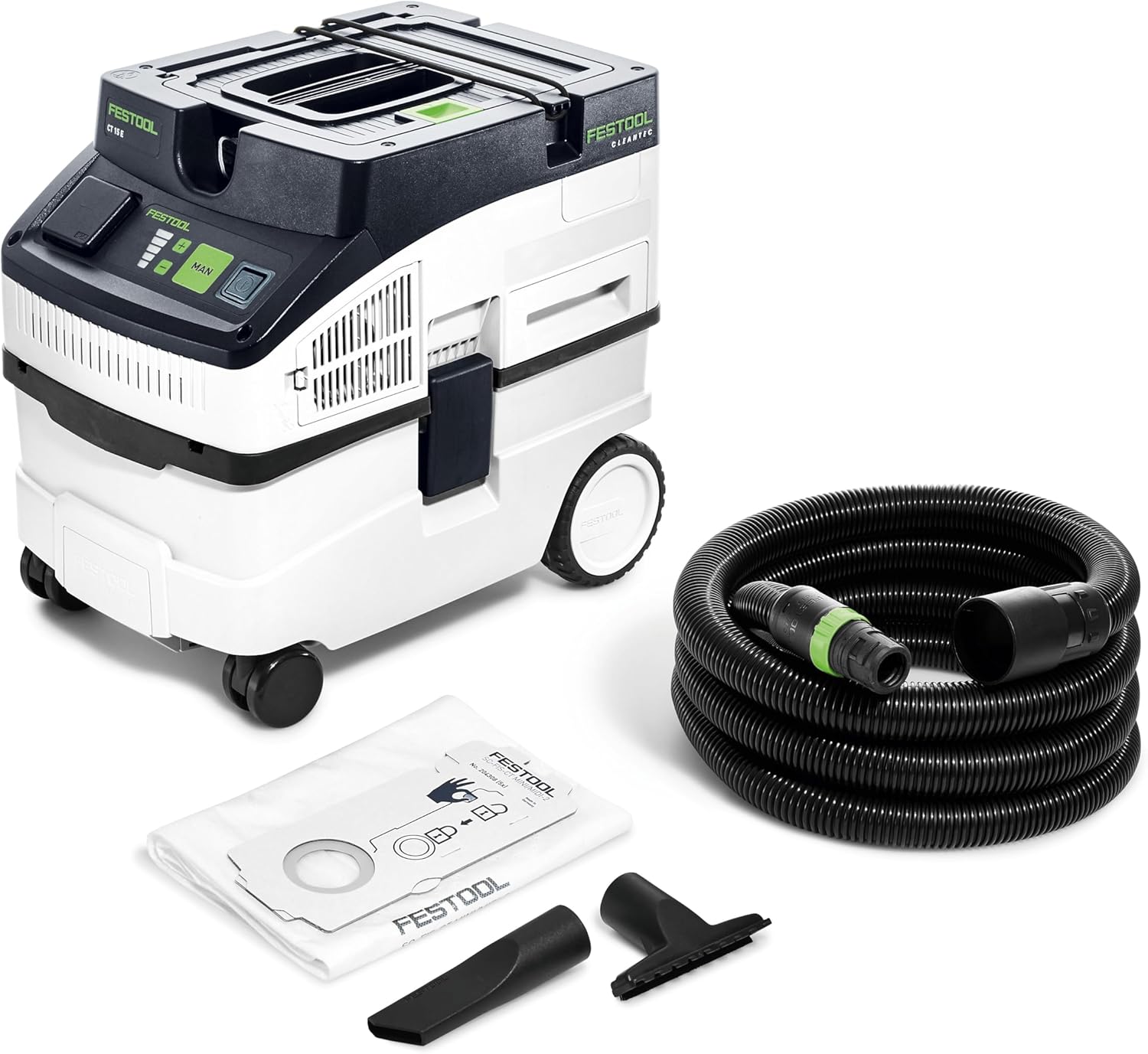
Festool CT 15 HEPA
- Price
- $$$$
- Type
- Dust extractor
- Capacity
- ~4 gal (15 L)
- Maker’s airflow / power
- 130 CFM
- HEPA filter
- ✅
- Auto filter cleaning
- ✅ AutoClean
- Tool-activated outlet
- ✅
- Hose
- See listing
- Best For
- Small shops, portability
Makita VC4210L
- Price
- $$$$
- Type
- Dust extractor
- Capacity
- 11 gal
- Maker’s airflow / power
- 148 CFM, 92 in water lift
- HEPA filter
- ✅
- Auto filter cleaning
- ✅
- Tool-activated outlet
- ✅
- Hose
- See listing
- Best For
- Big jobs, HEPA capacity
RIDGID RT1200
- Price
- $$$
- Type
- Wet/dry vac
- Capacity
- 12 gal
- Maker’s airflow / power
- 5.0 peak HP
- HEPA filter
- Optional filter
- Auto filter cleaning
- ❌
- Tool-activated outlet
- ❌
- Hose
- 1-7/8″ x 8 ft, locking
- Best For
- Small shop on a budget
CRAFTSMAN CMXEVBE17595
- Price
- $$$
- Type
- Wet/dry vac
- Capacity
- 16 gal
- Maker’s airflow / power
- 6.5 peak HP
- HEPA filter
- Optional filter
- Auto filter cleaning
- ❌
- Tool-activated outlet
- ❌
- Hose
- 2-1/2″ x 7 ft
- Best For
- Chips and big cleanups
Vacmaster VBV1210
- Price
- $$$
- Type
- Wet/dry vac + blower
- Capacity
- 12 gal
- Maker’s airflow / power
- 106 CFM, 5 peak HP
- HEPA filter
- Optional filter
- Auto filter cleaning
- ❌
- Tool-activated outlet
- ❌
- Hose
- 7 ft
- Best For
- Garage shops that also blow
⚡ Key Takeaways
- A dust extractor is a shop vac built for tools: HEPA filter, automatic filter cleaning and an outlet that starts the vac with your sander. The DEWALT DWV010 is the one I’d buy first.
- For drywall mud and other very fine dust, the Bosch VAC090AH cleans its filter twice as often as the DEWALT.
- A regular wet/dry vac like the RIDGID RT1200 is fine for chips and cleanup, as long as you add a cyclone separator and a fine filter or bag.
- Match the hose to the tool: most sanders have 1-1/4″ or similar small ports, and a 2-1/2″ floor hose needs an adapter and loses air speed at the tool.
- For table saws, planers and other big chip makers, a shop vac is the wrong tool: look at a dedicated dust collector instead.

Shop Vac vs. Dust Extractor vs. Dust Collector
These three machines get sold side by side and they do different jobs. Picking the wrong one is the most common reason people say “my vac doesn’t keep up with my sander.”
Shop Vacs: High Suction, Small Hoses
A wet/dry shop vac is built to pull debris through a narrow hose over a long distance, which means high suction (water lift) and modest airflow. That suits a sander’s small dust port and a crevice tool on the floor. What a standard shop vac lacks is fine filtration: the stock cartridge filter lets the smallest particles straight through the exhaust, and it clogs fast with sanding dust, so suction drops within minutes.
Dust Extractors: Shop Vacs Designed for Tools
A dust extractor is the same basic machine, rebuilt around power tools. You get a HEPA filter, a system that knocks dust off the filter automatically so suction stays steady, an outlet that turns the vac on when you pull your tool’s trigger, and usually a smooth anti-static hose sized for tool ports. It costs more, and for a sander it is worth it: the dust is captured at the pad instead of on your bench and in the air. To compare extractors side by side on tank size, airflow, filter cleaning and noise, see my guide to the best dust extractor for your shop.
Dust Collectors: High Airflow for Big Machines
A dust collector moves a very large volume of air at low pressure through 4-inch or bigger ducts. It is the right choice for a table saw, jointer, planer or drum sander that throws out chips by the bucketful, and the wrong choice for a handheld sander, because it cannot pull through a small hose. If that is your situation, my dust collector reviews cover single-stage and cyclone units in detail.
💡 Pro Tip
Most small shops end up with two machines: an extractor that lives next to the sander and follows it around, and a big wet/dry vac with a cyclone separator for floor cleanup and chips. Trying to make one cheap vac do both jobs is where the frustration starts.
Best Shop Vacs for Dust Collection: Reviews
Each pick below earns its place for a specific job. I’ve listed the maker’s published specs and who each machine suits; where a spec isn’t published by the maker, I’ve left it out rather than guess.
DEWALT DWV010 8-Gallon HEPA Dust Extractor
Best Overall Dust Extractor for Sanders
The DEWALT DWV010 is the straightforward answer for anyone who sands a lot. Its 15-amp motor is rated at 150 CFM, and the filter is pulsed clean automatically every 30 seconds, so you don’t have to stop and tap the filter halfway through a tabletop. The power tool actuation outlet starts and stops the vac with your sander, which is the feature that changes how often you actually use extraction.
It ships with a 15-foot anti-static hose in a small diameter that suits sander ports, and a universal connector that swivels. DEWALT states the DWV010 meets the EPA Lead Renovation, Repair and Painting (RRP) rule for HEPA vacuums only when fitted with DWV9330 filters, so check which filter you have before any work on old painted surfaces. At 8 gallons it is compact enough to roll next to you around a piece of furniture.
- ✅ HEPA filtration with automatic filter cleaning every 30 seconds
- ✅ Tool-activated outlet: vac follows your sander’s trigger
- ✅ 15 ft anti-static hose sized for tool ports
- ✅ Heavy-duty wheels and casters for moving around the shop
- ❌ 8 gallons fills quickly on chip-heavy work without a separator
- ❌ Premium price tier
Best For: Woodworkers who run a random orbital or sheet sander regularly and want dust captured at the pad, with one machine that starts and stops with the tool.
Bosch VAC090AH 9-Gallon Dust Extractor
Best for Drywall and Fine Dust
Drywall compound and plaster dust are the hardest test for any vacuum: the particles are fine enough to blind a filter in minutes. The Bosch VAC090AH answers that with automatic filter cleaning every 15 seconds, twice as often as the DEWALT, plus a HEPA filter that Bosch rates at 99.97% of particles at 0.3 microns and a fleece filter bag that takes the bulk of the load first.
Bosch lists 150 CFM of airflow and 97 inches of water lift, and a Power Broker dial lets you turn suction down so a small sander doesn’t glue itself to the work. Power tool activation is built in. Bosch positions it for its PRO+GUARD system aimed at OSHA silica dust compliance, which tells you the filtration target: concrete and masonry dust, not just wood.
- ✅ Filter cleans itself every 15 seconds
- ✅ HEPA filter plus fleece bag for very fine dust
- ✅ Adjustable suction to match the tool
- ✅ Tool-activated outlet
- ❌ The most expensive pick here
- ❌ Heavier than the DEWALT to carry up stairs
Best For: Drywall finishing, plaster, concrete grinding and anyone who sands painted surfaces indoors and needs suction that stays steady on fine dust.
Festool CT 15 HEPA Dust Extractor
Most Compact Premium Extractor
If floor space is the problem, the Festool CT 15 is the smallest serious extractor on this list. Festool rates it at 130 CFM with a container of about 4 gallons (15 liters), and the whole unit weighs about 23 pounds, so it goes in the car for site work and tucks under a bench at home. HEPA filtration and automatic tool start come standard, and the listing mentions an AutoClean system for the filter.
The crevice and upholstery nozzles store inside the machine, and the flat top holds a Systainer or a few tools. Festool backs it with its 3-year warranty that includes wear and tear. If you already own Festool sanders, the hoses and connectors fit without adapters; with other brands, check the port size first.
- ✅ Compact and light enough to carry one-handed
- ✅ HEPA filter and automatic tool start
- ✅ 3-year warranty including wear and tear
- ❌ About 4 gallons: empties often on bigger jobs
- ❌ Lowest airflow of the extractors here
Best For: Apartment, garage-corner and mobile woodworkers who sand furniture and trim and need a compact HEPA extractor they can move easily.
Makita VC4210L 11-Gallon HEPA Dust Extractor
Largest HEPA Capacity
The Makita VC4210L is the big one: an 11-gallon tank, a 12-amp motor that Makita rates at 148 CFM and 92 inches of water lift, and automatic filter cleaning. Filtration is two-stage, with a main flat filter first and a HEPA filter behind it, and it handles wet pickup as well as dust.
The tool-activated outlet has a 10-second off delay, which keeps the vac running just long enough to clear the hose after you let go of the trigger. That detail matters on a sander, where the last puff of dust otherwise settles back on the work. It is the choice for long sessions such as a room of trim or a floor, where a smaller tank would need emptying several times.
- ✅ 11-gallon capacity with HEPA filtration
- ✅ Two-stage filtration and automatic filter cleaning
- ✅ Tool outlet with a 10-second run-on to clear the hose
- ✅ Wet and dry pickup
- ❌ Heaviest machine on this list
- ❌ Premium price tier
Best For: Long sanding sessions, floor and trim jobs, and Makita tool owners who want one extractor with enough capacity for a full day.
RIDGID RT1200 NXT 12-Gallon Wet/Dry Vac
Best Shop Vac for a Small Shop
If an extractor is out of budget, the RIDGID RT1200 is the shop vac I’d build a small-shop system around. It has a 12-gallon tank, a 5.0 peak horsepower motor, and RIDGID’s scroll noise reduction design, which matters when the vac runs for as long as your sander does. The 1-7/8″ x 8 ft locking hose won’t pull loose from the vac, and its smooth interior resists clogging.
Filters install with RIDGID’s Qwik Lock system, without tools or fasteners, which makes it easy to swap the standard cartridge for a fine-dust or HEPA-rated one. There’s no automatic filter cleaning and no tool outlet, so add a cyclone dust separator in front of it and a plug-in auto-switch if you want it to follow your sander.
- ✅ Scroll Noise Reduction design to keep noise down
- ✅ Locking 1-7/8″ hose that stays put
- ✅ Tool-free filter changes
- ✅ Blower function for cleanup outside
- ❌ Needs a fine-dust filter or bag for sanding dust
- ❌ No tool-activated outlet
Best For: Garage and basement woodworkers who want one affordable vac for the sander and the floor, and are happy to add a separator and a better filter.
CRAFTSMAN CMXEVBE17595 16-Gallon Wet/Dry Vac
Best Big-Capacity Shop Vac
The CRAFTSMAN CMXEVBE17595 is about volume: a 16-gallon tank and a 6.5 peak horsepower motor for shops that make a lot of chips from miter saws, routers and planers. The 2-1/2″ x 7 ft Dual-Flex hose swivels at both ends to resist kinking, and the kit includes two extension wands, several nozzles, a filter and a dust collection bag.
A built-in blower port and an oversized drain make it a good all-rounder for a garage. The 2-1/2″ hose is the right size for a cyclone separator and floor cleanup; for a sander you’ll want a smaller tool hose and adapter. CRAFTSMAN lists a 3-year limited warranty.
- ✅ 16-gallon tank for chip-heavy work
- ✅ Kink-resistant 2-1/2″ hose
- ✅ Dust bag included in the kit
- ✅ Blower port and large drain
- ❌ Big footprint for a small shop
- ❌ 2-1/2″ hose needs an adapter for sander ports
Best For: Shops that produce lots of chips and want the largest tank for the money, ideally paired with a cyclone separator.
Vacmaster Blue Line VBV1210 12-Gallon Wet/Dry Vac
Best Shop Vac with a Detachable Blower
The Vacmaster VBV1210 comes with a published airflow figure, which most wet/dry vac listings skip: 106 CFM from a 5 peak horsepower motor in a 12-gallon tank. The motor head detaches and works as a handheld blower, which is handy for clearing sawdust off a bench or out of a garage.
Hose plus cord gives a 22-foot cleaning reach, accessories and cord store on board, and Vacmaster lists a 2-year warranty. Like any standard shop vac, it needs a fine-dust filter or bag to cope with sanding dust.
- ✅ Published 106 CFM airflow
- ✅ Detachable blower
- ✅ Long cleaning reach and on-board storage
- ❌ No auto filter cleaning or tool outlet
- ❌ Stock filter isn’t meant for fine sanding dust
Best For: Garage shops that want one machine for vacuuming chips and blowing dust off benches and floors.
How I Chose These Shop Vacs
I started from the jobs woodworkers actually ask about: capturing sander dust at the pad, dealing with drywall dust, and cleaning up chips. Then I looked only at machines that are sold on Amazon today, made by established tool brands, with published specs I could check against the maker’s listing. The criteria, in order:
- Filtration: HEPA-rated filters, or a standard filter that can be upgraded to one.
- Suction that holds: automatic filter cleaning, or at least an easy path to adding a separator.
- Fit with tools: hose diameter and connectors that work with sander dust ports, and a tool-activated outlet where available.
- Published numbers: where a maker publishes CFM or water lift, I used it; where it only publishes peak horsepower, I say so.
I left out models whose listings had too little information to compare, and I don’t show star ratings or prices: prices change daily, so each pick carries a price tier and the Amazon button shows the live price.
How to Choose the Best Shop Vac for Dust Collection
Suction (Water Lift) vs. Airflow (CFM)
Two numbers describe a vacuum. Water lift, or static pressure, is how hard it can pull; CFM is how much air it moves. A sander’s small port and a long, thin hose need pull, which is why extractors and shop vacs work on sanders while big dust collectors don’t. Airflow still matters, because air speed at the pad is what carries dust away. When a maker lists both, as Bosch and Makita do here, you have the full picture. Peak horsepower, the number on most shop vac boxes, is a motor rating and doesn’t tell you either.
Hose Diameter and Tool Ports
Most handheld sanders have small dust ports, and extractor hoses are made to match. A 2-1/2″ floor hose connected through a stepped adapter works, but air slows down in the wide section and dust drops out in the hose. If the vac will mostly serve a sander, a smaller, smooth-walled tool hose is worth buying. Anti-static hoses also stop the small shocks that build up when dry dust rushes through plastic.
HEPA Filters and Fine Dust
Sanding produces the finest dust in the shop, and fine dust is what a standard cartridge filter passes straight through the exhaust. A HEPA-rated filter traps it. The HEPA figure Bosch and Makita cite for their filters, 99.97% of particles at 0.3 microns, is the standard definition. For old painted surfaces this goes beyond comfort: the U.S. EPA’s lead guidance (“Protect Your Family from Sources of Lead”, checked September 2026) says that when there is visible dust or debris from chipping or flaking paint, you should use only vacuums with HEPA filters and not dry sweep.
⚠️ Important
A HEPA filter only helps if the whole machine seals around it. Buy the HEPA filter made for your model, fit it exactly as the manual shows, and if you’re working on paint in a home built before 1978, read the EPA’s renovation guidance before you start sanding.
Automatic Filter Cleaning
Sanding dust coats a filter quickly, and suction drops long before the tank is full. Extractors solve this by pulsing air back through the filter on a timer: every 30 seconds on the DEWALT, every 15 seconds on the Bosch. On a standard shop vac, the fix is a cyclone separator that catches most of the dust before it reaches the filter, plus a filter bag.
Tool-Activated Outlet
This is the feature people underrate. With the vac plugged into the extractor and your sander plugged into the extractor’s outlet, the vac starts when you pull the trigger and stops when you let go. That means you actually use it every time. For a shop vac without one, plug-in auto-switches do the same job.
Tank Size and Noise
Bigger tanks mean fewer trips to empty, but also a bigger, heavier machine to roll around a piece of furniture. For sanding, 8 to 12 gallons is a practical range; for chip-heavy cleanup, more helps, especially with a separator bucket taking the bulk. Noise matters because the vac runs as long as your tool: an extractor or a noise-reduced vac like the RIDGID is easier to live with over a long session.
How to Set Up a Shop Vac Dust Collection System
Step 1: Put a Separator in Front of the Vac
A cyclone separator on a 5-gallon bucket sits between the tool or floor hose and the vac. Dust and chips spin out into the bucket and only a small fraction reaches the filter, so suction stays up and filters last much longer. I’ve compared the main models in my guide to the best dust separators.
Step 2: Add a Fine Filter or Bag
Swap the stock cartridge for a fine-dust or HEPA-rated filter from your vac’s maker, and add a filter bag if your model takes one. The bag catches what the separator misses and keeps the cartridge clean.
Step 3: Use the Right Hose for the Tool
Keep a short, small-diameter hose for the sander and a 2-1/2″ hose for the floor. If your sander has an odd port, a rubber stepped adapter is cheaper than a new hose.
Step 4: Automate the Switch
Use the extractor’s tool outlet, or an auto-switch for a shop vac, so extraction runs every time the sander does. Pair it with a shop air filtration system to catch what escapes into the air.
ℹ️ Did You Know?
Many random orbital sanders collect dust through holes in the pad. Those holes only work when the sanding disc’s holes line up with them, so buy discs with the same hole pattern as your pad. See my random orbital sander reviews for which models pair best with a vacuum.
🏆 The Verdict
If you sand often, buy a dust extractor: the DEWALT DWV010 gives you HEPA filtration, a self-cleaning filter and a tool-activated outlet in an 8-gallon package. For drywall and plaster, the Bosch VAC090AH keeps suction steadier on the finest dust. If you need something compact, the Festool CT 15 is the one to carry around. On a budget, the RIDGID RT1200 with a cyclone separator and a fine filter does most of what an extractor does for a fraction of the cost.
❓ Frequently Asked Questions
Are shop vacs good for dust collection?+
Which vacuum is best for picking up fine dust?+
How do I keep dust from coming out of my shop vac?+
What is the number one rated shop vac?+
Do I need a HEPA shop vac for drywall dust?+
What size shop vac do I need for a small shop?+
Conclusion
Good dust collection with a shop vac comes down to three things: suction that holds up, filtration fine enough for sanding dust, and a setup you’ll actually switch on every time. A HEPA extractor does all three out of the box; a quality wet/dry vac gets there with a separator, a better filter and an auto-switch.
If you’re sanding drywall, my guide on how to sand drywall covers the technique that keeps dust down in the first place. Questions about your own setup? Leave a comment below and I’ll help you work it out.
