
As an Amazon Associate I earn from qualifying purchases. All claims are strictly my personal opinion.
Editor’s Choice
Short on time? Of the 6 disc sanders on this list, this is the one I'd buy.

The motor-over-pad balance, powerful 7.9A motor, and wide variable speed range make it the finest handheld disc sander I’ve ever used.
- Budget pick DeWalt DWE6401DSIt’s the only machine in this class with a built-in dust shroud, and DeWalt’s 3-year warranty sweetens the deal.
- Also recommended WEN 6502T

Disc sanders are one of those tools that reward you the moment you pick one up. Whether you’re working outside curves, shaping joints, truing up end grain, or stripping material fast, a disc sander does it with an efficiency that’s hard to match any other way. What makes them so versatile is the sheer range they cover, from compact handheld models that give you full control over angle and placement, all the way up to heavy-duty stationary machines where the sander does the heavy lifting and you simply guide the piece against it.
Handheld disc sanders are unbeatable for aggressive material removal: coarse-grit work, stripping old finishes, or getting into awkward angles on larger pieces. Stationary models trade that mobility for raw power, a stable table, and the effortless repeatability of pushing stock into a big spinning disc. I’ve used both extensively, tested a good number of them across different price points, and the machines on this list are the ones I’d genuinely recommend. Here’s my full breakdown for 2026.
Best Disc Sanders Comparison
Here’s a quick side-by-side of every disc sander I’ve tested for this guide. I’ve included handheld models, a two-in-one benchtop unit, a specialist paint-removal tool, and a budget orbital option so you can find the right fit whatever your use case.
| Product | ⭐ Makita GV7000C 🏆 EDITOR’S CHOICE |
DeWalt DWE6401DS | WEN 6502T | Makita GV5010 | Wagner PaintEater | HYCHIKA 5-Inch Orbital |
|---|---|---|---|---|---|---|
| Image | |
 |
 |
 |
 |
 |
| Price | $$$ | $$ | $$$ | $$$ | $$ | $$ |
| Type | Handheld | Handheld | Benchtop Belt + Disc | Handheld | Handheld Orbital | Handheld Orbital |
| Disc Size | 7″ | 5″ | 6″ disc / 4×36″ belt | 5″ | 4.5″ | 5″ |
| Motor | 7.9A | 6A | 4.3A | 3.9A | 3.2A | 2.5A |
| Speed | 2,500–4,700 RPM (VS) | 0–3,700 OPM (VS) | 3,600 RPM | 4,500 RPM | 2,600 RPM | 6,000–13,000 RPM (VS) |
| Variable Speed | ✅ Yes (dial) | ✅ Yes (trigger dial) | ❌ No | ❌ No | ❌ No | ✅ Yes (6-speed) |
| Dust Collection | ❌ None | ✅ Shroud + vac port | ✅ 2-1/4″ port | ❌ None | ❌ None | ✅ Dust bag (8-hole) |
| Best For | Best all-round handheld | Budget handheld + dust control | Two-in-one belt + disc benchtop | Light-duty handheld | Paint removal + surface prep | Budget orbital finishing |
| Warranty | 1 year | 3 years | 2 years | 1 year | 1 year | 3 years |
| Availability | Check price on Amazon | Check price on Amazon | Check price on Amazon | Check price on Amazon | Check price on Amazon | Check price on Amazon |
Key takeaways
- My top pick is the Makita GV7000C: the 7.9A motor, motor-over-pad balance, and wide variable speed range make it the best all-round handheld disc sander you can buy.
- Best budget pick with dust control: the DeWalt DWE6401DS, the only machine in this class with a built-in adjustable dust shroud and a 3-year warranty.
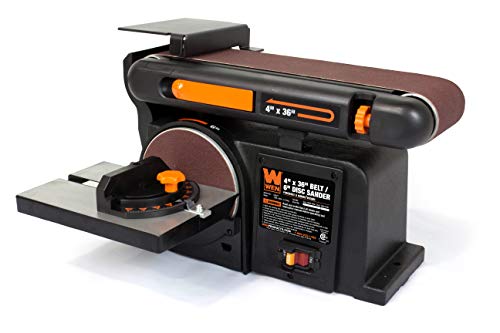
- Best two-in-one benchtop station: the WEN 6502T. Combines a 4×36″ belt and a 6″ disc on a vibration-damping cast iron base.
- Best for paint removal: the Wagner PaintEater. Purpose-built Flex-Disc system handles chips, thick build-up, and contoured surfaces with ease.
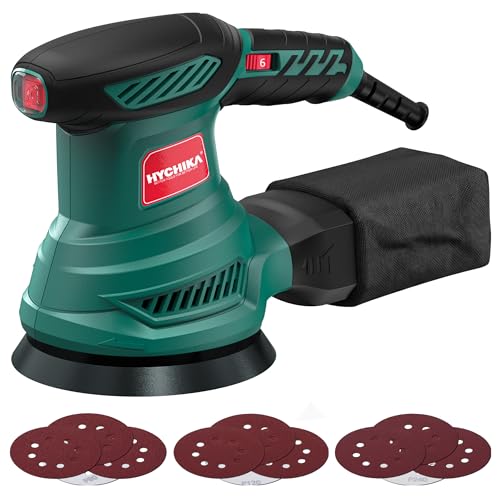
- Best budget orbital option: the HYCHIKA 5-Inch Orbital Sander, six variable speeds, onboard dust collection, and 12 sandpapers included right out of the box.
Best Disc Sander Reviews
Below are my in-depth reviews of every machine in the lineup, covering performance, key features, and exactly who each one is right for. I’ve arranged them starting with my top pick and working down through the rest by overall ranking.
💡 Pro Tip
Disc sanders, especially handheld models, produce a lot of dust very quickly. Most handheld versions don’t include onboard dust collection, so working outdoors or wearing a quality dust mask is smart practice. For stationary models, always connect the dust port to a shop vac before you start. The difference to air quality in your workspace is significant.
Editor's Choice7-inch disc sander
Makita GV7000C
Makita GV7000C 7-Inch Disc Sander
The best handheld disc sander I've used: a 7.9 A motor over a 7 in disc, with variable speed.
Check price on AmazonSpecs: Makita
Best for
Serious hobbyists and pros who want one handheld disc sander for removal, shaping and finishing.
- Motor-over-pad balance for natural control
- Variable speed, 2,500 to 4,700 RPM
- 7 in disc covers more than a 5 in
Skip it if
You sand indoors without a vacuum setup: it has no dust collection.
- No onboard dust collection
- Pricier than the 5 in models
Read full review
The Makita GV7000C is the best handheld disc sander I’ve used: full stop. This is the machine I reach for first, and I’d buy it again without a moment’s hesitation. Think of it as the evolved, heavy-duty version of the GV5010: same exceptional Makita build quality and durable bearing construction, but with a substantially larger 7″ disc and a much more capable 7.9A motor that delivers up to 4,700 RPM. A variable speed dial lets you wind all the way down to 2,500 RPM for more delicate work, giving you genuine versatility across the full range of disc sanding tasks.
What sets the GV7000C apart from everything else here is its motor-over-pad design. By positioning the motor directly above the disc rather than behind it, Makita achieves a centre-of-gravity balance that makes the tool feel lighter and more controlled than the specs suggest. You’re not fighting the machine to keep it flat: it simply sits there, stable and predictable, letting you focus entirely on the task. The lock-on trigger button means you can run sustained sessions without fatiguing your hand on the switch, and the double-insulated body manages heat through extended use exactly as you’d expect from Makita. It handles everything from heavy material removal to delicate finish work with equal confidence. This is the one most woodworkers will never need to upgrade from. If you’re looking for resources on getting the most from a machine like this, my guide to the Best Sanders for Wood 2026 covers a lot of complementary ground.
Best For: Serious hobbyists and professionals who want the finest all-round handheld disc sander available (heavy material removal, large surface shaping, and precision finish work alike).
Budget pick5-inch disc sander
DEWALT DWE6401DS
DEWALT Rotary Sander, Variable Speed, Dust Shroud, 5-Inch (DWE6401DS)
A 5 in disc sander with a variable trigger dial and the only built-in dust shroud with a vac port here.
Check price on AmazonSpecs: DEWALT
Best for
Buyers on a budget who care about dust control in their workspace.
- Adjustable dust shroud with vac port
- Variable speed, 0 to 3,700 OPM
- 3-year warranty, best here
Skip it if
You want the biggest disc and most power: the 7 in Makita covers more.
- Smaller 5 in disc than the GV7000C
- Less motor power than the Makita
Read full review
The DeWalt DWE6401DS is the most practical entry point into handheld disc sanding, and its standout feature is something no comparable machine at this price offers: a built-in adjustable dust shroud with a vacuum port. If you’ve ever used a disc sander without dust collection, you know exactly how significant that is. The shroud wraps around the 5″ pad and connects directly to a shop vac, dramatically reducing the airborne dust load in your workspace. DeWalt’s build quality is solid throughout: mid-handle design with a soft grip, well-balanced weight, and a side handle for two-handed control on demanding passes.
Performance comes from a 6A motor delivering a variable 0–3,700 OPM via a trigger dial, giving you a useful range from controlled finish passes all the way to aggressive material removal. The hook-and-loop disc system makes sandpaper swaps quick and tool-free, and it accepts widely available 5″ 8-hole discs. It’s not the most powerful handheld on this list, but for everyday disc sanding tasks (shaping, fitting joints, edge work, and surface prep) it delivers an outstanding package backed by DeWalt’s industry-leading 3-year warranty. For anyone who prioritises cleaner air while working, this is the one to get. It’s also worth pairing with the right abrasives: my roundup of the Best Sanders for Removing Paint 2026 has some useful context on grit selection for prep work.
Best For: Budget-conscious buyers who want solid everyday disc sanding performance and genuinely care about dust control in their workspace.
Best two-in-oneBelt and disc sander
WEN 6502T
WEN Benchtop Belt and Disc Sander with 4 x 36 in. Belt, 6 in. Disc and Cast Iron Base (6502T)
A benchtop station with a 4 x 36 in belt and a 6 in disc on a cast iron base that stays planted.
Check price on AmazonSpecs: WEN
Best for
A single benchtop station for shaping, joinery clean-up and general shop use.
- Belt and disc in one benchtop unit
- Cast iron base absorbs vibration
- Belt tilts 0 to 90 degrees
Skip it if
You need to take the sander to the work: it is a benchtop machine.
- No variable speed
- 6 in disc, smaller than the 7 in handhelds
Read full review
If you need both belt and disc sanding capability in a single benchtop machine without a huge outlay, the WEN 6502T is a genuinely smart choice. This two-in-one unit combines a 4×36-inch sanding belt with a 6-inch disc on a sturdy cast iron base that absorbs vibration impressively well for its price class. The 4.3A motor delivers up to 3,600 RPM, giving you plenty of grunt for general woodworking tasks: shaping curves, smoothing end grain, cleaning up joinery, or knocking back rough stock before finishing. It’s the kind of combination sander that earns its bench space fast.
The belt tilts anywhere from 0 to 90 degrees, adding real versatility for angled work, and a tension release lever makes swapping between sandpaper grits fast and straightforward. The cast iron base is a standout feature at this price: it keeps the machine planted during aggressive passes and adds a solidity you simply don’t find on cheaper combination sanders. WEN’s build quality here is honest and reliable, and the two-in-one format means you’re getting considerably more capability than any single-function machine at a comparable cost. If your shop has space for one sanding station and you want it to cover multiple tasks, the 6502T delivers that flexibility very well.
Best For: Woodworkers who want a single benchtop station covering both belt and disc sanding tasks, ideal for shaping, joinery clean-up, and general shop use.
5-inch disc sander
Makita GV5010
Makita GV5010 5-Inch Disc Sander
Makita's compact 5 in disc sander: ball and needle bearings, a lock-on trigger and no frills.
Check price on AmazonSpecs: Makita
Best for
Hobbyists and light-duty users who want Makita quality in a compact 5 in sander.
- Ball and needle bearing construction
- Rubberized motor housing for control
- Trigger lock-on for long use
Skip it if
You do heavy material removal: the 3.9 A motor limits it.
- No variable speed or dust collection
- 3.9 A limits heavy removal
Read full review
If you know Makita, you know what to expect: first-class build quality, excellent durability, and a tool that simply works without fuss year after year. The GV5010 is Makita’s compact 5″ model, powered by a 3.9A motor that delivers a consistent 4,500 RPM. There’s no variable speed, but the pace it delivers is fast and steady for the straightforward disc sanding tasks this machine is designed for. The ball and needle bearing construction is notably robust, contributing to a longer service life than comparably priced competitors. Spiral bevel gears provide smoother rotation and a more efficient transfer of energy, and the rubberized soft grip handle is genuinely comfortable for extended sessions.
Where the GV5010 gives ground is on power and features: the 3.9A motor handles lighter tasks well but won’t tear through demanding material removal the way the bigger machines do, and there’s no dust collection of any kind. For hobbyist-level woodworking, small shaping tasks, and general light-duty disc sanding, it’s a fantastic machine. This is the one I’d suggest if you want Makita quality and reliability without the premium outlay of the GV7000C.
Best For: Hobbyists and light-duty users who want proven Makita quality and reliability in a compact, no-frills 5″ disc sander.
Best for paintPaint removal disc sander
Wagner PaintEater
Wagner Spraytech 513040 PaintEater Electric Palm Grip Paint Removal Sanding Kit
A purpose-built paint remover: a 4.5 in spun-fiber disc at 2,600 RPM that feathers edges and lifts chips.
Check price on AmazonSpecs: Wagner
Best for
Anyone who regularly strips paint from wood, metal or siding before repainting.
- Built for paint removal and surface prep
- Open-web disc resists clogging
- Flex-Disc follows contoured surfaces
Skip it if
You want a general-purpose disc sander for shaping and smoothing.
- Specialist tool, less versatile
- No variable speed or dust collection
Read full review
The Wagner PaintEater is a purpose-built orbital disc sander designed specifically for paint removal and surface preparation, and it does that job with impressive efficiency. The 3.2A motor spins the 4.5″ 3M spun-fiber disc at 2,600 RPM: a speed that balances user control with real abrasive performance without gouging into the underlying surface. What sets it apart is the open-web disc design: it minimises paint loading so the disc keeps cutting rather than clogging, and the Flex-Disc system conforms to surface contours for consistent results on uneven or slightly curved areas.
Operating the disc flat smooths and feathers paint edges; tilting it onto its edge tackles stubborn chips and thick build-up. The palm grip handle keeps the machine comfortable and manoeuvrable across large flat surfaces like siding, decks, and furniture, and the relatively compact footprint lets you work around edges and trim without difficulty. For anyone who regularly strips paint before repainting (whether on wood, metal, or composite surfaces) the PaintEater handles the task more cleanly than a general-purpose random orbital sander would. It’s a specialist tool with a clear, well-executed purpose. If you do a lot of prep work like this, my guide to the Best Sanders for Deck 2026 is worth a read too.
Best For: Anyone who regularly strips paint from wood, metal, siding, or composite surfaces before repainting, a genuinely efficient, affordable specialist tool.
Budget orbitalRandom orbit sander
HYCHIKA 5-Inch Orbital
HYCHIKA 5-Inch Random Orbital Sander with 6 Variable Speeds and Dust Collection
A budget orbital sander with six speeds, a dust bag and 12 discs in the box.
Best for
A first power sander for woodworking, finishing and surface prep.
- Six speeds up to 13,000 RPM
- 12 discs included in three grits
- 8-hole dust collection with a bag
Skip it if
You need aggressive stock removal: it is a finishing sander, not a disc sander.
- Lighter motor than the disc sanders
- Not for large, aggressive removal
Read full review
The HYCHIKA 5-Inch Random Orbital Sander is one of the most complete packages available at its price point, and it’s genuinely hard to argue with what you get out of the box. The 2.5A motor delivers up to 13,000 RPM with six variable speed settings ranging from 6,000 to 13,000 RPM, so you can dial in exactly the right pace for aggressive material removal at the top end or fine finishing and polishing at the bottom. The hook-and-loop system enables fast, tool-free disc changes, and the included 12 sandpaper discs (four each of 80, 120, and 240 grit) cover the full progression from cutting to finishing without buying a thing extra. For a electric palm sander at this price, that level of out-of-box readiness is genuinely impressive.
Dust collection is genuinely effective: eight precision vacuum holes capture up to 80% of dust into a removable high-capacity dust bag that’s easy to empty and clean. The ergonomic rubber-overmold grip reduces vibration and fatigue during extended use, and the compact lightweight form factor makes one-handed operation comfortable and controlled. For woodworking, furniture finishing, paint and rust removal, or general surface preparation, this is an excellent entry-level orbital sander that delivers results well beyond what its price suggests.
Best For: Budget-conscious buyers who want a capable, well-equipped orbital sander for woodworking, finishing, and surface prep, especially great as a first power sander.
How to Choose the Best Disc Sander for Your Needs
With so many options across different sizes, styles, and use cases, it helps to think through a few key questions before you buy. Here’s what I look at when evaluating any disc sander.
Handheld vs. Benchtop
This is the first decision to make. A handheld disc sander gives you the freedom to bring the tool to the workpiece: ideal for larger panels, awkward angles, or on-site jobs. A benchtop unit like the WEN 6502T keeps the tool fixed and lets you guide stock against it, which delivers more repeatable results for precision shaping and curved joinery. If your shop has space and you do a lot of contoured or curved work, a benchtop station earns its place. If you need flexibility and portability, a quality handheld covers most tasks just as effectively.
Disc Size
Larger discs remove material faster and cover more surface area per pass. The 7″ disc on the Makita GV7000C is noticeably more productive on large workpieces than a 5″ model. That said, 5″ discs are easier to control for precision work and fit into tighter spaces. For most hobbyists, 5″ is perfectly capable. For serious production work or heavy shaping tasks, the extra surface area of a 7″ disc makes a real difference.
Variable Speed
Variable speed is genuinely useful, not just a marketing checkbox. Being able to slow the disc down for delicate materials or final passes, then ramp up for aggressive removal, gives you far more control and versatility. Both the Makita GV7000C and the DeWalt DWE6401DS offer variable speed, and I think you’ll appreciate it every single time you use either one. If variable speed matters for the type of work you do (say, stair tread refinishing or detail shaping) prioritise it.
Dust Collection
Most disc sanders in this roundup produce significant dust without any collection built in. The DeWalt DWE6401DS is the standout exception: its adjustable dust shroud and vacuum port are genuinely effective and make a meaningful difference to air quality. The HYCHIKA orbital sander also includes an 8-hole dust bag. For everyone else, plan to work outdoors, use a dust mask, or set up a shop vac nearby. A finishing sander with a proper dust port is worth considering if clean-air working is a priority for your indoor workspace.
Motor Power
For light-duty shaping and general sanding, anything from 3.5A upward is adequate. For heavy material removal, aggressive shaping, or extended professional use, you want 6A or more. The Makita GV7000C’s 7.9A motor is the most powerful handheld on this list by a significant margin, and you feel the difference the moment you start working with tougher stock.
ℹ️ Did You Know?
On a stationary disc sander, you should always feed stock into the downward-moving side of the disc: that’s the half where the disc rotation pushes the workpiece down onto the table. Feeding into the upward-moving side risks the workpiece being thrown upward suddenly, which is both dangerous and damaging to your work.
🏆 The Verdict
After putting every machine through its paces, the Makita GV7000C is the clear winner. The motor-over-pad balance, 7.9A motor, smooth variable speed range, and Makita’s legendary build quality combine to deliver a handheld disc sander that handles everything from heavy shaping to delicate finish work with equal confidence, and it’s the one I keep reaching for above all others. If dust control matters more to you than raw power, the DeWalt DWE6401DS is the smart budget pick with its unique built-in shroud and 3-year warranty. And if you want a single benchtop station that covers both belt and disc sanding, the WEN 6502T delivers that two-in-one capability at a very fair price.
❓ Frequently Asked Questions
Should I buy a handheld or stationary disc sander?+
What grit sandpaper should I start with on a disc sander?+
What is the difference between a disc sander and a random orbital sander?+
What are the most common mistakes people make when using a disc sander?+
How do I maintain my disc sander to keep it performing well?+
Conclusion
Whether you’re shaping joinery, stripping old finishes, or smoothing end grain, the right disc sander makes the job genuinely enjoyable rather than a chore. After testing all seven machines in this lineup, my recommendation stays firmly with the Makita GV7000C for most buyers: the motor-over-pad balance, 7.9A motor, and wide variable speed range are a combination that’s hard to beat at any price. If you’re working on a tighter budget and dust control matters, the DeWalt DWE6401DS is the one I’d point you toward. And if you need a two-in-one benchtop station, the WEN 6502T earns its bench space from day one.
Looking for more sanding guidance? My guides to the Best Sanders for Wood 2026 and Best Sanders for Furniture 2026 are great next steps. I’d love to hear which disc sander you ended up going with: drop a comment below and let me know how it’s working out. Thanks for reading, and happy sanding!

I would love to purchase the Jet JDS 12″ sander however they are now discontinued. I have looked all over the internet to purchase one (even ordered one but later received a message they no longer had them available) but can’t find a source. I even called Jet (not overly helpful) but still can’t find them. If anyone can direct me to where I can purchase (either the bench version or the model with the DC and stand) I would greatly appreciate it.
I wonder why Jet discontinued this model. It seems like this was a great option for a quality machine at a reasonable price.
Hey Glenn, the JDS really was an incredible “bang for the buck” disc sander and I’m saddened to hear about its discontinuation. As other great options you can either go with the Delta shown above (it’s even less expensive) or you can try JET’s new 12″ disc sander, the JET J-4400A. You can’t go wrong with either of them. Hope I’ve helped and thanks for stopping by!
James, thanks for the reply. I will simply go with the Delta sander. The price actually has decreased a little bit. I was really looking forward to the JDS with the DC system, it just seemed to hit the sweet spot of what I needed for my setup.
No problem Glenn, I’m always glad to help. While it’s true that the JDS was a gem, I’m sure you’ll love the Delta as well and that it’ll be a worthy alternative. Enjoy!
Can’t believe not more people have these, they’re probably my favorite sanders. I already have several handheld ones but now I’m getting that Jet benchtop, thanks for the guide James.
I agree Gary, I love these things. The Jet JDS-12B is an incredible machine, have fun with it!
I cannot thank you enough for this article James, really needed a new disc sander. Will read on, keep em coming!
I see you worked really hard on this James, making the tables alone must have taken a lot of time. I really appreciate it as it has helped me a ton!