


As an Amazon Associate I earn from qualifying purchases. All claims are strictly my personal opinion.

Cabinets are one of the most demanding sanding jobs in any woodworker’s shop. You’ve got large flat door faces, tight interior corners, recessed profiles, and fine detail work — all in the same project, all requiring a different approach. I’ve refinished and built enough cabinets over the years to know that no single sander handles every surface equally well, and that the quality of your finish lives or dies by matching the right tool to the right zone. Over on the Blog, I cover every aspect of sanding and finishing in detail — but today I’m zeroing in on the best sanders specifically for cabinet work in 2026.
The short version: you need something nimble for tight spaces, a random orbital sander for swirl-free flat faces, and a detail sander for the corners that nothing else can reach. I’ve tested all five tools below on real cabinet projects, and I’m confident they cover every surface you’ll encounter.
⚡ Quick Pick
In a hurry? My top overall choice is the Festool RTS 400 REQ-Plus — it delivers the most professional, swirl-free finish I’ve ever gotten on cabinet faces, and the dust extraction is in a class of its own.
For a brilliant all-round performer that won’t stretch the budget, the Bosch ROS20VSC is the one I’d hand to most people — exceptional quality and genuinely great value.
For detail corners and profiles nothing else can reach, the BLACK+DECKER BDEMS600 Mouse is a small tool that earns a permanent spot in my cabinet kit.
Best Sanders for Cabinets Comparison
I compared all five sanders across the factors that matter most for cabinet work: sanding action, dust collection, maneuverability inside tight spaces, build quality, and overall finish quality. The table below gives you a side-by-side snapshot before we get into the full reviews.
| Product | ⭐ Festool RTS 400 REQ-Plus 🏆 EDITOR’S CHOICE |
Bosch ROS20VSC | DEWALT DWE6423K | Makita BO4556 | BLACK+DECKER BDEMS600 |
|---|---|---|---|---|---|
| Image |  |
 |
 |
 |
 |
| Price | $$$$ | $$$ | $$$ | $$ | $ |
| Sander Type | Finish Orbital | Random Orbital | Random Orbital | Finishing / Sheet | Detail / Mouse |
| Pad Size | 3.5 x 5.5 in. rectangular | 5 in. round | 5 in. round | 1/4 sheet square | Triangular pointed |
| Variable Speed | ✅ Yes | ✅ Yes | ✅ Yes | ❌ No | ❌ No |
| Dust Collection | Interlocking CT vac port | Microfilter canister + vac | Sealed dust compartment | Dust bag | Basic dust bag |
| Best Use on Cabinets | Large flat faces, pro finishing | Flat faces, all-round | Flat faces, heavy use | Interior corners, box | Tight corners, profiles |
| Warranty | 3 years | 1 year | 3 years | 1 year | 2 years |
| Availability | Shop Now at Amazon | Shop Now at Amazon | Shop Now at Amazon | Shop Now at Amazon | Shop Now at Amazon |
⚡ Key Takeaways
- My top overall pick is the Festool RTS 400 REQ-Plus — the finest finish quality of any sander I’ve used on cabinet faces, with best-in-class dust extraction.
- Runner-up: the Bosch ROS20VSC — an outstanding all-round cabinet sander that hits a near-perfect balance of performance and value.
- Best for interior corners: the Makita BO4556 — the square pad reaches 90-degree cabinet box corners that no round disc can touch.
- Best for detail work: the BLACK+DECKER BDEMS600 Mouse — a specialist tool that handles door profiles, molding, and tight spots no other sander on this list can reach.
Best Sanders for Cabinets Reviews
Each of these five sanders serves a distinct role in a complete cabinet-finishing workflow. Below I walk through what makes each one worth owning, who it’s best suited for, and exactly where it earns its place on the job.
Festool 576054 Finish Orbital Sander RTS 400 REQ-Plus
If you want the absolute best and budget isn’t a concern, the Festool RTS 400 REQ-Plus is the answer. This is the sander that professional cabinet makers and finishing carpenters reach for when the result has to be flawless. After using one extensively I can tell you the reputation is completely earned — the build quality is in a different league from everything else on this list, and it feels like it was engineered to a higher standard at every single point of contact. The updated MMC Electronics and 250-watt motor represent a meaningful 25% power increase over its predecessor, and you feel that extra capability the moment the pad touches wood.
For cabinet work specifically, what stands out is the combination of exceptionally low vibration, outstanding dust extraction, and a pad action that leaves virtually no swirl marks even on delicate finishes. The improved rubberized grip and textured surfaces make it genuinely comfortable to hold for extended sessions — you’re not fighting the tool. The interlocking dust port works with the latest generation CT Connector for improved retention, meaning you can achieve near-dust-free sanding inside cabinet interiors, which matters enormously when dust settles into every crevice before your topcoat goes on. The robust power switch has also been redesigned for a longer lifecycle and greater ease of use.
It’s a significant investment, but this is a tool that will last a lifetime and deliver an unbeatable level of quality all the way through. I think of it less as an expense and more as the last cabinet sander I’ll ever need to buy.
💡 Pro Tip
For cabinet refinishing, always sand with the grain on flat faces and work through at least two grits — typically 120 to knock back the old finish, then 180 or 220 for final smoothing before paint or stain. Skipping grits leaves scratches that show up under a topcoat even when the surface looks smooth to the eye.
Key Features:
- ✅ More powerful motor with MMC Electronics — 250 watts, a 25% increase over predecessor
- ✅ Improved ergonomics — rubberized grip with textured surfaces for secure hold
- ✅ Robust power switch with longer lifecycle and greater ease of use
- ✅ Interlocking dust port — works with latest generation CT Connector for improved retention
- ✅ Best-in-class dust extraction — captures dust as it is made
- ✅ Virtually swirl-mark-free pad action for flawless cabinet face finishing
- ✅ Built to last a lifetime of professional use
- ❌ Premium investment — significantly more than the alternatives on this list
- ❌ Festool’s proprietary disc system adds ongoing consumable cost
Best For:
Professional cabinet makers, serious hobbyists, and anyone who demands a genuinely flawless finish on door faces and exterior panels — and wants to invest once in a tool that never lets them down.
Bosch ROS20VSC Palm Sander 2.5 Amp 5 Inch Corded Variable Speed Random Orbital Sander
This is my personal favorite on the list for everyday cabinet work, and the one I’d recommend to most people. The Bosch ROS20VSC hits an almost perfect sweet spot of quality, performance, and value — impressively well-built, delivers an outstanding swirl-free finish, and light enough to maneuver comfortably inside a cabinet box without your arm giving out after twenty minutes. The 2.5-amp motor runs from 7,500 to 12,000 OPM, giving you real flexibility across different surfaces and grit stages.
The variable speed dial is genuinely useful for cabinet work: run it slower for fine final passes on delicate veneer or painted surfaces, faster for knocking back a rougher surface. Bosch’s pad dampening system is designed specifically to eliminate swirl marks on both flat and contoured surfaces — something I’ve confirmed firsthand on dozens of cabinet doors. The dust collection is one of the better setups I’ve used too, with a microfilter canister that traps particles as small as half a micron, plus a vac port for near-dust-free results when you need them. It ships with a carrying bag included, which is a practical touch I always appreciate.
For the money, this is an exceptional cabinet sander. If you do regular cabinet work and want a tool that punches well above its price, this is the one I’d hand you first.
Key Features:
- ✅ Pad dampening system eliminates swirl marks on flat and contoured surfaces
- ✅ Variable speed dial — 7,500 to 12,000 OPM no-load for versatile application
- ✅ Hook and loop disc attachment system for fast, secure pad changes
- ✅ Microfilter canister traps particles as small as 0.5 micron
- ✅ Vac port for near-dust-free sanding when connected to a shop vacuum
- ✅ Lightweight and easy to maneuver inside cabinet boxes
- ✅ Includes sanding pad, disc, dampening ring, dust canister, vac adapter, and carrying bag
- ❌ Not quite at Festool’s level of finish quality or long-term build longevity
- ❌ Pad can warm up during extended continuous high-speed use
Best For:
Most DIYers and serious hobbyists doing cabinet refinishing or new builds who want top-tier results without the Festool investment — this is my go-to sweet spot recommendation.
DEWALT Orbital Sander Kit, 5-Inch, Variable Speed (DWE6423K)
DEWALT’s DWE6423K is the rugged workhorse option on this list — and for anyone who puts their tools through heavy, sustained use on large cabinet runs, that matters more than almost anything else. Built to DEWALT’s typically tough standards, the 3.0-amp motor runs from 8,000 to 12,000 OPM and gives you solid variable speed control across different surfaces and grit stages. The compact, shorter-profile body means you can get closer to the work piece, which I find genuinely helpful when sanding inside a cabinet box.
A separate counterweight design reduces vibration for improved comfort during long sessions, and the rubber over-mold in all critical grip areas makes it easy to hold at any angle. The dust-sealed switch protects against dust ingestion for longer switch life — a detail that matters when you’re sanding inside enclosed cabinet interiors where dust has nowhere to go. Like the Bosch, it ships with a carrying case. If you already run DEWALT tools in your shop and want a sander that matches that ecosystem’s build standard, this is the natural choice.
ℹ️ Did You Know?
DEWALT’s DWE6423K uses a separate counterweight design rather than a simple weighted disc — this keeps vibration noticeably lower than many random orbitals at the same price point, which makes a real difference on a full day of cabinet refinishing.
Key Features:
- ✅ Powerful 3.0-amp motor — 8,000 to 12,000 OPM variable speed
- ✅ Shorter profile body for closer contact with the work piece
- ✅ Separate counterweight design reduces vibration for improved comfort
- ✅ Rubber over-mold on all critical grip areas for secure handling
- ✅ Dust-sealed switch extends switch life against fine particle ingestion
- ✅ Rugged DEWALT construction — built for heavy, sustained use
- ✅ Includes carrying case
- ❌ Slightly heavier than the Bosch ROS20VSC
- ❌ Dust bag capacity is modest — needs emptying more frequently on large jobs
Best For:
Tradespeople and heavy-use DIYers who already work in the DEWALT ecosystem, or anyone tackling large-scale cabinet projects where durability under sustained use is the top priority.
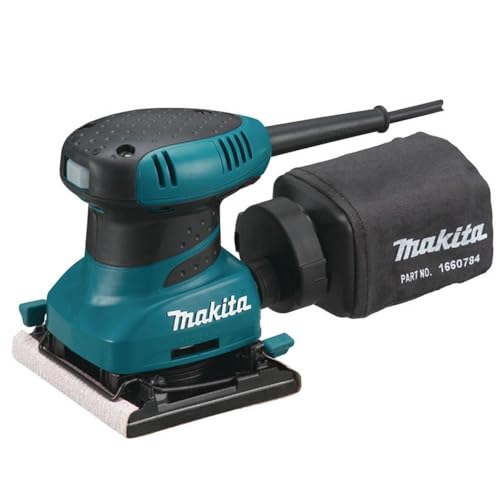
Makita BO4556 1/4 in. Sheet Finishing Sander
The Makita BO4556 earns its place on this list for one reason above all others: the square 1/4-sheet sanding pad. When you’re working inside a cabinet box — sanding the back panel, shelf dadoes, and interior side walls — a round orbital pad always leaves unsanded corners. The BO4556’s square pad gets all the way into 90-degree angles that a round disc physically cannot reach, making it genuinely indispensable for thorough interior cabinet work. Powered by a 2.0-amp motor delivering 14,000 OPM, it has more than enough speed for the task.
Beyond that specific advantage, it’s an excellent tool in its own right. All-ball bearing construction reduces noise and vibration for easier handling, and the rubberized contoured palm grip makes it secure and comfortable even in awkward angles inside a cabinet. The large clamping lever makes paper installation quick and easy — no fumbling around in tight spaces. I’d strongly suggest pairing this alongside one of the orbital sanders above rather than choosing between them. For cabinet interiors specifically, it does things no random orbital can do. If you’re curious how finishing sanders like this stack up in the broader Best Sanders for Furniture 2026 category, that guide is worth a read too.
ℹ️ Did You Know?
A round 5-inch orbital pad leaves a small unsanded crescent in every 90-degree corner — typically about half an inch on each wall. On a standard cabinet with four interior corners per shelf opening, those missed spots add up fast. A square-pad sander eliminates this completely.
Key Features:
- ✅ Square 1/4-sheet pad reaches corners that round orbital pads cannot
- ✅ 2.0-amp motor delivers 14,000 OPM for efficient finishing
- ✅ All-ball bearing construction reduces noise and vibration
- ✅ Rubberized contoured palm grip for secure, comfortable hold
- ✅ Large clamping lever for fast, easy paper installation
- ✅ Lightweight and very easy to maneuver in tight cabinet spaces
- ✅ Includes abrasive papers, dust bag, and punch plate
- ❌ No variable speed control
- ❌ Less efficient than a 5-inch RO sander on large flat panels
Best For:
Anyone doing thorough interior cabinet work — especially on built-in or frameless boxes where every corner needs to be cleanly sanded before staining or painting. Best used alongside a 5-inch orbital for the flat faces.
BLACK+DECKER BDEMS600 Mouse Detail Sander
The B+D Mouse is the specialist on this list — purpose-built for the spots that every other sander here simply cannot reach. The pointed triangular pad is designed to get into tight corners, along edges, and into recessed areas that would stump any pad sander. For cabinet work this makes it essentially essential: door frame profiles, stile-and-rail junctions, decorative molding details, the edges of drawer openings. Running at 16,000 OPM through a 1.2-amp motor, it has enough power for detailed surface work without being aggressive. If you want a truly complete, professional cabinet finish, this handles the last 20% of the job that no other tool can.
The 3-position grip design reduces fatigue during detailed work, and it comes with a detail-finger attachment that extends its reach even further into tight channels and profiles. The compact design navigates cramped corners and tight spaces with ease — that’s the whole point of this tool. At its very accessible price, owning this alongside one of the orbital sanders above is an easy decision. Between a good finish orbital for the flat faces, the Makita for interior corners, and this for detail work, you have every single surface on a cabinet fully covered. For other situations where a compact, maneuverable sander is the answer, my roundup of the Best Palm Sanders 2026 covers a wider range of compact options worth knowing about.
⚠️ Important
Always wipe down all sanded surfaces with a tack cloth or a slightly damp rag before applying any finish. Sanding dust left on the surface — even dust you can’t see — will contaminate your paint or stain and create a rough, gritty texture in the final coat.
Key Features:
- ✅ Pointed triangular pad reaches corners and profiles nothing else can
- ✅ 1.2-amp motor at 16,000 OPM — effective and controlled for detail work
- ✅ 3-position grip for enhanced control and reduced fatigue
- ✅ Detail-finger attachment included for even tighter spots and narrow profiles
- ✅ Compact design navigates cramped corners and tight cabinet spaces with ease
- ✅ Corded design provides unlimited runtime for extended sessions
- ✅ Very affordable — easy to own alongside another sander
- ❌ Not a replacement for a pad sander on larger flat surfaces
- ❌ Small pad means slower coverage on open areas
Best For:
Anyone wanting a truly complete, professional cabinet finish — especially on cabinets with decorative molding, routed profiles, or tight door-frame junctions where a standard sander can’t follow the shape.
How to Sand Cabinets: A Step-by-Step Guide
Having the right tools is half the battle — knowing how to use them on cabinets is the other half. Here’s the approach I follow on every cabinet project for a consistently professional result. Each step below maps directly to one or more of the sanders reviewed above, so you can see exactly where each tool earns its keep.
Step 1: Disassemble First
Remove all doors, drawer fronts, and hardware before you start sanding. Working on flat, detached panels is infinitely easier than sanding in place, and it means you can reach every surface properly. Label the backs of doors and drawers so you know where they go back — this takes thirty seconds and saves real frustration at reassembly.
Step 2: Start with the Flat Faces
Use your finish orbital — the Bosch, DEWALT, or Festool — on all large flat surfaces: door faces, drawer fronts, cabinet side panels. Start with 120 grit to remove the existing finish or level the surface, then follow up with 180 or 220 for final smoothing. Always let the sander do the work — don’t press hard, just guide it. If you’re curious how these tools compare for furniture work more broadly, I cover that in detail in my random orbital sander reviews.
Step 3: Sand the Interior Box
This is where the Makita BO4556 earns its place. The interior of a cabinet box — back panel, side walls, top and bottom — has corners that a round pad simply can’t reach cleanly. Use the Makita to work all interior surfaces, getting all the way into the 90-degree corners. Again, 120 grit first, then 180.
Step 4: Handle the Detail Work
Any recessed profiles, door molding, frame junctions, or tight areas that still need attention get the B+D Mouse treatment. Work carefully and methodically — these are the spots that reveal themselves under a finish if they’re missed. The finger attachment is especially useful for narrow routed channels and stile-and-rail profiles on shaker-style doors.
Step 5: Hand Sand the Last Spots
Even with all five tools above, there will always be a few spots requiring hand sanding. Fold a piece of 180 or 220 grit sandpaper and work any remaining areas manually — typically the very tightest corners, inside profiles, and anywhere the machines left a slight witness mark. Give everything a final light hand sand with the grain at 220 before applying your finish.
How to Choose the Best Sander for Cabinets
Cabinets demand more from a sander than most other woodworking tasks. Before buying, it’s worth thinking through exactly which surfaces you need to cover and what finish you’re aiming for. Here are the factors I weigh when choosing a cabinet sander.
Sander Type — Match the Tool to the Surface
Random orbital sanders (5-inch disc) are the workhorses for large flat surfaces — door fronts, side panels, drawer faces. The random motion prevents swirl marks and cuts efficiently through old finishes. A sheet or finishing sander with a square pad is the right call for interior cabinet boxes, because the square corners reach into 90-degree angles a round disc can’t. A detail sander with a triangular pad handles profiles, molding, and the tight spots where both other types give up.
For most complete cabinet jobs, I’d recommend having at least two types — one orbital for the flat faces and one detail or sheet sander for the corners. If you’re interested in exploring cordless options for any of these roles, my Best Cordless Sanders 2026 guide covers the best battery-powered picks available right now.
Variable Speed — More Useful Than You Might Think
On cabinets, variable speed matters. Slower speeds suit delicate veneer, painted surfaces between coats, and final finishing passes where you don’t want to cut too aggressively. Higher speeds are better for initial paint or finish removal. If you’re investing in a primary orbital sander for cabinet work, variable speed is a feature I’d call essential rather than optional.
Dust Collection — Critical for Cabinet Interiors
Cabinet interiors trap dust like nowhere else. Good dust collection isn’t just about keeping your workshop clean — it’s about keeping dust out of your finish. A fine sanding dust particle that settles inside a cabinet before you apply stain will create a visible grit inclusion in your topcoat. Look for a sander with a microfilter canister or, better still, a vac port you can connect to a shop vacuum. For the very best results — especially on painted finishes — the Festool’s interlocking CT connector dust port integration is genuinely in a different class from everything else on this list.
Pad Size and Shape
A 5-inch round pad is the standard for flat cabinet faces and is broadly the most versatile option. A square 1/4-sheet pad is essential for reaching 90-degree cabinet interior corners. A triangular pointed pad is the specialist choice for molding, profiles, and tight decorative details. Matching pad shape to the surface is the single most impactful technique upgrade most people make when they switch from a single sander to a two- or three-sander kit.
Weight and Ergonomics
Cabinet work involves a lot of overhead sanding, awkward angles inside a box, and sustained repetitive motion. A lighter sander reduces fatigue significantly on a full-day refinishing project. The Bosch ROS20VSC and Makita BO4556 both shine here — they’re meaningfully lighter than many competitors and far more comfortable to use inside a confined cabinet interior. If you want to understand more about why a dedicated sander beats a multi-tool for this kind of sustained work, my article on Why You Should Use a Sander Over an Oscillating Tool lays out the case clearly.
🏆 The Verdict
For most people doing serious cabinet work in 2026, the Festool RTS 400 REQ-Plus is the finest all-round cabinet sander you can buy — the finish quality, dust extraction, and long-term build are simply unmatched. If you want the same swirl-free results at a more accessible price, the Bosch ROS20VSC is the one I’d hand to almost anyone and be confident they’d be thrilled with the results. Whichever orbital you choose, add the Makita BO4556 for interior corners and the BLACK+DECKER BDEMS600 Mouse for detail profiles — together, those tools cover every surface a cabinet can throw at you.
❓ Frequently Asked Questions
What grit sandpaper should I use for sanding cabinets?+
Should I use a random orbital sander or a sheet sander for cabinet work?+
Do I need to sand between coats of paint or stain on cabinets?+
Can I sand cabinets without removing the doors?+
How do I sand inside tight cabinet corners that my sander can’t reach?+
Conclusion
Cabinet sanding is one of those tasks where matching the right tool to each surface makes all the difference between a finish you’re proud of and one that bothers you every time you open a door. The Festool RTS 400 REQ-Plus is the gold standard for flat faces if quality is your top priority, while the Bosch ROS20VSC delivers outstanding results at a more accessible price point. Add the Makita BO4556 for interior corners and the BLACK+DECKER BDEMS600 Mouse for profiles and detail work, and you’ve genuinely got every surface covered.
If you’re building out your sanding kit beyond cabinets, I’d also point you toward my roundup of the Best Spindle Sanders 2026 for curved work, and the Best Cheap Sanders 2026 if you’re looking to fill out your toolkit without overspending. If you have any questions about your specific cabinet project, drop a comment below and I’ll do my best to help.
