
As an Amazon Associate I earn from qualifying purchases. All claims are strictly my personal opinion.
Editor’s Choice
Short on time? Of the 7 sanders on this list for doors, this is the one I'd buy.
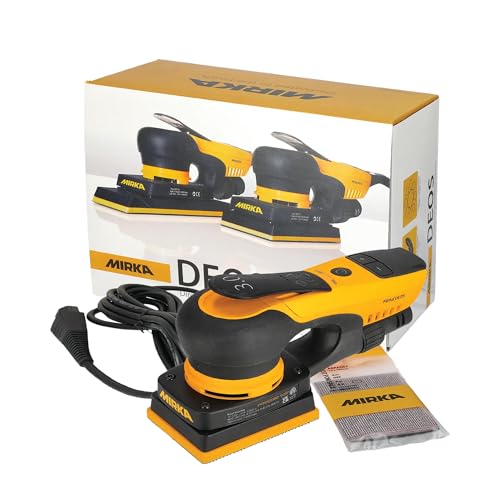
A compact 3 x 4-inch brushless sheet sander that Mirka designed for doors, windows and frames.
- Budget pick Bosch ROS20VSCA variable-speed 5-inch random orbit sander that leaves a swirl-free finish on painted or stained doors.
- Also recommended BLACK+DECKER MouseThe pointed pad that finishes the spots every flat-pad sander leaves behind.

The best sander for doors is a compact orbital sander for the flat faces plus a detail sander for the panel corners and molding. No single door sander covers every zone of a door: flat stiles and rails, recessed panels, profiled molding, the edges and the glass. Here are the picks I’d reach for in 2026, whether the job is an interior repaint, an exterior refinish or a new install, chosen so that every zone of a door is covered.
Below you’ll find seven door sanders compared side by side, short reviews, a step-by-step guide on how to sand a door (in place or off its hinges, panel or flush, plus frames and a sticking edge), a grit table for each door job, and answers to the questions people ask most. The specs come from each maker’s own page. If your doors are going straight to paint after a strip, start with the guide to stripping paint from wood and come back here for the sanding.
Best Sanders for Doors Comparison
I picked each of these sanders specifically for door work, weighing pad shape and size, weight for one-handed vertical use, dust collection, and how each handles the transition between flat faces and detailed panel work. Here’s how the seven door sanders stack up side by side.
| Product | ⭐ Mirka DEOS 343X 🏆 EDITOR’S CHOICE |
Festool ETS EC 150/5 EQ-Plus | Festool ETS 125 REQ-Plus | Bosch ROS20VSC | Makita BO4556K | DEWALT DCW200B | BLACK+DECKER BDEMS600 Mouse |
|---|---|---|---|---|---|---|---|
| Image | |
 |
 |
 |
 |
 |
 |
| Type | Compact sheet sander | 6″ random orbit | 5″ random orbit | 5″ random orbit | 1/4-sheet finishing sander | Cordless 1/4-sheet sander | Detail (mouse) sander |
| Pad | 3″ x 4″ rectangular | 6″ round | 5″ round | 5″ round | 4-1/2″ x 4″ square | 1/4 sheet, square | Pointed detail pad |
| Motor | 250 W brushless | 400 W EC brushless | 250 W | 2.5 A | 2.0 A | 20V brushless | 1.2 A |
| Orbit / Speed | 3 mm orbit | 5 mm stroke | 2 mm stroke | 7,500-12,000 OPM | 14,000 OPM | 8,000-14,000 OPM | 16,000 OPM |
| Variable Speed | ✅ Yes | ✅ Yes | ✅ Yes | ✅ Yes | ❌ No | ✅ Yes | ❌ No |
| Dust Collection | Extractor port | Extractor port | Extractor port | Microfilter canister | Dust bag | Dust bag or vacuum | Dust canister |
| Best For | Every door type, frames | Large flush doors | Glazed and panel doors | Best value all-rounder | Square corners on a budget | Doors sanded in place | Panel corners and molding |
| Warranty | 2 years | 3 years | 3 years | 1 year | 1 year | 3 years | 2 years |
| Price | $$$$ | $$$$ | $$$ | $$ | $$ | $$ (tool only) | $ |
| Buy | Check price on Amazon | Check price on Amazon | Check price on Amazon | Check price on Amazon | Check price on Amazon | Check price on Amazon | Check price on Amazon |
Key takeaways
- Best door sander overall: the Mirka DEOS 343X. Its rectangular 3 x 4-inch pad follows stiles and rails and reaches square corners that a round pad can’t.
- Best for large flush door faces: the Festool ETS EC 150/5 EQ-Plus, whose 6-inch pad covers more ground per pass.
- Best for glazed and panel doors: the Festool ETS 125 REQ-Plus, a compact 5-inch pad that works around glazing bars and panel molding.
- Best value: the Bosch ROS20VSC. Budget square-pad option: the Makita BO4556K. No cord on a ladder or in a hallway: the DEWALT DCW200B.
- Whatever main sander you choose, a panel door also needs a detail sander like the BLACK+DECKER Mouse for the panel corners and molding profiles.
💡 Pro Tip
Whenever possible, remove the door from its hinges before sanding. Laying it flat on sawhorses gives you far better control, prevents sawdust from settling into the hinge mortises, and means gravity isn’t working against you the whole time. It takes five minutes and makes a noticeable difference to the quality of the result, especially on the top rail and any recessed panel work.
Best Sanders for Doors Reviews
Below I’ve reviewed each door sander, covering what it does well, where it fits in a door-sanding workflow, and exactly who it’s best suited for. They’re ordered from my overall top pick down through the specialists, so you can read straight through or jump to the one that matches your doors.
Editor's Choice3 x 4-inch sheet sander
Mirka DEOS 343X
Mirka DEOS 343X Compact Sheet Sander
A compact brushless sheet sander whose 3 x 4-inch pad follows stiles and rails and gets close to hardware and glass.
Check price on AmazonSpecs: Mirka
Best for
One premium sander for every door type, from flush to panel and glazed, plus the frames.
- Compact pad fits door edges and stiles
- Brushless motor, low vibration
- Dust extractor-compatible
Skip it if
You only sand a door now and then: the Bosch ROS20VSC costs far less.
- Premium price
- Mirka-specific accessories add running costs
Read full review
The Mirka DEOS 343X is my top pick for door sanding in 2026, and it earns that spot by solving the exact problems that make door work tricky. Mirka itself describes it as a sander for windows, doors and frames, and the geometry backs that up: the compact 3 x 4-inch rectangular pad follows the straight edges of stiles and rails, reaches into square corners, and gets closer to hardware and glass than any round pad can. The 250 W brushless motor runs with a 3 mm orbit, speed is set with a lever, and at about 2.1 lbs it’s light enough to hold one-handed against a hung door.
Key Features:
Where the DEOS earns its place is the transition between zones on a panel door. A round pad stops short of every inside corner where a stile meets a rail; the DEOS’s square-cornered pad keeps going right into that corner before you need to bring in the detail sander. Connected to a dust extractor, the workspace stays far cleaner, which matters when you’re refinishing a door in place inside the house. If you’re weighing Mirka against Festool more generally, the Festool vs Mirka comparison covers the two systems side by side.
Best for flush doors6-inch random orbit sander
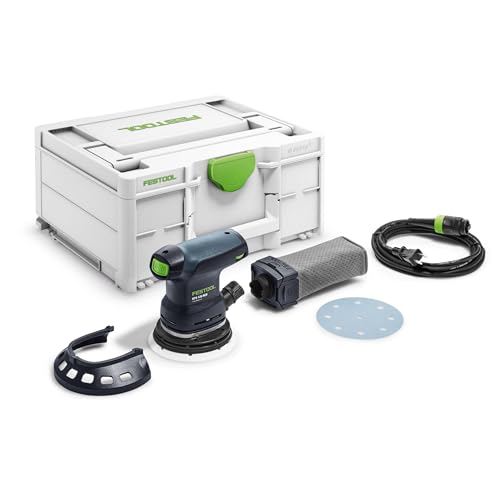
Festool ETS EC 150/5 EQ-Plus
Festool ETS EC 150/5 EQ-Plus 6-Inch Random Orbital Sander
A brushless 6-inch random orbit sander with a 5 mm stroke that covers large, flat door faces in fewer passes.
Check price on AmazonSpecs: Festool
Best for
Large flush doors and wide flat panels, when speed and finish come first.
- 6" pad covers large door faces faster
- EC brushless motor with pad brake
- Constant speed under load
Skip it if
Your doors have glazing bars or tight panel work: the 5-inch ETS 125 is more precise.
- Big price premium over mid-range sanders
- Festool discs add running costs
Read full review
The Festool ETS EC 150/5 EQ-Plus steps up to a 6-inch sanding pad while keeping a low, palm-friendly body. That larger pad means noticeably faster coverage on the flat faces of door panels and stiles (you cover the same area in fewer passes), and the EC brushless motor holds a constant speed under load. This is the tool I’d pick when the priority is speed on large, open door faces.
Key Features:
What makes this tool well suited to doors specifically is the combination of the EC brushless motor and Festool’s vibration control. When you’re sanding a door vertically in place, fatigue accumulates fast, and a smooth-running sander is easier to keep flat on the surface. Connected to a compatible extractor, very little dust escapes at the surface, which matters when you’re working inside the house. If you want the fastest, smoothest finish on flush and flat-panel doors and you’ll use it regularly, this is a tool built for years of work. For the full lineup, see my guide to Festool sanders.
Best for panel doors5-inch random orbit sander
Festool ETS 125 REQ-Plus
Festool ETS 125 REQ-Plus 5-Inch Random Orbital Sander
A compact 5-inch Festool that works around glazing bars and panel molding with less risk of hitting the detail.
Check price on AmazonSpecs: Festool
Best for
Panel and glazed doors, and fine stained finishes where swirl marks show.
- Compact 5" pad, precise around glazing
- Balanced design for a swirl-free finish
- Jetstream dust extraction
Skip it if
You mostly sand plain flush doors, where the 6-inch pad is faster.
- Premium price
- Slower on big faces than the ETS EC 150
Read full review
One of the finest one-handed random orbital sanders made. The Festool ETS 125 REQ-Plus is more compact than the ETS EC 150 above, which for door work is often a genuine advantage: the smaller 5-inch pad navigates around window panes, glazing bars, and panel molding with less risk of catching the surrounding detail or the glass. It’s the tool I’d pick for a door with complex panel work or glazing, whereas the ETS EC 150 wins on a plain flush door where coverage speed matters more.
Key Features:
The body fits naturally in one hand for vertical sanding, and the 2 mm stroke is a finishing stroke: it removes material more slowly than the 5 mm EC 150 but leaves a finer surface, which is what you want on delicate stained doors where swirl marks show. Step-less variable speed lets you dial back for the final pass on a sensitive finish.
Best value5-inch random orbit sander
Bosch ROS20VSC
Bosch ROS20VSC Random Orbit Sander
Swirl-free random orbit sanding with variable speed and a microfilter canister, at a fraction of the Festool price.
Check price on AmazonSpecs: Bosch
Best for
Homeowners and trades who want pro door results without a premium tool.
- Variable speed for finishing control
- Microfilter dust canister
- Carrying bag included
Skip it if
You need to reach panel corners: the round pad can't, so add a detail sander.
- Not quite Festool finish quality
- Pad can warm up in long sessions
Read full review
The Bosch ROS20VSC is my recommendation for anyone who wants professional results without the Festool price tag, and it’s genuinely excellent value. For door sanding in particular, its two standout qualities are weight and maneuverability: at 3.5 lbs it’s easy to hold vertically against a mounted door, and the compact body handles well with just one hand. Bosch lists a 2.5 A motor, 7,500 to 12,000 OPM variable speed and a pad dampening brake to help prevent swirl marks.
Key Features:
Performance-wise it punches well above its price: the variable speed is smooth and responsive, the microfilter canister catches a good share of the dust, and the swirl-free random orbit action produces a clean finish on painted or stained door faces. For a homeowner or tradesperson who wants a long-lasting door sander at a fair price, this is exactly where I’d point them. It also pairs well with the work covered in my guide to the best sanders for furniture and cabinets: many of the same techniques apply. The full write-up is in my Bosch ROS20VSC review.
Budget square pad1/4-sheet finishing sander
Makita BO4556K
Makita BO4556K 1/4 Sheet Finishing Sander
A 1/4-sheet finishing sander whose square pad reaches the inside corners of stiles and rails that a round pad misses.
Check price on AmazonSpecs: Makita
Best for
Painted panel and Shaker-style doors on a budget.
- Square pad reaches inside corners
- Uses cheap clamp-in sheet paper
- Dust bag and case included
Skip it if
You stain bare hardwood doors: a random orbit leaves a finer scratch pattern.
- Single speed
- Slower than a random orbit on big flush faces
Read full review
A square pad is the cheapest way to get into the corners of a door. The Makita BO4556K is a 1/4-sheet finishing sander with a 4-1/2 x 4-inch pad, a 2.0 A motor at 14,000 OPM and a large clamping lever for regular sandpaper, so you can cut your own sheets from a standard 9 x 11 sheet instead of buying discs. The square edge runs right up to the line where a stile meets a rail or a panel meets its frame, which a round random orbit pad can’t do.
Key Features:
The trade-off with any sheet sander is the scratch pattern: an orbital sheet sander moves in a fixed orbit, so on bare wood that will take a stain it can leave faint loops. On a door going to paint that hardly matters, and for scuffing between coats it’s ideal. If you’re choosing between the two pad types for other jobs too, my sheet sander vs random orbital sander guide goes through the differences.
Best cordlessCordless 1/4-sheet sander
DEWALT DCW200B
DEWALT DCW200B 20V MAX XR Cordless 1/4 Sheet Sander
A brushless 20V 1/4-sheet sander with variable speed and no cord to catch on a hung door, a ladder or a finished floor.
Check price on AmazonSpecs: DEWALT
Best for
Sanding doors and trim in place, room to room, if you own DEWALT 20V batteries.
- No cord when sanding doors in place
- Square pad and variable speed
- Fits DEWALT vacuum hoses
Skip it if
You have no DEWALT batteries: the corded Makita BO4556K does the same corner work for less.
- Battery and charger sold separately
- Dust bag alone catches less indoors
Read full review
Sanding a door where it hangs means working from a step stool, around a door handle and down a hallway, and a cord catches on all of it. The DEWALT DCW200B is a brushless cordless 1/4-sheet sander with a variable-speed dial from 8,000 to 14,000 OPM, a low profile that keeps your hand close to the surface, and a dust port that takes DEWALT’s vacuum hoses or a 1-1/4-inch hose with an adapter. It’s sold as a bare tool, so it makes most sense if you already run DEWALT 20V batteries.
Key Features:
On a hung door, the square pad does the same job as the Makita’s: it runs into the corners of the panels and along the edge of the frame. Variable speed is the other reason to choose it, since a lower speed is easier to control on the vertical face and for the light scuff between coats. For more battery options, including random orbit models, see the best cordless sanders.
Detail specialistMouse detail sander
BLACK+DECKER BDEMS600
BLACK+DECKER BDEMS600 Mouse Detail Sander
The companion for panel doors: a pointed pad for panel corners, molding profiles and glazing bars.
Best for
Panel doors, glazed doors and any door with decorative molding.
- Pointed pad reaches panel corners
- Detail finger attachment
- Very budget-friendly
Skip it if
Your doors are plain and flush: an orbital sander covers them alone.
- Not a replacement for an orbital on flat faces
- Small pad, slow on large areas
Read full review
The B+D Mouse is the secret weapon for any door with panels, molding, or glazing bars, and it’s genuinely indispensable there. The pointed pad is designed to reach the places that stop every other tool on this list: the tight inside corners of panel recesses, the profiled molding that borders each panel, and the junction between a glazing bar and the frame. These are exactly the spots where old paint builds up thickest and where a missed patch is most visible once the new coat goes on.
Key Features:
Used after one of the sanders above has handled the flat faces, the Mouse takes care of everything that remains. Think of it not as an alternative to the other tools on this list, but as the finishing move that gets a panel door from nearly done to truly complete. It’s easy to control in tight spaces and affordable enough that there’s little reason not to own one if you ever sand a panel door. If you’re also tackling stairs with similar molding profiles, I cover some great options in my best sanders for stairs guide, and the best detail sanders cover the category in full.
How to Sand a Door: In-Place vs. Removed
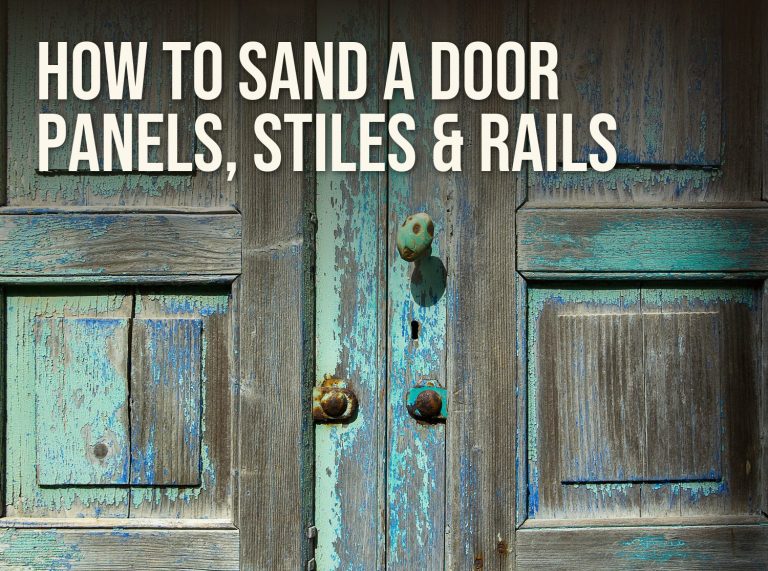
The two main ways to sand a door are quite different in practice, and knowing which one suits your situation saves a lot of frustration. Whichever you choose, the order is the same: prepare, sand the flat faces, sand the detail, sand the edges, then clean. Here’s how I approach each one, and when I’d choose one over the other.
⚠️ Lead Paint First
The EPA notes that homes built before 1978 may have lead-based paint, and names surfaces that rub, like doors, as a source of lead chips and dust. Sanding that paint makes the dust airborne. On an older door, test the paint before you sand. If it contains lead, follow the EPA’s lead-safe practices or use a certified contractor instead of dry-sanding it yourself.
Sanding a Door In Place (Mounted)
Working on a mounted door is the more practical option for a quick refresh or a light scuff sand between coats. Use a lightweight one-handed sander (the Mirka DEOS, the Bosch ROS20VSC, either Festool, or the cordless DEWALT) and work methodically from top to bottom. Keep your sander moving at all times and use the lightest pressure that still removes material; gravity wants the tool to drag downward and leave heavier marks at the bottom of each pass if you’re not careful.
Wedge the door so it can’t swing, tape off glass panes and hardware (or better, take the handle and latch plate off), and keep a vacuum close by. Sanding dust on a vertical surface falls straight down and settles on every horizontal surface below: floor, baseboards, furniture. A sander connected to an extractor makes this much more manageable indoors; the best dustless sanders are the ones built for exactly that.
Sanding a Door Removed (Flat)
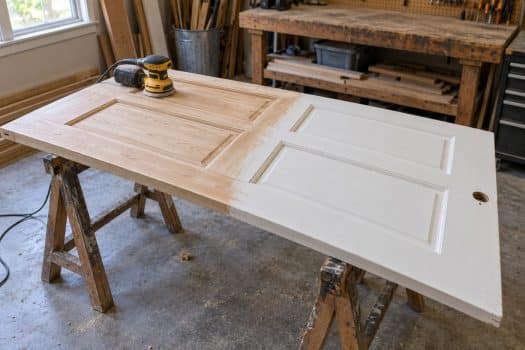
This is the better approach whenever a thorough job is needed. Remove the door, pull the hinges and hardware, and lay it flat across a pair of sawhorses at a comfortable working height. You now have full access to every surface including the top and bottom edges, the sander isn’t fighting gravity, and you can lean into the work with both hands when needed.
Work the flat faces first with your main sander, handle the panel detail with the detail sander, then finish with hand sanding any remaining spots before reinstalling. The extra time to remove and rehang the door is small compared to the total job time, and the quality difference is significant. My guide to the best sanders for removing paint goes into detail on stripping painted doors. On a door with many old coats, strip the old paint with a heat gun first, or follow my guide to stripping paint from wood for the chemical route.
Tackling Panel Doors
Panel doors require a zoned approach. Sand each flat section (the panel faces, then the rails, then the stiles) independently with your main sander, always working with the grain. Where a rail meets a stile the grain changes direction, so finish each joint by sanding the rail first and the stile last, along its own grain, to cut off any cross-grain scratches. Then switch to the detail sander for panel corners and molding profiles, and finish with hand sanding any remaining tight spots.
Here’s that order on a three-panel door, with the grain direction for each part:
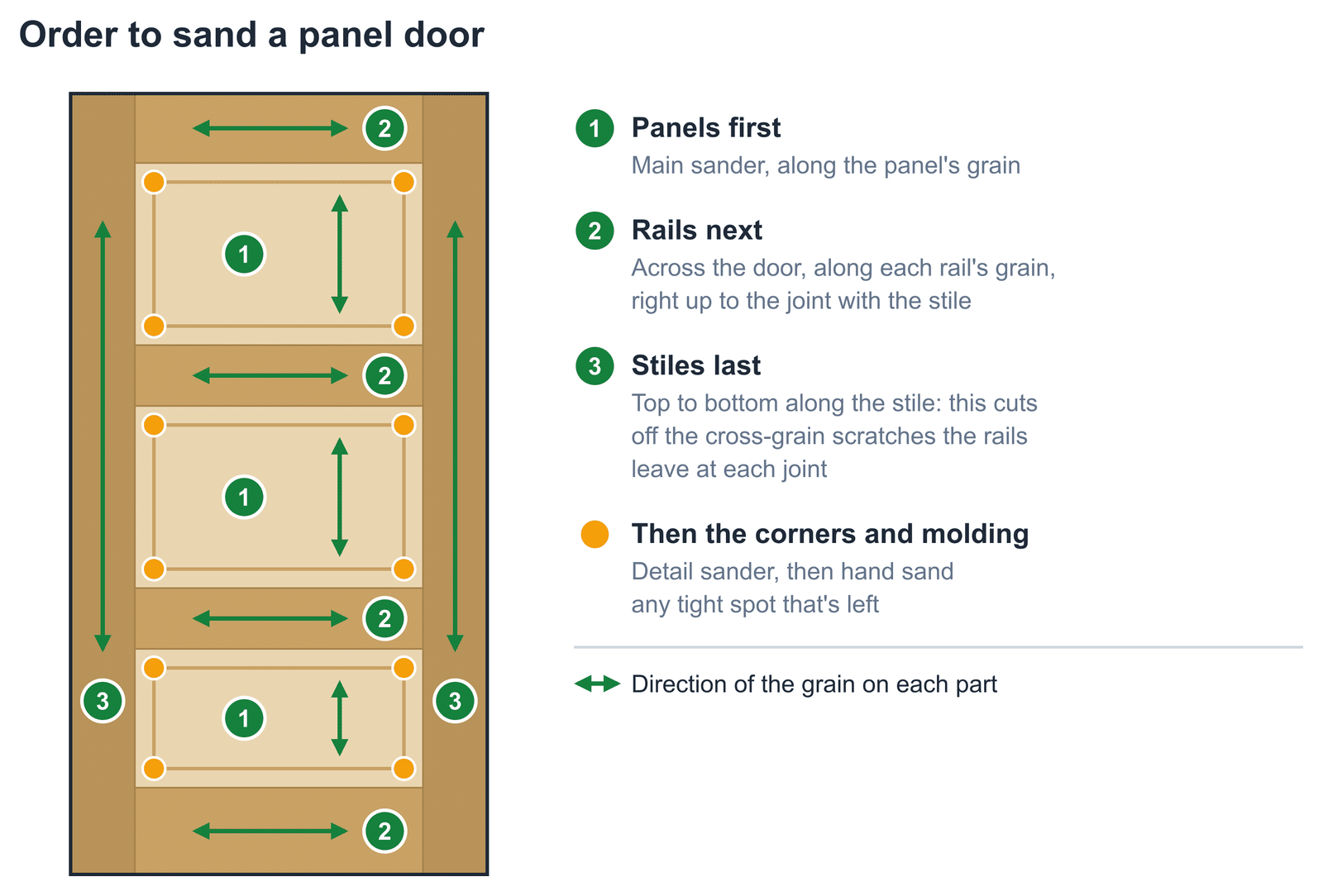
The key is to work each zone to completion before moving to the next, rather than trying to do everything in one broad pass with one tool. It takes more patience but the result is a finish where nothing was missed: no paint ridges in panel corners, no unsanded strip along the molding border.
Door Frames, Casings and Trim
A door frame is a set of narrow, flat strips with a profile on one edge, so a big round pad is the wrong tool. A compact sheet sander like the Mirka DEOS, the Makita or the DEWALT covers the flat faces of the casing and the jamb, and the Mouse or a flexible sanding sponge follows the profile. Mask the wall along the casing, because a sander that slips off the edge will scuff the paint on the drywall. Fill dents and nail holes with a wood filler after the first sanding pass and sand it flush with the finish grit.
Sanding the Edge or Bottom of a Sticking Door
When a door sticks, mark where it rubs (a pencil line or chalk on the frame shows it), then sand that edge with a sheet sander and 80 grit until it clears, checking the fit as you go. You can reach the latch side and a small amount at the bottom with the door hung, but trimming more than a sliver off the bottom is easier and straighter with the door off. Whatever you remove, seal the bare edge with primer and paint afterwards: unsealed wood takes on moisture and the door will swell again.
⚠️ Important
On exterior doors, always check the condition of the wood before sanding. If there are soft, punky areas, particularly at the bottom rail where water collects, treat them with a wood hardener before sanding, not just sand them away. Sanding over soft, damaged wood removes material without solving the underlying problem and can turn a small issue into a much larger one.
What Grit to Use on a Door
The grit depends on what is already on the door and what goes on next. These steps follow my grit guide for wood and the sandpaper grit chart.
| Door job | Grit steps | Notes |
|---|---|---|
| Repaint a sound painted door | 120 to 150 | Scuff until the gloss is gone; you are not trying to reach bare wood |
| Strip old paint or varnish | 80, then 120, then 150 to 180 | Stop at 150 before paint, go to 180 before stain |
| New bare wood door | 120, then 150 | 180 or 220 on smooth hardwood under a clear finish |
| Between coats | 220 to 320 | Very light pressure, then remove all the dust |
| Sticking edge | 80, then 120 | Seal the bare edge afterwards |
How to Choose the Best Sander for Your Door
Not every door-sanding job calls for the same tool. Before spending money on a new door sander, think through these factors to match the tool to your project.
Door Type: Flush vs. Panel
Flush doors are the simplest case: a large flat surface on each face with minimal detail. A 5″ or 6″ random orbital sander handles these brilliantly, and coverage speed becomes more important than precision. The Festool ETS EC 150 or the Mirka DEOS both excel here.
Panel doors are a different challenge entirely. You have flat stiles and rails, recessed panel faces, and profiled molding borders, at least three distinct zones that each need a different approach. A good door-sanding kit for a panel door includes a main sander for the flat zones and a detail sander for everything else. Don’t try to do it all with one tool.
Pad Shape: Round vs. Square
A round random orbit pad gives the best finish on open faces but can’t reach a square inside corner. A square or rectangular pad (Mirka DEOS, Makita, DEWALT) goes right into the corner where a stile meets a rail, at the cost of a fixed orbit that can leave faint loops on bare wood. On doors going to paint, a square pad is often the more useful single tool; on stained hardwood doors, the random orbit finish matters more. My detail sander vs orbital sander guide covers where each one stops.
In-Place vs. Removed Sanding
If you’re sanding the door while it’s still mounted on its hinges, weight is the most important spec on your sander. A light sander like the Mirka DEOS at about 2.1 lbs feels completely different from a heavier tool after half an hour of vertical sanding, and no cord helps too. Go as light as possible for mounted work.
If you always remove doors and work flat, weight matters less and coverage speed becomes the priority, which is where the 6″ Festool ETS EC 150 earns its keep.
Dust Management
If you’re sanding indoors, dust collection is non-negotiable. Sanding a door in a hallway or bedroom without dust control means fine dust settling over every surface in the room for hours. The Mirka DEOS and both Festool sanders connect to dedicated extractors, the Bosch ROS20VSC’s microfilter canister is a solid middle ground, and the bags on the sheet sanders catch less. Wear a dust mask either way; the best respirators for sanding cover what to look for. My best sanders for walls guide covers the same dust-management principles for indoor work.
ℹ️ Did You Know?
New paint grips poorly on a glossy old finish. A scuff sand that takes the shine off, even on a smooth factory-primed door, gives the next coat something to bond to. Wipe the dust off with a damp cloth or tack cloth before you paint, or it ends up in the finish.
How I Chose These Door Sanders
I looked at sanders that a homeowner or painter can buy and use on a standard interior or exterior door, from makers that publish their specifications, and that are on sale on Amazon today. The criteria, in order:
- Pad shape and size for door zones: a large pad for flush faces, a compact or square pad for stiles, rails and corners, and a pointed pad for molding.
- Weight and one-handed control, because many doors are sanded where they hang.
- Dust collection: an extractor port or at least a canister, since most doors are sanded indoors.
- Published specs: motor, orbit or speed and warranty are taken from Mirka, Festool, Bosch, Makita, DEWALT and BLACK+DECKER pages. Prices are shown as tiers only.
I didn’t include belt sanders (too aggressive for a door, see the FAQ) or industrial door sanding machines, the brush and contour sanders that cabinet shops use for production runs, since they are a different purchase from a handheld door sander.
🏆 The Verdict
The Mirka DEOS 343X is my overall pick for door sanding in 2026: a brushless motor, low vibration and a compact 3 x 4-inch pad that reaches the corners of stiles and rails. For a mid-range alternative that still delivers professional results, the Bosch ROS20VSC is outstanding value and I’d recommend it without hesitation; on a tight budget, the square-padded Makita BO4556K does the painted-door job well. And no matter which main sander you choose, if your doors have any panel detail at all, add the BLACK+DECKER Mouse to your kit: it’s the tool that takes a good finish and makes it a great one.
❓ Frequently Asked Questions
What is the best sander for sanding a door?+
What is the best way to sand a door?+
What can I use to sand down a door?+
Can I sand a door without removing it from its hinges?+
What grit sandpaper should I use on a door?+
What is the best sander for sanding door frames?+
What type of sander is best for sanding cabinet doors?+
How long should it take to sand a door?+
Can you sand the bottom of a door without taking it off?+
How do I sand the detailed molding around door panels?+
Should I use a belt sander on a door?+
Conclusion
Sanding doors is one of those tasks where having the right tool for each zone makes an enormous difference to the final result. With the Mirka DEOS handling tight spaces and all-round door work, the Festool ETS EC 150 covering large flat faces at speed, the Bosch ROS20VSC delivering professional results at a more accessible price, the Makita and DEWALT sheet sanders reaching square corners, and the BLACK+DECKER Mouse tackling every corner and molding profile the others can’t reach, no part of even the most ornate panel door is out of reach.
If you’re building out your wider sanding toolkit, my guide to the best sanders for wood is a great companion read, and if you’re wondering when a sander is the smarter choice over a multi-tool, I cover exactly that in orbital sander vs oscillating multi-tool. If you have questions about your specific door project, drop a comment below: I’m always happy to help. Thanks for reading!
