


As an Amazon Associate I earn from qualifying purchases. All claims are strictly my personal opinion.

If you want one sander that can handle almost anything you throw at it — from aggressively stripping old finishes off large panels to carefully smoothing a freshly built cabinet door — a belt sander is the tool you’re looking for. I’ve been using them for as long as I can remember, and there are few tools in the shop that give you the same combination of raw power, speed, and versatility. The wide, continuously moving belt covers ground fast, runs cool, and on a good machine leaves a surface that barely needs touching up before finishing.
In 2026 the belt sander market is healthier than ever — there are genuinely excellent options at every price point, from solid budget picks all the way up to professional-grade cordless machines that would have seemed impossible a few years ago. I’ve personally tested the best of them, and below you’ll find my honest, detailed reviews along with a full comparison table. Whether you’re a hobbyist picking up your first belt sander or a seasoned pro looking to upgrade, there’s something here for you.
One thing worth noting before we dive in: belt sanders come in two main styles. The traditional kind has the belt running underneath the machine — great for flat surfaces and large-area sanding. The front-facing style has the belt running out in front like a file, which is incredible for tight spots, contours, and metalwork. I cover both types below so you can choose exactly what suits your work.
⚡ Quick Pick
In a hurry? My top overall choice is the Makita 9903 — it delivers the finest balance of power, quiet operation, auto belt tracking, and build quality of any corded belt sander I’ve used.
If you want a budget-friendly entry point, go with the WEN 6321 — straightforward, reliable, and one of the most affordable full-size belt sanders you’ll find.
For a premium cordless upgrade, consider the DeWalt DCW220B — brushless cordless performance that genuinely competes with corded machines, with 25-step variable speed and exceptional dust collection.
Best Belt Sanders Comparison
Here’s a quick side-by-side look at every belt sander I’ve tested and reviewed below, spanning budget-friendly file sanders all the way up to professional-grade benchtop and cordless machines.
| Product | ⭐ Makita 9903 🏆 EDITOR’S CHOICE |
WEN 6321 | SKIL 7510-01 | Ryobi ZRBE319 | DeWalt DCW220B | Metabo HPT SB8V2 | Makita 9403 | Makita 9031 | Makita 9032 | 3M File Sander | EX Electronix Mini | Kalamazoo 1SM |
|---|---|---|---|---|---|---|---|---|---|---|---|---|
| Image |  |
 |
 |
 |
 |
 |
 |
 |
 |
 |
 |
 |
| Price | $ | $ | $ | $ | $ | $ | $ | $ | $ | $ | $ | $ |
| Motor | 8.8A | 7A | 6A | 6A | 20V Brushless | 9A | 11A | 5A | 4.4A | 0.6 HP Pneum. | 3.0A | 1/3 HP |
| Belt Size | 3×21″ | 3×21″ | 3×18″ | 3×18″ | 3×21″ | 3×21″ | 4×24″ | 1-1/8×21″ | Up to 1/2″ | File Belt | 1×30″ | 1×42″ |
| Variable Speed | ✅ | ❌ | ❌ | ❌ | ✅ (25 steps) | ✅ | ❌ | ✅ | ✅ | N/A | ❌ | ❌ |
| Type | Handheld | Handheld | Handheld | Handheld | Cordless | Handheld | Handheld | Front-Facing | Front-Facing | File/Pneumatic | Benchtop | Benchtop |
| Best For | Best All-Round | Budget Pick | Beginners+ | Casual Use | Pro Cordless | Hobbyists / Pro | Large Surfaces | Tight Spots | Metal / Detail | Metal Pro | Knife Making | Knife / Wood |
| Warranty | 1 year | 2 years | 1 year | 3 years | 3 years | 5 years | 1 year | 1 year | 1 year | 1 year | 1 year | 1 year |
| Availability | Shop Now at Amazon | Shop Now at Amazon | Shop Now at Amazon | Shop Now at Amazon | Shop Now at Amazon | Shop Now at Amazon | Shop Now at Amazon | Shop Now at Amazon | Shop Now at Amazon | Shop Now at Amazon | Shop Now at Amazon | Shop Now at Amazon |
⚡ Key Takeaways
- My top overall pick is the Makita 9903 — the finest balance of power, variable speed, quiet operation, and auto belt tracking in the corded category.
- Best budget pick: the WEN 6321 — a dependable full-size 3×21″ corded sander at the lowest practical price point.
- Best premium cordless: the DeWalt DCW220B — brushless 20V MAX performance that genuinely competes with corded machines.
- Best for large surfaces: the Makita 9403 — the legendary 4×24″ machine that covers more ground per pass than anything else on this list.
- Best for knife making and precision blade work: the Kalamazoo 1SM — an industrial-grade benchtop machine with a cult following in the knife-making world.
Belt Sander Reviews
Below are my in-depth, hands-on reviews of every belt sander in the comparison table above. I’ve used all of these personally and I’ll give you an honest picture — what each machine does well, where it falls short, and exactly who it’s best suited for. The reviews follow the same left-to-right order as the table columns, so you can cross-reference easily.
💡 Pro Tip
Belt sanders are aggressive tools — they remove material fast. If you’re new to them, always sand with the grain and keep the machine moving constantly. Leaving a belt sander stationary on wood for even a second or two can leave a noticeable gouge. Start with a medium grit like 80 and work up to finer grits for a smooth, finish-ready surface.
Makita 9903 3″ x 21″ Belt Sander
I’ve used a lot of belt sanders over the years. The Makita 9903 remains my personal favorite, and I don’t think that’s going to change anytime soon. It’s one of those machines that hits every mark — powerful, quiet, precise, and beautifully built — without asking you to pay a premium price for the privilege. The 8.8A motor delivers strong, consistent power, and the variable speed control dial (690–1,440 ft./min.) ensures you have exactly the right belt speed for any material, from rough lumber down to fine finish passes on delicate hardwood.
The feature I keep coming back to is the auto-tracking belt system. On cheaper machines, re-centering the belt is a constant annoyance. On the Makita 9903, it simply doesn’t wander — the belt stays centered automatically, which means you can focus entirely on the work rather than the machine. The dust bag is one of the most effective I’ve used at this price point, and the machine runs at just 85dB — shockingly quiet for a belt sander at full speed. The build quality is top-tier: durable materials, a long power cord that shows real user consideration, and an innovative design that lets you sand flush to a wall with both the nose and the side of the sander. If I could only recommend one belt sander to every woodworker reading this, it would be this one — no hesitation.
- ✅ Best-in-class auto belt tracking — stays centered without adjustment
- ✅ Powerful 8.8A motor with full variable speed (690–1,440 ft./min.)
- ✅ Exceptionally quiet at just 85dB
- ✅ Highly effective dust bag
- ✅ Innovative design for sanding flush to wall
- ✅ Balanced, comfortable, and easy to maneuver
- ✅ Outstanding build quality and long-term durability
- ❌ No cordless version available
- ❌ Slightly less raw amperage than the Metabo HPT SB8V2
Best For: Woodworkers of all levels who want the best all-round corded belt sander available — from weekend DIYers to full-time professionals who need a machine they can rely on every single day. This is my top pick, and it has been for years.
WEN 6321 7-Amp 3 in. x 21 in. Corded Belt Sander with Dust Bag
WEN consistently delivers reliable tools at genuinely accessible prices, and the 6321 is a good example of that philosophy. It’s a no-frills, straightforward 3×21-inch belt sander with a 7-amp motor that rotates the belt at over 13 feet per second — respectable output for everyday sanding tasks like smoothing lumber, cleaning up joints, and prepping surfaces for finish. At just six pounds, it’s light enough to maneuver comfortably without arm fatigue building up quickly.
The lock-in safety feature allows for continuous sanding without a constant grip on the trigger, which is a thoughtful detail that reduces fatigue on longer sessions. The included detachable dust bag keeps cleanup manageable during operation. The honest limitations here: the WEN 6321 lacks variable speed, which means you’re locked into a single belt speed regardless of what you’re sanding. The build is functional rather than robust, and it can be noticeably loud. But for occasional DIY projects where budget is the primary concern, this is a solid, dependable machine backed by a two-year warranty and a nationwide service network.
- ✅ Full 3×21″ belt — more coverage than competing budget models
- ✅ 7A motor — belt runs at over 13 feet per second
- ✅ Lightweight at just six pounds — comfortable for extended use
- ✅ Detachable dust bag included
- ✅ Lock-in safety feature for continuous sanding
- ✅ Two-year warranty with nationwide service network
- ❌ No variable speed
- ❌ Build quality is functional but not robust
- ❌ Can be noisy in operation
Best For: First-time belt sander buyers, casual DIYers, and anyone who needs a full-size corded machine for everyday workshop tasks without spending much.
SKIL 6 Amp 3″x18″ Belt Sander with Pressure Control – 7510-01
I picked up the SKIL Sandcat on the recommendation of several readers, and I came away genuinely impressed. At this price level you don’t usually expect meaningful feature differentiation — but the Sandcat delivers a few extras that set it apart. The standout is SKIL’s pressure control system, which alerts you when you’re applying too much force to the surface. That might sound like a gimmick, but for anyone learning to sand without gouging, it’s a genuinely valuable training tool that makes this the smartest first belt sander for beginners.
The auto belt tracker and micro-filtration dust system both work reliably — belt tracking in particular is one of my biggest pet peeves on budget machines, so finding it functioning smoothly here was a genuine plus. The 6A motor provides adequate power for regular use, and the machine is vacuum-compatible with standard 1-1/4″ hoses for even better dust control. The trade-off is the 3×18-inch belt — slightly smaller than the standard 3×21-inch — but the overall package is very well-rounded at this price point.
- ✅ Pressure control technology — genuinely useful for beginners
- ✅ Auto belt tracking works reliably
- ✅ Micro-filtration dust containment
- ✅ Vacuum-compatible with standard 1-1/4″ hoses
- ✅ Solid build quality for the price
- ❌ Smaller 3×18″ belt vs. standard 3×21″
- ❌ No variable speed
Best For: Beginners who want smart, forgiving features that help them learn good technique, and intermediate DIYers who want more than a bare-bones budget machine.
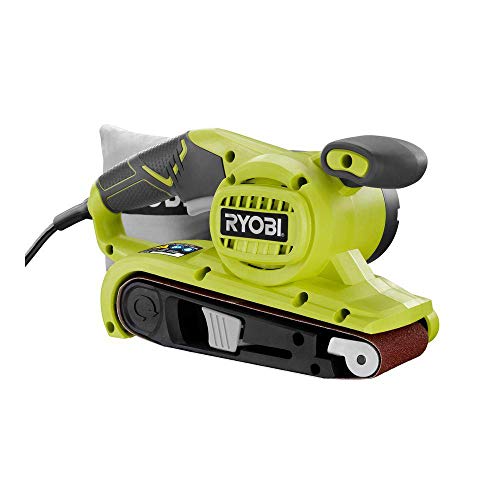
Ryobi ZRBE319 6 Amp 3 in. x 18 in. Belt Sander (Renewed)
Ryobi fans will find a lot to appreciate in the ZRBE319. It has all the hallmarks Ryobi has built its reputation on: sensible ergonomics, a well-assembled body, and excellent value for the price. The two smooth, comfortable grips make this one of the easier belt sanders to use for extended periods in this category, and the 6A motor running at 820 FPM is more than adequate for everyday tasks — sanding table surfaces, smoothing rough lumber, and cleaning up joints.
The toolless tracking knob is a convenience I genuinely appreciate, and the simple tension lever makes belt changes quick and easy. The 3×18-inch belt’s compact dimensions can actually be an advantage in tighter areas where a full-size sander would feel unwieldy. The machine lacks variable speed, which is a genuine limitation for precision work on delicate surfaces, and the build quality, while decent, doesn’t match premium machines. For casual users, hobbyists, and Ryobi ecosystem fans who want a solid, reliable belt sander at a reasonable price, the ZRBE319 delivers.
- ✅ Excellent ergonomics — dual comfortable grips
- ✅ Toolless tracking knob for easy belt centering
- ✅ Simple tension lever for fast belt changes
- ✅ Well-assembled, solid body
- ✅ Compact size useful for tighter spaces
- ❌ No variable speed
- ❌ Smaller 3×18″ belt
- ❌ Build quality doesn’t match premium machines
Best For: Casual users, hobbyists, and Ryobi loyalists who want a comfortable, well-built handheld belt sander for everyday sanding tasks without a large investment.
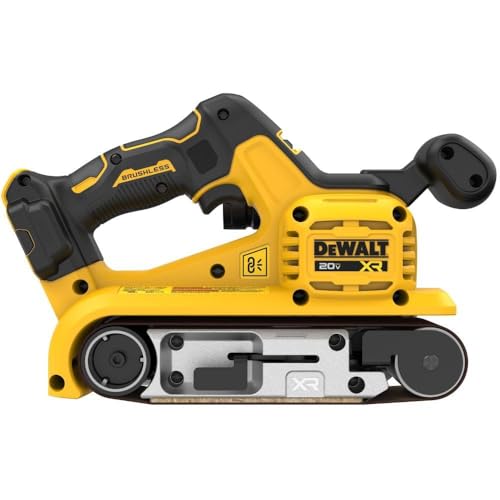
DEWALT 20V MAX Cordless Brushless Belt Sander – DCW220B
The DeWalt DCW220B is what happens when a major tool manufacturer decides cordless shouldn’t mean compromised. This is DeWalt’s 20V MAX XR brushless cordless belt sander, and it’s a proper professional machine. The brushless motor delivers up to 22% more power compared to comparable corded sanding applications, and the full 3×21-inch platen gives you more sanding surface area than most cordless competition. I tested this back-to-back against several corded machines, and the difference in feel and sustained output is immediately apparent.
The variable speed trigger with a 25-step selection dial gives you genuine precision control across a wide range of materials — something almost no other cordless belt sander offers. The dust collection system, compatible with DeWalt’s AirLock connector, achieves up to 95% collection efficiency, which is exceptional for any class of belt sander. The quick-release tool-free belt change system is fast and frustration-free, and the overmolded auxiliary handle enables secure two-handed control on demanding work. If you’re working on Best Sanders for Deck 2026 projects or large job-site surfaces where a cord would be a liability, this is the machine to have.
- ✅ Brushless motor — up to 22% more power than comparable corded applications
- ✅ Full 3×21″ belt with more sanding area than most cordless rivals
- ✅ Variable speed with 25-step precision dial
- ✅ Up to 95% dust collection efficiency with AirLock system
- ✅ Wireless Tool Control pairs with compatible DeWalt vacuums
- ✅ Quick-release tool-free belt change system
- ✅ Overmolded auxiliary handle for secure two-handed operation
- ❌ Battery and charger sold separately
- ❌ AirLock dust connector sold separately
- ❌ Premium price point
⚠️ Important
The DCW220B is a tool-only listing — the 20V MAX battery and charger are sold separately. If you’re not already in the DeWalt 20V ecosystem, be sure to factor the cost of a compatible battery into your decision before purchasing.
Best For: Professionals and serious hobbyists who want the freedom of cordless operation without sacrificing power, precision, or dust control — especially those already in the DeWalt 20V ecosystem.
Metabo HPT SB8V2 9.0 Amp 3-Inch-by-21-Inch Variable Speed Belt Sander
The Metabo HPT SB8V2 — formerly the Hitachi SB8V2 — is a machine I’ve always had a lot of time for, and it holds up extremely well against newer competition. The 9A motor is actually more powerful than the Makita 9903’s 8.8A, and variable speed from 820 to 1,475 FPM gives you excellent range from delicate finish passes all the way up to aggressive stock removal. The soft grip handles are among the best I’ve used on any corded belt sander — they genuinely reduce vibration fatigue during extended sessions.
The standout characteristic of this machine is how remarkably quiet it runs. Belt sanders are not known for being pleasant to operate acoustically, but the SB8V2 is noticeably quieter than almost everything else in its class, including the Makita 9903. The build quality is what you’d expect from a Japanese-engineered professional tool — well-assembled, smartly designed, and built for years of regular use. The left-side mounted dust collection bag improves access in corner sanding applications. The 5-year warranty is outstanding for a machine at this price and represents genuine long-term value. If you want a powerful, refined, and quiet belt sander that earns its keep in a serious workshop, this is my first runner-up to the Makita 9903.
- ✅ Powerful 9A motor — slightly more than the Makita 9903
- ✅ Variable speed 820–1,475 FPM
- ✅ Exceptionally quiet for a belt sander
- ✅ Outstanding soft grip handles reduce vibration fatigue
- ✅ Trigger lock for continuous operation
- ✅ Left-side dust bag improves corner access
- ✅ Impressive 5-year warranty
- ❌ Auto belt tracking not quite as refined as the Makita 9903
Best For: Hobbyists and professionals who want a quiet, powerful, refined corded belt sander with a rock-solid warranty — and who may find the Makita 9903 slightly out of reach.
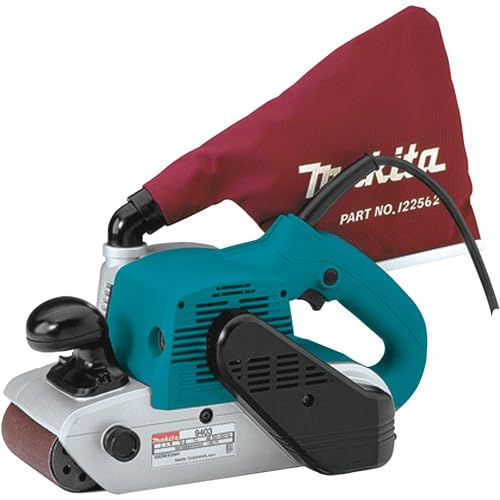
Makita 9403 4″ x 24″ Belt Sander
Everything I admire about the 9903 — Makita’s build quality, auto belt tracking, quiet operation, and exceptional dust collection — applies here too. But the 9403 is a different beast in one key respect: that 4×24-inch belt is an inch wider and covers significantly more surface area per pass than the standard 3×21-inch, making it the professional’s tool of choice for large panel work, wide board surfacing, floor refinishing prep, and any job where speed and coverage matter. The 11A motor provides the extra power needed to drive that wider belt without bogging down.
Many professional publications and experienced woodworkers — myself included — consider this the finest 4×24-inch belt sander ever produced. The labyrinth construction seals and protects the motor and bearings from dust for longer tool life, the dust collection is the best I’ve encountered in this class, and the results are consistently clean and fast. The trade-off is that the wider belt makes this less suitable for narrow stock and tight areas. But for anyone regularly working large surfaces, the 9403 earns its place permanently on the workbench. If you’ve been refinishing furniture, do check out my guide to Best Sanders for Furniture 2026 for pairing recommendations.
- ✅ Wide 4×24″ belt — superior surface coverage per pass
- ✅ Powerful 11A motor drives the wider belt without hesitation
- ✅ Best-in-class auto belt tracking
- ✅ Exceptional dust collection
- ✅ Labyrinth construction protects motor and bearings from dust
- ✅ Quiet, smooth, and comfortable in use (84dB)
- ✅ Durable, professional-grade build quality
- ❌ Wider belt less practical for narrow stock or tight spaces
- ❌ No variable speed
- ❌ Premium price point
Best For: Professionals and serious woodworkers who regularly work large panels, wide boards, or surfaces where maximum coverage and speed are the priority.
Makita 9031 1-1/8″ x 21″ Belt Sander
Here’s where the belt sander category gets genuinely interesting. The Makita 9031 is a front-facing belt sander — instead of the belt running underneath the machine, it runs out in front, like an elongated file. This design is transformative for certain kinds of work: getting into tight corners, sanding irregular shapes, reaching inside frames and box joints, and tackling any surface where a conventional belt sander simply can’t get access. It’s the kind of tool you don’t think you need until a job demands it — and then you wonder how you managed without one.
The 9031 is compact and lightweight — genuinely easy to maneuver with one hand when needed — and despite its slim profile it packs a capable 5A motor with variable speed from 656 to 3,280 ft./min. The front-facing 1-1/8×21-inch belt is surprisingly wide for a machine of this type, which means it covers ground faster than most front-facing sanders. The lock-on button for continuous operation and multi-position side handle are smart ergonomic details. Build quality is pure Makita — solid, precise, and built for years of reliable service. This is my top pick in the front-facing belt sander category, and it’s versatile across wood, metal, and fiberglass. For similar specialist precision work on stair stringers and balusters, I’d also recommend checking out my Best Sanders for Stairs 2026 guide.
- ✅ Front-facing belt — ideal for tight spots and irregular shapes
- ✅ Versatile across wood, metal, and fiberglass
- ✅ Compact and lightweight for excellent maneuverability
- ✅ Variable speed (656–3,280 ft./min.) for wide application range
- ✅ Wide 1-1/8″ belt for a front-facing sander
- ✅ Lock-on button for continuous operation
- ✅ Makita build quality throughout
- ❌ Narrower belt not ideal for open flat surfaces
- ❌ Premium price for a specialist tool
Best For: Woodworkers, finish carpenters, and metalworkers who regularly encounter complex shapes, tight geometries, and areas where a conventional belt sander simply cannot reach.
Makita 9032 3/8″ x 21″ Belt Sander
The Makita 9032 is the more extreme specialist in the front-facing belt sander family — thinner, more compact in profile, and with a design that prioritizes access above all else. Where the 9031 has a wider belt suited to general use, the 9032’s front extends much further without handles in the way, making it absolutely unbeatable for reaching inside box frames, tight weld seams, narrow recesses, and any area where even the 9031 can’t get a clean angle. It’s particularly beloved by metalworkers for deburring, weld mark removal, and surface blending in confined spaces.
At just 3.5 lbs and running at up to 5,600 FPM with an adjustable sanding arm that pivots up to 100 degrees, this is a fast, agile, precision machine. The belt tracking knob is one of the simplest and most effective I’ve used — centering is literally a matter of turning a single knob. Variable speed (980–5,600 ft./min.) gives you control across very different applications, and the large 21″ belt length produces a 4-5/16″ maximum sanding length for faster work. The trade-off is clear: the narrow belt makes this a specialist, not a general-purpose sander. For woodworkers who regularly encounter complex shapes and tight geometry, it’s an invaluable shop addition.
- ✅ Superior access to tight spots — best in class for extreme reach
- ✅ Sanding arm pivots up to 100° for hard-to-reach areas
- ✅ Excellent for metalworking and weld removal
- ✅ Lightweight at just 3.5 lbs
- ✅ Variable speed up to 5,600 FPM
- ✅ Simple, effective belt tracking knob
- ✅ Works on both wood and steel
- ❌ Not suitable for large surface sanding
- ❌ Specialist tool — most woodworkers won’t use it daily
Best For: Metalworkers, sculptors, door hangers, and craftspeople who need the ultimate in access for deburring, blending, and finishing in extremely confined spaces.
3M File Belt Sander – Pneumatic, 28366
The 3M File Belt Sander is the undisputed king of pneumatic file sanders — the professional metalworker’s weapon of choice for tight-area finishing work. Collision repair technicians, bodyshop professionals, and industrial fabricators around the world rely on this machine for weld spot removal, deburring, blending, and precision finishing in areas that no other tool can reach. The 0.6 HP pneumatic motor is the most powerful in its class, and the 360-degree rotatable housing means you can work from virtually any angle without repositioning.
The balanced weight distribution and 3M Gripping Material provide improved ergonomics and reduced wrist strain during extended use — a detail that matters enormously in a professional shop environment. The attached belt cover won’t fall off during belt changes, which sounds minor but is a real practical advantage on the job. I want to be upfront: this is not primarily a woodworking tool. For that, the Makita 9031 or 9032 will serve most readers better. But for metalworkers, fabricators, and professionals who need the absolute best in pneumatic file belt sanding performance — and who have an air compressor available — there is nothing else on the market that comes close.
- ✅ Most capable pneumatic file belt sander available
- ✅ Industry-standard for professional metalworking and collision repair
- ✅ 360° rotatable housing for maximum angle flexibility
- ✅ Balanced weight distribution and 3M Gripping Material for comfort
- ✅ Attached belt cover stays put during belt changes
- ✅ Optimized for 3M Abrasive and Scotch-Brite Belts
- ❌ Pneumatic — requires a compressed air supply
- ❌ Not the ideal choice for woodworking applications
- ❌ Premium price point
Best For: Professional metalworkers, collision repair technicians, and industrial fabricators who require the best pneumatic file belt sander for deburring, blending, and finishing in tight spaces.
EX Electronix Express Mini 1 x 30 Belt Sander
Update: this model has been discontinued on Amazon. The closest current equivalent I’d point you to is BUCKTOOL Bench Belt Disc Sander for Woodworking,4×36″ Belt,8″ Disc,5A | Benchtop Sander with 3/4HP Direct Drive,2161FPM,3450RPM,Miter Gauge,Dual Dust Ports for Bevel,Contour Sanding.
I’ve never reviewed a cheaper stationary belt sander than this EX Electronix Express mini machine, and I’ve rarely been more surprised by what you can get at such a low price. At its core this is a benchtop 1×30-inch machine — it stays put, you bring the workpiece to it — running at 3,400 RPM with a 3.0A motor and a 1/3 HP output. The 5×5-inch table tilts from 0 to 45 degrees for angled sanding, and a 1-3/4-inch vacuum port keeps dust manageable during operation.
With expectations properly set — the build is modest, the belt tracking requires patience, and this isn’t a machine for demanding heavy-duty work — the power output is genuinely surprising for the price. For light sanding tasks, small hobby projects, and knife sharpening in particular, it gets the job done without complaint. This is a reasonable first machine for a beginner knife maker testing the waters before investing in something more serious like the Kalamazoo below. If you want to learn more about Best Spindle Sanders 2026 for complementary benchtop options, that guide is worth a read too.
- ✅ Very affordable benchtop belt sander
- ✅ Surprising power output for the price
- ✅ Table tilts 0–45° for angled sanding
- ✅ Vacuum port for dust extraction
- ✅ Good entry point for beginner knife makers and hobbyists
- ❌ Belt tracking can be frustrating to dial in
- ❌ Build quality is minimal — not suited for heavy-duty use
- ❌ Limited versatility compared to larger benchtop machines
Best For: Budget-conscious beginners, hobby knife makers, and casual DIYers who need a basic benchtop belt sander for light tasks without a large upfront investment.
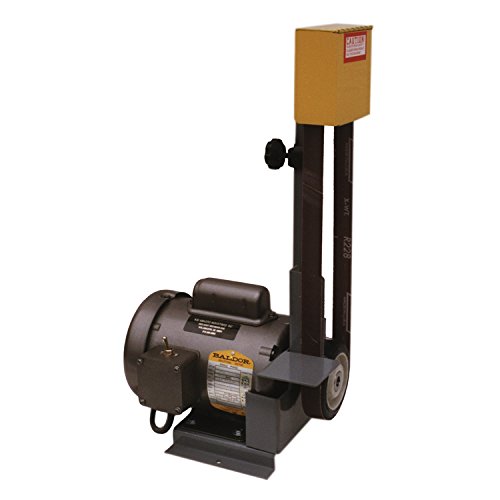
Kalamazoo 1SM 1″ Belt Sander
The Kalamazoo 1SM has a reputation in the knife-making and blade-sharpening community that borders on legendary, and having used this machine extensively I can tell you it’s entirely deserved. This is a stationary 1×42-inch benchtop belt sander powered by a Baldor direct-drive 1/3 HP motor — and the choice of Baldor is significant. These motors are industrial-grade, built for continuous duty, and they don’t back down from sustained hard use. The 1×42-inch belt moves efficiently and removes material with authority, turning what would be a long, tedious grinding or sharpening session into something quick and precise.
The 4-inch contact wheel gives you a radiused grinding surface ideal for hollow grinding blades and working curved profiles — a feature that no general-purpose belt sander can replicate. The build quality of the machine itself matches the motor: serious, durable, and built to last for decades. This machine handles everything from professional woodworkers needing precision edge work to dedicated knife makers grinding full bevels. It’s not the most affordable option on this list, but it’s one that will outlast everything else here — and for the specialized tasks it excels at, there’s simply no substitute. If you’ve been tackling paint removal on old furniture before resharpening your tools, I also recommend reading my Best Sanders for Removing Paint 2026 guide.
- ✅ Industrial-grade Baldor direct-drive motor built for continuous duty
- ✅ 1×42″ belt — the gold standard for knife making and sharpening
- ✅ Outstanding build quality designed to last decades
- ✅ 4″ contact wheel for curved and hollow grinding
- ✅ Handles sustained hard use without fatigue or performance drop
- ❌ Specialist tool — not suited for general large-surface sanding
- ❌ Premium price point
Best For: Knife makers, blade sharpeners, and professional woodworkers who need a dedicated, industrial-quality benchtop belt sander that will perform flawlessly for decades of demanding use.
How to Choose the Right Belt Sander
With so many types and sizes on this list, picking the right belt sander comes down to honestly assessing what you’ll actually be doing with it. Here are the key factors I weigh whenever I recommend a machine to someone.
Belt Size and Type
For most woodworkers, a 3×21-inch handheld belt sander is the sweet spot — wide enough for efficient coverage, small enough to maneuver on curved or irregular pieces. If you regularly work large panels, decks, or wide boards, step up to a 4×24-inch like the Makita 9403. If you need to get into tight spots, contours, or frame interiors, a front-facing file sander is the tool the job demands. And if your work centers on knife making or blade sharpening, a narrow benchtop machine like the Kalamazoo 1SM is purpose-built for exactly that.
Variable Speed
Variable speed is one of the most underappreciated features on a belt sander, and I always recommend paying a bit more to get it if you can. Being able to slow the belt down for delicate work — softwoods, veneer, finished surfaces — and speed it up for aggressive stock removal gives you a machine that’s genuinely versatile rather than one-dimensional. Fixed-speed machines are fine for rough work but can be too aggressive for precision finishing passes. If you’re going to be doing any furniture work or fine woodworking alongside rough sanding, variable speed is worth having. For more on pairing a belt sander with the right follow-up tool, my guide on orbital sander options is a useful companion read.
Corded vs. Cordless
For most shop-based work, a corded machine still makes the most sense — unlimited runtime, consistent power delivery, and no battery cost to factor in. But if you’re working on job sites, in spaces without convenient outlets, or on large outdoor projects, a quality cordless machine like the DeWalt DCW220B now offers performance that genuinely competes with corded equivalents. The key question is whether you’re already in a battery ecosystem and whether the tool-only price makes sense alongside a battery you may already own.
Dust Collection
Belt sanders produce a significant amount of fine dust, and effective dust collection matters for both your health and the quality of your finish. Look for machines with a tightly sealed dust bag or — better yet — vacuum compatibility. The Makita 9903 and 9403 have the best bag systems I’ve used in their respective classes. For the most demanding dust control, the DeWalt DCW220B’s AirLock-compatible system achieving up to 95% collection efficiency is genuinely impressive. If you’re also using a benchtop belt sander in your shop, pairing it with a dedicated dust extractor is worth considering.
💡 Pro Tip
When choosing sanding belts, buy a variety pack with 40, 80, and 120 grit to start. Use 40-60 grit for stripping old paint or finish, 80 grit for general stock removal, and 100-120 grit for final smoothing before switching to a random orbital sander for the finishing passes. You’ll get cleaner results and go through fewer belts overall.
Build Quality and Warranty
A belt sander takes a lot of abuse — dust, vibration, heat, and the constant stress of a moving belt under load. Build quality directly determines how long the machine stays accurate and reliable. Professional brands like Makita and Metabo HPT use tighter tolerances and better materials, which is why their machines track better and last longer than budget alternatives. Check the warranty too — Metabo HPT’s 5-year coverage on the SB8V2 is exceptional, while most budget machines offer only one year.
🏆 The Verdict
After testing every machine on this list, the Makita 9903 stands out as the best belt sander for the overwhelming majority of woodworkers and DIYers — delivering an exceptional balance of power, precision, quiet operation, and long-term reliability that no competitor at its price tier can match. The auto belt tracking and variable speed control make it as approachable for weekend hobbyists as it is dependable for professional daily use. Budget shoppers who want smart features should look closely at the SKIL Sandcat 7510-01, while pros who want cordless freedom without performance compromise will find everything they need in the DeWalt DCW220B. For specialized blade work, the Kalamazoo 1SM remains the undisputed choice — a machine built to last a lifetime of serious use.
❓ Frequently Asked Questions
What’s the difference between a belt sander and a random orbital sander?+
What grit sandpaper should I use in a belt sander?+
Is a cordless belt sander as powerful as a corded one?+
What is a front-facing belt sander and do I need one?+
How do I stop my belt sander from leaving marks on the wood?+
Conclusion
After reviewing every machine on this list, my personal recommendation remains the Makita 9903. I use it in nearly every woodworking job that calls for a belt sander, and I reach for it without thinking — that’s the real test of a great tool. It gives me power and control together, which is genuinely rare. The auto belt tracking alone saves me more time per session than I could calculate over a year of work.
That said, there’s a machine on this list for every type of woodworker. If budget is your primary concern, the WEN 6321 or SKIL Sandcat 7510-01 offer solid performance without a large investment. If you want the best cordless experience available in 2026, the DeWalt DCW220B is the clear answer. And if you’re a knife maker or blade sharpener, the Kalamazoo 1SM is the machine your craft deserves.
I hope these reviews help you find the perfect belt sander for your shop. If you have questions about any of the machines above, drop them in the comments and I’ll do my best to help. Thanks for reading!

Can I flip the makita 9903 to make it stationary
Hi Tracy, absolutely. With a little handiwork to make a sturdy base for it (to ensure it doesn’t move), you can easily turn it stationary – especially with its power lock-on button. Couple a dust collector into the equation and you’ve got a powerful, effective stationary belt sander. Thanks for the great question and have a good one!
I got the Makita 9903 that you recommended and just gave it a whirl today. It’s so good that I had to come back here to say THANK YOU. You’re the best.
Hey Dean, thanks for the kind words, the pleasure’s all mine. Enjoy that Makita, it’s a beast!
What a surprise! I’m more (or was more) of an air-tool guy but the Makita 9903 is unbelievable, it’s interesting how far these machines have come. I really appreciate the recommendation James, I even like the design and feel of it, it hit all the marks!
I’m very glad you like it Shane, it’s one of my favorites as well! I’m right there with you, the design and handling is fantastic, they really knocked it out of the park with the 9903. Thanks for stopping by!
Can’t decide so I’m getting two – the Hitachi and the Makita 9903. Great work James
Beautiful selection and even better presentation James, it’ll be the Makita 9403 for me!
Very nice design and well written Mr.Draper, I enjoyed reading a lot! I’m trying to find a good belt sander to give to my dad on his birthday and you are being excellent help. He always says he wants the best, no matter the cost, because “you get what you pay for” haha, which one would you recommend for him? Thanks in advance!
Hey Mona, hope you’re having a great day. If he loves quality above everything else, I’d have to go with the Makita 9403. It’s big, potent and will last a lifetime. It’s very sweet of you to take the time to find your dad a good gift, I’d sure love it if my kids did the same for me. Have fun!
Mr.Draper thank you so much for the quick reply! It’s settled then, I just know he’ll love it. Thank you so much, it’s dearly appreciated. I wish you the best!
Man I really like your analysis, I’ve been reading some others on a few forums but your work is just top notch James, I appreciate it.
I’m glad I could help Sam, that’s what I’m here for. Thank you for the kind words.
Very good work James, made my life easy with that comparison table. I’ve been a longtime fan of Hitachi so that’s the one I’m going with. Thank you.
Thanks Connor. The Hitachi is a fantastic choice, one of the best belt sanders I’ve used!