
As an Amazon Associate I earn from qualifying purchases. All claims are strictly my personal opinion.

To sand drywall, wait until the joint compound is fully dry, scrape off ridges with a taping knife, then sand the seams, screw spots and corners with 150-grit paper or a 220-grit mesh screen, using light pressure and feathering each joint into the wall. Check your work with a light held flat against the wall, remove the dust, prime, and give the wall one light pass with 220 grit before you paint.
That is the whole job in two sentences. The rest of this guide is how to sand drywall without gouging the mud, tearing the face paper or filling the house with dust: whole walls, taped seams, inside and outside corners, ceilings, and which tool to use for each, from a sponge to a pole sander to a power drywall sander on a vacuum. Everything here follows what the two big compound makers, USG (Sheetrock) and National Gypsum (ProForm), publish for their own products.
⚡ How to Sand Drywall in 8 Steps
- Let the last coat of mud dry completely.
- Seal the room: plastic on doorways, vents covered, HVAC off.
- Put on a dust mask rated for fine dust and safety glasses.
- Scrape ridges and lumps off every joint with a taping knife.
- Sand seams, screw spots and corner bead with 150-grit paper or a 220 screen, light pressure.
- Use a sponge in inside corners and a pole sander on the ceiling.
- Check every joint with a raking light, then vacuum and wipe the dust off.
- Prime, fix what the primer shows, and do a light 220 pass before paint.
What You Need to Sand Drywall
The abrasive doesn’t change much from job to job. What changes is the tool that holds it, and that depends on how much wall you have and how much dust you can live with.
| Job | Tool | Abrasive |
|---|---|---|
| Seams and screw spots on walls | Flat hand sander | 150-grit paper or 220-grit screen |
| Ceilings, tops of walls, long seams | Pole sander | 220-grit screen (or 150 paper) |
| Inside corners, around outlets | Drywall sanding sponge | Medium side to cut, fine side to smooth |
| Touch-ups in a furnished room | Damp sponge | Water, no paper |
| Basements, additions, whole houses | Power drywall sander + dust extractor | Hook-and-loop discs, 150 or finer |
| After primer | Hand sander or fine sponge | 220-grit paper, fine sponge |
Add a taping knife (6 inch is fine) for scraping, a bright work light, plastic sheeting and painter’s tape, a vacuum with a fine-dust filter, a respirator and safety glasses. The reasoning behind each grit, stage by stage, is in my guide on what grit to sand drywall.
Before You Sand: Three Things That Save Hours
Make Sure the Mud Is Dry All the Way Through
Ready-mixed compound dries by evaporation, so a thick coat in a cold, damp basement takes far longer than a thin coat in a warm room. Wet compound gums up the paper and tears out of the joint instead of sanding. Look for an even, light color with no darker patches along the center of the joint, where the mud is thickest, and press there with a fingernail: it should feel hard, not cool or soft.
Scrape First, Sand Second
Sandpaper is for blending, not for removing lumps. Run a taping knife along every seam, holding the blade at a low angle, and knock off ridges, crumbs and knife lines before you start. National Gypsum makes the same point the other way round: trying to sand out deep imperfections is inefficient, so fill low spots with compound, let it dry and sand them lightly. Ten minutes with a knife saves an hour of sanding and keeps you away from the face paper.
Seal the Room Before the First Pass
Drywall dust is fine enough to drift through a house. Tape plastic over doorways, cover or tape the HVAC registers, and switch off forced-air heating or cooling so the blower doesn’t pull dust into the ducts. Lay drop cloths, take out what you can and cover the rest, especially electronics. If you have an air filtration unit, start it before you sand and leave it running after you finish.
How to Sand Drywall Step by Step
Work in the same order every time, so nothing gets missed: flat seams first, then butt joints, screw spots, corners and finally the ceiling, before you check the whole room. The sequence matters. I’ve walked through thousands of feet of finished drywall over the years, and the differences between professional and amateur finishes always trace back to one or more of these steps being overlooked.
Step 1: Sand the Flat Seams
Put the hand sander or pole sander flat on the joint and sand along its length with long, overlapping strokes, then lightly across it at the edges. Let the weight of the tool do the work. Your goal is to take the high spots off the compound and make the edges disappear into the wall, feathering out 6 to 8 inches on each side of the tape line. Sand the compound, not the paper beside it: USG warns that roughened face paper has raised fibers that are conspicuous after painting.
Step 2: Butt Joints and Screw Spots
Butt joints, where two uncut panel ends meet, are finished with a wide, low crown of mud, so they need the widest feathering and the lightest touch. Don’t try to flatten the crown: that is what hides the joint. Screw spots need only a pass or two. USG is explicit here, telling finishers not to sand the compound flush to the panel surface, because that exposes the fastener and tape it was meant to conceal.
Step 3: Inside Corners
A flat pad in an inside corner sands one wall while it digs into the other. Use a sanding sponge instead, and work one face of the corner at a time with light pressure. A sponge with an angled edge gets into the crease without rounding it. If the corner has a ridge of mud down the middle, scrape it with the knife rather than trying to sand it away.
Step 4: Outside Corners and Corner Bead
Keep the sander flat on the wall and let it run off the edge of the bead rather than tilting it over the corner. Tilting puts all the pressure on the narrow strip of mud along the metal or plastic nose, and that is where you sand through first. Feather the mud out from the bead the same 6 to 8 inches you used on the flat seams.
Step 5: Check Every Joint With a Raking Light
Hold a work light or a bright flashlight flat against the wall so the beam skims across the surface. Ridges and dips throw shadows you will never see head-on. Mark problems with a pencil, then sand the high spots lightly and fill the low ones with a thin coat of mud. Run a flat palm over each joint too: you are feeling for a step where the compound ends.
Step 6: Remove the Dust
Vacuum the walls with a soft brush attachment, then wipe them with a well-wrung damp sponge or cloth and let them dry. USG’s finishing guidance says to remove all sanding dust and debris before any surface treatment, and primer laid over dust peels with it. Vacuum the floor last, not with a broom, which just puts the dust back in the air.
💡 Fixing a Single Hole Instead?
A patch is a smaller job with its own rules about drying time and feathering. My step-by-step for that is how to sand a drywall patch.
How to Sand a Drywall Ceiling
Ceilings are the hardest part of the job: you are working overhead, gravity is pulling dust into your face, and the light is usually behind you. Three habits make it manageable.
Use a Pole Sander, Not a Ladder
A pole sander lets you sand from the floor with both hands and your arms below your shoulders, which is far less tiring than working from a ladder and keeps the dust further from your eyes. Push the head along the seam and pull it back, keeping it flat; if the swivel head flips, you are pushing too hard or holding the pole too steep. National Gypsum describes the pole sander as slower than a power sander but easier to control, with less risk of over-sanding.
Go Lighter Than on the Walls
The weight of a pole or a power sander adds to whatever pressure you apply, so ease off. Sand along the joint, check it from below with a light pointed across the ceiling rather than up at it, and stop as soon as the ridge is gone. Overhead mistakes show more, because ceilings catch light from windows at a very low angle.
Power Sanders on Ceilings
For a whole ceiling, a power drywall sander on a dust extractor is the fastest and cleanest option. Some machines help with the weight: Bosch says the ceiling-suction mode on its GTR55-85 reduces the weight of the tool while you work overhead. If your ceiling is textured, sanding it is a different job: see popcorn ceiling removal tools first, and test the texture in an older home before you disturb it.
Hand Sander vs Pole Sander vs Power Drywall Sander
All three use the same grits. The choice comes down to how much wall you have, how flat you need it and how much dust you can tolerate.
Sanding Drywall by Hand
A flat hand sander and a sponge are all you need for a room or two. The flat pad bridges low spots instead of following them, and you have full control near the edges of each joint. It is also the cheapest kit by far. The downsides are effort and dust: dry hand sanding puts all the dust in the air at face height.
Pole Sander
The same flat pad on a swivel head and a 4 to 5 foot handle. It covers long seams quickly and reaches ceilings without a ladder. Mesh screens suit it best because they don’t tear on the swivel head and you can flip them when one side wears. For a DIYer it is the single most useful drywall sanding tool to buy.
Power Drywall Sander With a Vacuum
A power drywall sander spins a disc about 9 inches across on a long boom and pulls the dust straight into a dust extractor. It earns its cost in basements, additions and whole-house remodels, and the dust control matters more in a house you live in than the speed does. It needs a careful hand, though: National Gypsum warns that powered sanders can gouge the compound or tear the drywall paper. I compare the DEWALT DCE800B, the Bosch GTR55-85 and the Festool PLANEX in my picks of the best drywall sanders.
Can You Use an Orbital or Palm Sander on Drywall?
Yes, for small areas and patches. A 1/4-sheet palm sander or a random orbital sander with a 150-grit disc smooths a few joints quickly, and a model with a vacuum port keeps the dust down. Keep it moving and keep it flat: a small, fast pad removes soft compound much faster than a hand sander does, and it will dish out a joint if you stop on one spot. For more than a room, a pole sander or a dedicated drywall sander is easier to keep flat. The trade-offs between the two small sanders are in sheet sander vs random orbital sander.
How to Sand Drywall Without Dust
There is no completely dust-free way to sand drywall, but there are three ways to keep almost all of it out of the air.
Wet Sanding With a Sponge
USG calls wet sanding with a damp sponge the preferred alternative to dry sanding, especially when only a little sanding is needed, and says it produces no dust and is less likely to scuff the panel face. Wring the sponge until it is barely damp, rub the joint in small circles, and rinse the sponge often. USG also sets the limit: wet sanding isn’t meant to remove large amounts of compound or to make up for poorly finished joints. Use it for touch-ups, patches and corners.
Vacuum Sanders
When you dry-sand, USG recommends a sanding tool connected to a HEPA vacuum. That can be a power drywall sander on a dust extractor, or a simple vacuum hand sander or pole sander head with holes in the pad and a hose to your shop vac. Use a fine-dust or HEPA filter, or a bag, in the vac: drywall dust clogs a standard cartridge filter within minutes. My picks for that are in the best shop vac for dust collection.
Low-Dust Joint Compound
Some compounds are made to drop their dust instead of floating it. National Gypsum says its ProForm compounds with Dust-Tech reduce airborne dust by up to 60%. It only helps if you use it from the start, so it is worth knowing before you mix the last coat, not after.
In practice, I combine three things: a sander on a vacuum for the bulk of the work, plastic barriers to contain what dust escapes, and a light wet-sand pass with a damp sponge for the touch-ups.
ℹ️ The Fastest Way to Less Dust
The cleanest sanding is the sanding you don’t do. Thin, smooth coats of mud and a knife pass to take off ridges before each new coat leave far less to sand at the end. National Gypsum lists both as the first ways to cut sanding time.
What Grit Sandpaper to Use on Drywall
Use 150-grit paper or a 220-grit mesh screen for the main sanding. USG’s product literature for its lightweight compound says nothing coarser than 150-grit sandpaper or 220-grit abrasive mesh should be used, and its finishing guide adds 80-micron sanding film or finer as a third option. After primer, a light pass with 220-grit paper or a fine sponge is enough. Coarser paper leaves scratches that show through paint, and much finer paper polishes the mud. The full chart is in what grit to sand drywall, and the sandpaper grit chart covers every other material.
How to Know When You’ve Sanded Enough
Stop when the joint is invisible to your hand and to a raking light, not when the mud is gone. The compound is supposed to stay on the wall: it is what hides the tape and the screws. Two signs mean you have gone too far:
- Fuzzy paper. The face paper starts to lift and feel furry. Stop sanding that spot; more sanding makes it worse.
- Tape showing through. You can see the edge or the texture of the paper tape under the mud. That joint needs another thin coat.
Both are fixed the same way: seal the spot with primer so the fibers lie down, skim a thin coat of compound over it with a wide knife, let it dry and sand it lightly.
Prime, Then Decide on a Skim Coat
Primer Shows What Sanding Missed
Raw compound and face paper look alike until primer goes on, and then every ridge, scratch and dip shows. Prime the whole wall, look again with your raking light, and fix the flaws now, before the paint. USG’s finishing guide calls for a high-solids pigmented drywall primer, because it evens out the different porosity of mud and paper and gives the best chance of keeping joints from flashing through the paint. After the primer dries, a light pass with 220-grit paper or a fine sponge knocks off raised fibers and specks.
When a Skim Coat Is Worth It
Under strong side light from big windows, or with eggshell, satin or darker paint, joints can show through even a well-sanded wall. USG explains why: the texture of the smoothed compound and the panel face are different, and sanding the panel face raises its nap and makes that worse. Its answer is a skim coat over the whole surface, the Level 5 finish, before primer. A skim coat is a thin layer of all-purpose compound troweled on and scraped back hard, then sanded lightly the same way as the joints. For flat paint on an ordinary wall, a good Level 4 finish and primer are enough.
Drywall Dust Safety: Silica, Masks and Older Homes
Sanding dust comes from the joint compound, not the panel. USG’s safety data sheet lists its all-purpose ready-mixed compound as more than 65% limestone, with small amounts of mica, clay, perlite and quartz. The biggest issue is how fine the dust is, and some of it is more than a nuisance:
- Crystalline silica. USG’s safety data sheet for Sheetrock All Purpose ready-mixed compound (2023 revision) says the raw materials contain respirable crystalline silica as an impurity, below 0.7% by weight, and that normal use isn’t expected to exceed the OSHA exposure limit. The same sheet warns that prolonged, repeated exposure to airborne respirable silica can cause silicosis and lung cancer. That is the reason to treat a full room of sanding as a respirator job, not a bandana job.
- Masks and glasses. National Gypsum notes that OSHA has no rule specific to drywall sanding, but its general requirements for respiratory and eye protection apply. Wear a NIOSH-approved respirator with P100 filters, or at least a well-fitted N95, and sealed safety glasses. My picks are in the best respirators for dust.
- Asbestos in older compound. The U.S. Consumer Product Safety Commission banned consumer patching and joint compounds containing respirable asbestos in December 1977. In a house built before about 1980, have the compound tested before you sand or scrape it.
- Lead in older paint. EPA’s guidance is that homes built before 1978 may have lead-based paint, and sanding it creates hazardous dust. Test painted drywall in an older house before you sand it.
Common Drywall Sanding Mistakes
I’ve seen each of these mistakes ruin otherwise solid drywall finishing work. Knowing what to watch for prevents hours of frustrating rework.
- Sanding mud that is still damp. It clogs the paper and pulls out of the joint.
- Using coarse paper to save time. 80 or 100 grit leaves scratches that telegraph through paint. Scrape instead.
- Pressing hard. Pressure gouges soft compound and dishes out the middle of joints.
- Sanding the joint flush with the panel. The crown of mud is what hides the tape and screws; take it down and they show.
- Sanding the face paper. Fuzzed paper shows through paint. Prime and skim it instead.
- Trying to sand out low spots. Sanding around a dip only lowers the wall around it. Fill it.
- Checking with the overhead light on. Flat, even light hides everything. Use a raking light.
- Painting over dust. Primer won’t bond to it.
My Picks for Sanding Drywall
You don’t need all of these. For a room or two, the pole sander, a pack of screens and a sponge cover the whole job. The vacuum sander and the power sander are for when dust or scale is the problem.
MARSHALLTOWN Pole Sander, 48-Inch Aluminum Handle

Best Tool for Walls and Ceilings
The one drywall sanding tool I would buy first. MARSHALLTOWN builds the head from die-cast aluminum with a low-profile, no-flip swivel bracket and quick-change locking clamps, and this version comes on a 48-inch aluminum handle. It takes 11-1/4 inch sandpaper or sanding screens, sold separately, so a pack of precut screens is the other half of the kit.
- ✅ Reaches ceilings from the floor
- ✅ No-flip swivel head
- ✅ Tool-free paper changes
- ❌ Abrasive sold separately
Gator Drywall Sanding Screens, 220 Grit
Best Abrasive for a Pole Sander
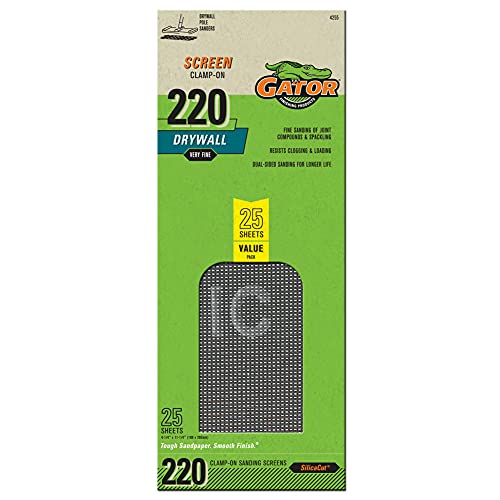
220-grit mesh is the screen USG lists alongside 150-grit paper for sanding its compound. Gator’s screens come precut and notched to fit most drywall pole sanders, the open mesh lets dust fall through instead of clogging, and both sides cut, so you flip the sheet when the first side wears. For a flat hand sander, Gator’s 150-grit drywall sheets do the same job.
- ✅ The mesh grit USG names
- ✅ Fits most pole sanders
- ✅ Two usable sides
- ❌ Too aggressive for the pass after primer
3M Drywall Sanding Sponge, Fine/Medium

Best for Corners and Wet Sanding
A dual-grit sponge: the medium side removes compound and the fine side smooths it. The foam flexes over flat or contoured surfaces, which is what you want in inside corners and around outlet boxes, and 3M rates it for wet or dry sanding, so the same block does your dust-free touch-ups. Rinse it and it goes again. More options are in my best sanding blocks and sponges.
- ✅ Two grits in one block
- ✅ Wet or dry
- ✅ Rinse and reuse
- ❌ Too small and soft for whole walls
Hyde 09165 Dust-Free Drywall Vacuum Hand Sander

Best Low-Cost Way to Sand Without Dust
The cheapest way to put a vacuum behind a hand sander. Hyde’s pad attaches to any wet/dry vacuum and comes with a 6-foot hose and a coupling adapter for the common shop-vac hose sizes, so the dust goes into the vac instead of the room. An EasyClamp system holds the sanding screen, and it ships with one reversible screen to start.
- ✅ Uses the shop vac you already have
- ✅ Adapter for common hose sizes
- ✅ Fast screen changes
- ❌ Needs a fine-dust filter in the vac
DEWALT 20V MAX Cordless Drywall Sander (DCE800B)

Best Power Drywall Sander for Big Jobs
For a basement or an addition. DEWALT’s sander has a brushless motor, a telescoping shaft and an articulating head that stays flat on the wall at different angles, with a variable-speed dial. It connects to DEWALT extractors through AirLock, and Wireless Tool Control switches a compatible extractor on and off with the sander. DEWALT quotes about 30 minutes of runtime on a 5Ah DCB205 battery, which is sold separately, like the charger.
- ✅ No cord on a busy job
- ✅ Telescoping for walls and ceilings
- ✅ Extractor switches on with the sander
- ❌ Tool only: battery and charger extra
DEWALT DWV010 8-Gallon HEPA Dust Extractor
Best Vacuum Behind a Drywall Sander
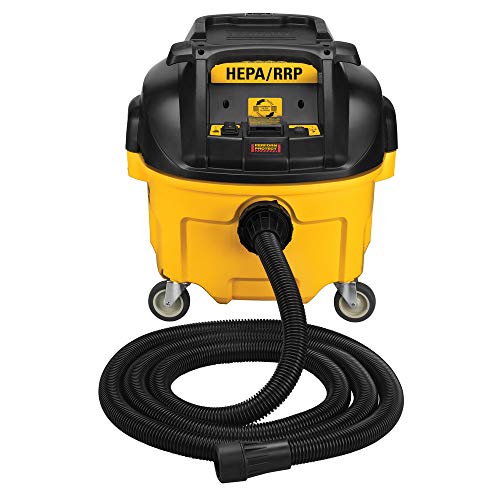
Drywall dust is what kills ordinary vac filters, and this extractor is built around that. DEWALT specifies 150 CFM from a 15-amp motor, two HEPA filters, and an automatic filter clean that pulses every 30 seconds so suction doesn’t fade halfway through a wall. Power tool actuation starts it with your sander, and the 15-foot anti-static hose reaches across a room. DEWALT also notes it meets the EPA RRP rule for HEPA vacuums with its DWV9330 filters.
- ✅ HEPA filtration
- ✅ Self-cleaning filter for fine dust
- ✅ Starts with the tool
- ❌ Overkill for a hand sander on one wall
🏆 The Short Version
Scrape first, then sand dry joint compound with 150-grit paper or a 220 screen and light pressure, feathering each joint without sanding it flush or scuffing the paper. Use a sponge in corners, a pole sander on ceilings and a power drywall sander on a HEPA extractor for whole houses. Check with a raking light, remove the dust, prime, and fix what the primer shows. Wear a real respirator, and test old walls before you start.
❓ Frequently Asked Questions
Do you sand the first coat of drywall?
How bad is it to sand drywall without a mask?
Can you sand drywall by hand?
Do I need to wipe down drywall after sanding?
Is it better to wet sand or dry sand drywall mud?
Can you use a regular sander to sand drywall?
How do I sand a drywall ceiling?
Do dustless drywall sanders work?
What is the fastest way to sand drywall mud?
Stuck on a tricky wall, a ceiling or an old house? Ask in the comments and I’ll help you work out the right tool and grit.
